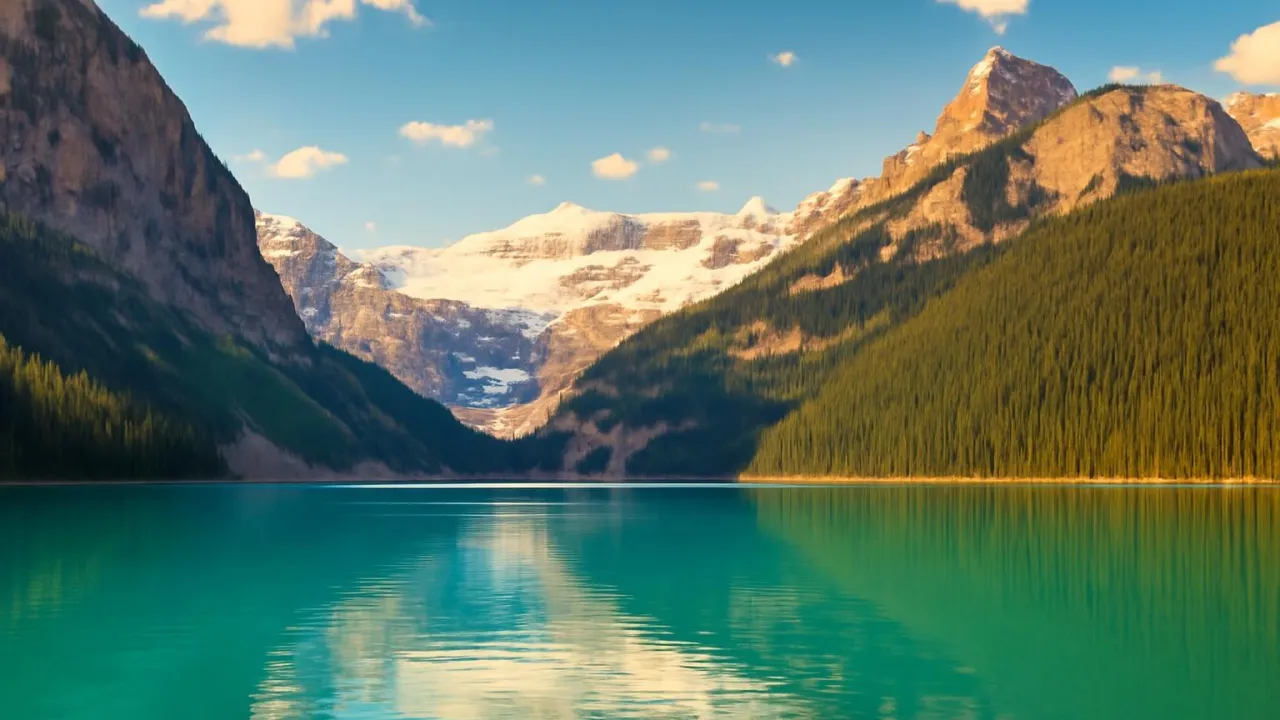
Lake Louise is named after a real princess from England.
✨ Word Sparks (Grade 2 Glossary)
Tap 🔊 to hear
glacier
A giant sheet of moving ice
rock flour
Tiny powdery rocks in water
trail
A path for walking or hiking
🪝
Have you ever seen a lake as blue as the sky?
1
A Shiny Blue Surprise
Lake Louise sparkles with a bright blue color, even on cloudy days. Tall, snowy mountains surround the lake, making it look like a painting. People come from all over the world to see this amazing place.
2
How the Lake Gets Its Color
The lake’s blue color comes from tiny rock pieces called . These rocks are made by scraping the mountains and melting into the water. The sunlight bounces off the rock flour and makes the water look blue.
3
Fun at Banff Lake Louise
Visitors hike on , paddle red canoes, and watch ducks swim. In winter, people skate on the frozen lake and see snowy trees. Lake Louise is a place for adventure all year long.
Lake Louise sits over 5,600 feet (1,700 meters) above sea level.
✨ Word Sparks (Grade 3 Glossary)
Tap 🔊 to hear
rock flour
Tiny rock dust from glacier grinding
suspended
Floating in water, not sinking
geology
The science of rocks and land
🪝
Can you imagine dipping your hand in water as blue as a gemstone?
1
A Sparkling Mountain Lake
Nestled in the Canadian Rockies, Lake Louise glows with a stunning turquoise color. Towering peaks and thick pine forests surround the lake, making it look like a secret treasure. The air smells fresh and cool, and you can hear birds singing nearby. Visitors often stop to take photos of the beautiful scene.
2
The Science of Blue Water
Lake Louise’s unique color comes from glacier , which is made when glaciers grind rocks into tiny powder. When the glacier melts, this powder flows into the lake, staying in the water. Sunlight hits the rock flour and scatters, reflecting back only blue and green light. This process gives the lake its famous turquoise shine.
3
A Place for Adventure
People love to hike along the scenic trails around Lake Louise. In summer, you might see red canoes gliding across the calm water, or ducks paddling near the shore. During winter, the lake freezes solid, turning into a giant natural skating rink. No matter the season, Lake Louise is full of outdoor fun.
4
A World-Famous Landmark
Lake Louise is part of Banff National Park, a UNESCO World Heritage site. It was named after Princess Louise, the daughter of Queen Victoria. The lake and its mountains have been protected for over a century. People from all over the world visit to see its beauty and learn about its .
The turquoise color of Lake Louise changes with the seasons and amount of glacier melt.
✨ Word Sparks (Grade 4 Glossary)
Tap 🔊 to hear
wavelength
A way to describe light’s color
ecosystem
All living and nonliving things in an area
conservation
Careful protection of nature and wildlife
🪝
What if you could paddle across a lake colored by ancient glaciers?
1
A Jewel in the Rockies
Lake Louise is a breathtaking sight, set high in the Canadian Rockies and surrounded by dramatic snow-capped peaks. The lake’s brilliant turquoise color stands out against the dark green forests and white glaciers. Early morning visitors might hear the echo of a loon’s call or the gentle splash of a canoe paddle. This natural wonder draws travelers and scientists from around the globe.
2
Glacial Origins and Rock Flour
The lake was formed at the end of the last Ice Age, when massive glaciers carved deep valleys. As glaciers still move and grind the rocks today, they create a fine powder called rock flour. Meltwater carries this powder into Lake Louise, where it remains suspended and interacts with sunlight. This interaction scatters blue and green , giving the lake its signature turquoise color.
3
A Playground for All Seasons
Lake Louise offers year-round adventure, from hiking and canoeing in summer to skating and snowshoeing in winter. The lake sits at an elevation of about 5,680 feet (1,730 meters), making its air crisp and cool even in July. In winter, the surface freezes thick enough for ice castles and skating festivals. The area is also home to wildlife like elk, bears, and mountain goats.
4
A Protected Landmark
Lake Louise is part of Banff National Park, which became Canada’s first national park in 1885. The park is recognized as a UNESCO World Heritage site for its outstanding natural beauty and important geology. efforts help protect the lake’s delicate from pollution and overuse. Today, Lake Louise inspires visitors to learn about glaciers, geology, and the importance of protecting wild places.
1. What causes the turquoise color in Lake Louise?
2. Why is Lake Louise protected as a national park?
🤯 Mind-Blowing Fact • Grade 5
Lake Louise’s turquoise color is brightest in July, when glacier melt is at its peak.
✨ Word Sparks (Grade 5 Glossary)
Tap 🔊 to hear
glacial erosion
When glaciers scrape and shape the land
selective wavelength scattering
How light bounces to show certain colors
hydrology
The science of water on Earth
🪝
What if you could decode the secret behind a lake’s dazzling turquoise glow?
1
A Glacial Masterpiece in the Rockies
Lake Louise, nestled within Banff National Park, is celebrated for its breathtaking turquoise water and dramatic mountain backdrop. The lake sits at an elevation of approximately 5,680 feet (1,730 meters), surrounded by rugged peaks like Mount Victoria and the Victoria Glacier. Early explorers and Indigenous peoples alike were captivated by its unique color and pristine setting. Today, Lake Louise is recognized globally as one of the most iconic glacial lakes on Earth.
2
The Science Behind the Turquoise Waters
The lake’s vivid color is a result of complex interactions between sunlight and suspended rock flour, which is produced by . As glaciers grind against bedrock, they create ultra-fine particles that are carried into the lake by meltwater streams. These particles remain suspended in the water column, scattering incoming sunlight and reflecting primarily blue and green wavelengths. This phenomenon, known as , is responsible for the lake’s signature turquoise hue.
3
Geological and Environmental Significance
Lake Louise formed after the last Ice Age, as retreating glaciers carved deep basins in the Canadian Rockies. The ongoing process of continues to shape the landscape, contributing to the region’s dramatic topography. The lake’s depth reaches approximately 230 feet (70 meters), and its surface area spans about 0.8 square miles (2.1 square kilometers). These features make it an important site for studying glacial geology, , and climate change impacts.
4
A Hub for Recreation and Conservation
Lake Louise is a year-round destination for outdoor enthusiasts, offering activities such as hiking, canoeing, rock climbing, and cross-country skiing. In winter, the frozen lake hosts world-class ice skating and the annual Ice Magic Festival, where artists sculpt elaborate ice castles. Conservation efforts are crucial here, as increased tourism can threaten the fragile alpine ecosystem. Park management uses scientific monitoring and sustainable tourism practices to protect the area’s biodiversity and water quality.
5
Cultural Heritage and Global Recognition
Banff National Park, established in 1885, is Canada’s oldest national park and a UNESCO World Heritage site. Lake Louise was named in honor of Princess Louise Caroline Alberta, daughter of Queen Victoria, reflecting Canada’s colonial history. Indigenous peoples, including the Stoney Nakoda, have long regarded this region as sacred. Today, Lake Louise inspires artists, scientists, and visitors from around the world, serving as a symbol of natural beauty and environmental stewardship.