1. What gives Earth its four changing seasons each year?
2. What season happens when your half of Earth leans toward the Sun?
🤯 Mind-Blowing Fact • Grade 2
Billions of years ago, a Mars-sized space rock crashed into young Earth—knocking our planet into its 23.5-degree tilt and forming our Moon at the same time!
✨ Word Sparks (Grade 2 Glossary)
Tap 🔊 to hear
Axial Tilt
Earth's 23.5-degree lean on its spin line
Direct Light
Sunbeams shining steeply onto a small area
Slanted Light
Low-angle sunbeams spread thinly across ground
🪝
Does summer feel hot because Earth moves closer to the Sun—or because of a clever flashlight trick?
1
Busting a Popular Myth!
Many people guess summer feels hot because Earth swims closer to the Sun, yet that's actually backwards! Earth is slightly closer to the Sun in snowy January than in sunny July. The real secret behind our four seasons is Earth's 23.5-degree tilt!
2
The Flashlight Experiment
Shine a flashlight straight down onto dark paper, and you see a tight, bright circle of energy. Now tilt that flashlight at a low slant, and the same beam spreads out dim and wide! Summer brings steep, concentrated sunbeams, while winter brings slanted, spread-out beams.
3
Spring and Fall in Between
Between summer and winter, mild spring and crisp autumn arrive when neither pole leans toward the Sun, giving plants and animals four predictable seasons.
1. What happens when you tilt a flashlight at a low angle instead of shining it straight down?
2. Is summer caused by Earth moving closer to the Sun?
🤯 Mind-Blowing Fact • Grade 3
Ice-giant planet Uranus has an extreme axial tilt of ninety-eight degrees—it practically rolls around the Sun on its side, giving each pole forty-two years of nonstop summer!
✨ Word Sparks (Grade 3 Glossary)
Tap 🔊 to hear
Polaris
North Star aligned with Earth's northern axis
Angle
How steep or slanted sunbeams hit ground
Tropics
Warm belt around Earth's middle Equator
🪝
Why does the North Pole keep pointing at the exact same star all year while our seasons flip from summer to winter?
1
One Steady Direction in Space
Hold a pencil tilted slightly toward a poster on your classroom wall and walk in a circle around a desk lamp without twisting your wrist! Notice how on one side of the lamp the pencil's eraser tips toward the light, and on the opposite side it tips away? Earth's axis works that exact same way, pointing steadily toward all year.
2
Double Teamwork: Angle Plus Hours
Earth's 23.5-degree axial tilt changes two things at once. In summer, high- sunbeams pack strong warmth into soil and lakes, AND the Sun stays up for fourteen or fifteen hours each day! In winter, low-angle beams deliver less heat during much shorter nine-hour days.
3
Why Tropical Places Stay Warm
Countries near Earth's middle Equator receive steep, high- sunshine all twelve months, so instead of snowy winters they often experience warm rainy and dry seasons.
4
Mirrored Hemispheres
Whenever Virginia rakes colorful October autumn leaves, kids in Chile and New Zealand are planting spring gardens!
1. Which TWO teamwork factors make summer much warmer than winter?
2. Why don't tropical countries right along the Equator have snowy winters?
🤯 Mind-Blowing Fact • Grade 4
Planet Mercury has almost zero axial tilt—just 0.03 degrees—so deep craters right at Mercury's poles stay in permanent shadow and hold frozen water ice even on the Sun's closest planet!
✨ Word Sparks (Grade 4 Glossary)
Tap 🔊 to hear
Revolution
One complete orbital trip around the Sun
Rotation
Earth's daily 24-hour spin on its axis
Parallelism
Earth's axis keeping the same space direction
🪝
How does our Moon help stop Earth's axial tilt from wobbling wildly like Mars's tilt?
1
Parallelism of Earth's Axis
In Virginia fourth-grade Earth science, modeling the Sun-Earth-Moon system reveals a vital geometric rule called axial : throughout each 365.25-day around the Sun, Earth's axis stays tilted 23.5 degrees relative to its orbital plane and parallel to its earlier positions. Earth does NOT flop back and forth between June and December; instead, our planet's motion to opposite sides of its orbit swaps which hemisphere leans sunward.
2
Energy Density Across Latitudes
At temperate mid-latitudes (between 23.5° and 66.5°), shifting solar angles drive dramatic seasonal cycles—spring budburst, lush summer photosynthesis, autumn leaf color and migration, and winter dormancy. Polar latitudes experience extreme daylight swings with glancing sunlight, whereas equatorial zones maintain steady year-round warmth that powers global wind belts.
3
Our Moon: The Tilt Stabilizer
Compare Earth with neighbor Mars! Because Mars has only two tiny asteroid-sized moons, gravitational tugs from giant Jupiter cause Mars's axial tilt to wobble chaotically between roughly 15 and 35 degrees over millions of years. Earth's large Moon exerts a steady gravitational anchor on our planet's equatorial bulge, keeping Earth's tilt gently buffered!
4
Astronomical vs. Meteorological Seasons
While astronomers start seasons on exact solstices and equinoxes, weather scientists group full calendar months—like June, July, and August for northern meteorological summer—to compare temperature and rainfall records cleanly.
1. What does 'axial parallelism' mean as Earth revolves around the Sun?
2. How does Earth's large Moon help keep our four seasons dependable over millions of years?
🤯 Mind-Blowing Fact • Grade 5
Counterintuitively, Ice Ages begin because of mild northern summers rather than extra-bitter winters—when Earth's tilt dips closer to 22.1 degrees, cooler summers allow winter snowfields to survive and stack into glaciers!
✨ Word Sparks (Grade 5 Glossary)
Tap 🔊 to hear
Obliquity
Scientific term for a planet's axial tilt
Milankovitch Cycles
Long-term orbital and tilt shifts pacing Ice Ages
Phenology
Study of seasonal timing in living nature
🪝
How does a tiny two-degree nod in Earth's axial tilt every forty-one thousand years help trigger and end great Ice Ages?
1
Obliquity of the Ecliptic
Astronomers call the angle between a planet's equatorial plane and its orbital plane '.' Today Earth's obliquity measures 23.436 degrees, decreasing by barely 0.013 degrees per century. Combined with rotational angular momentum that holds the spin axis gyroscopically fixed in inertial space during each revolution, obliquity governs latitudinal insolation gradients from tropics to poles.
2
Quantifying Beam Spreading and Atmospheric Path
Solar irradiance reaching the top of Earth's atmosphere averages ~1,361 watts per square meter perpendicular to the beam. At ground level, surface heating obeys Lambert's cosine law: a beam striking at 30 degrees above the horizon spreads across twice the ground area of an overhead 90-degree beam while traversing twice the air mass, increasing Rayleigh scattering and cloud reflection.
3
Comparative Planetary Obliquities
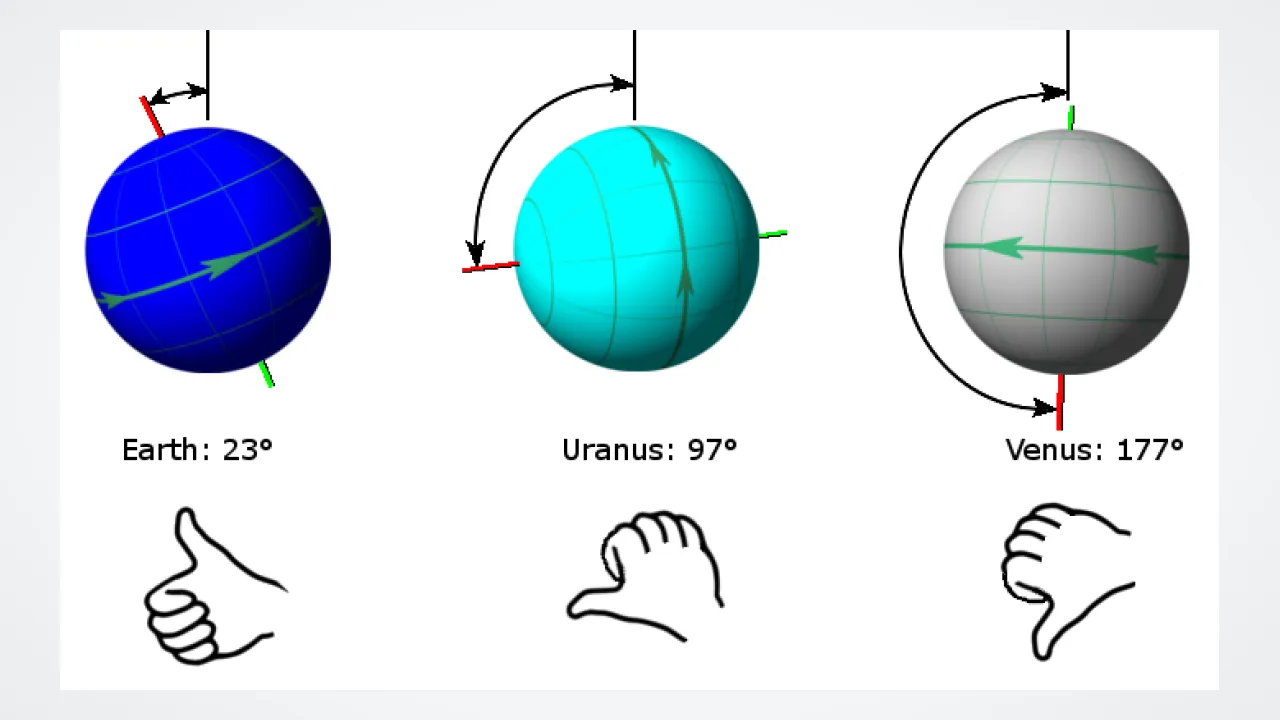
Across our solar system, shapes wildly diverse seasonal worlds. Jupiter tilts only 3.1 degrees, experiencing negligible seasonal shifts; Mars tilts 25.2 degrees, driving seasonal dry-ice polar caps; Saturn tilts 26.7 degrees, tilting its rings dramatically from Earth's viewpoint; and Venus tilts 177.4 degrees—spinning backward almost completely upside down!
4
Milankovitch Cycles and Ice Sheet Pacing
In the 1920s, Serbian mathematician Milutin Milankovitch calculated how subtle gravitational tugs from Jupiter and Saturn nudge Earth's gently between 22.1 and 24.5 degrees every 41,000 years, alongside 100,000-year orbital eccentricity cycles and 26,000-year precession. When smaller tilt reduces high-latitude northern summer sunshine, winter snow in Canada and Scandinavia survives July without melting—gradually building continental ice sheets!
5
Biospheric Rhythms and Phenology
On human timescales, plants and migratory animals use photoperiod—reliable day-length cues tied directly to axial tilt—to time flowering, bird migration, and autumn leaf senescence, a seasonal calendar biologists track through the science of .