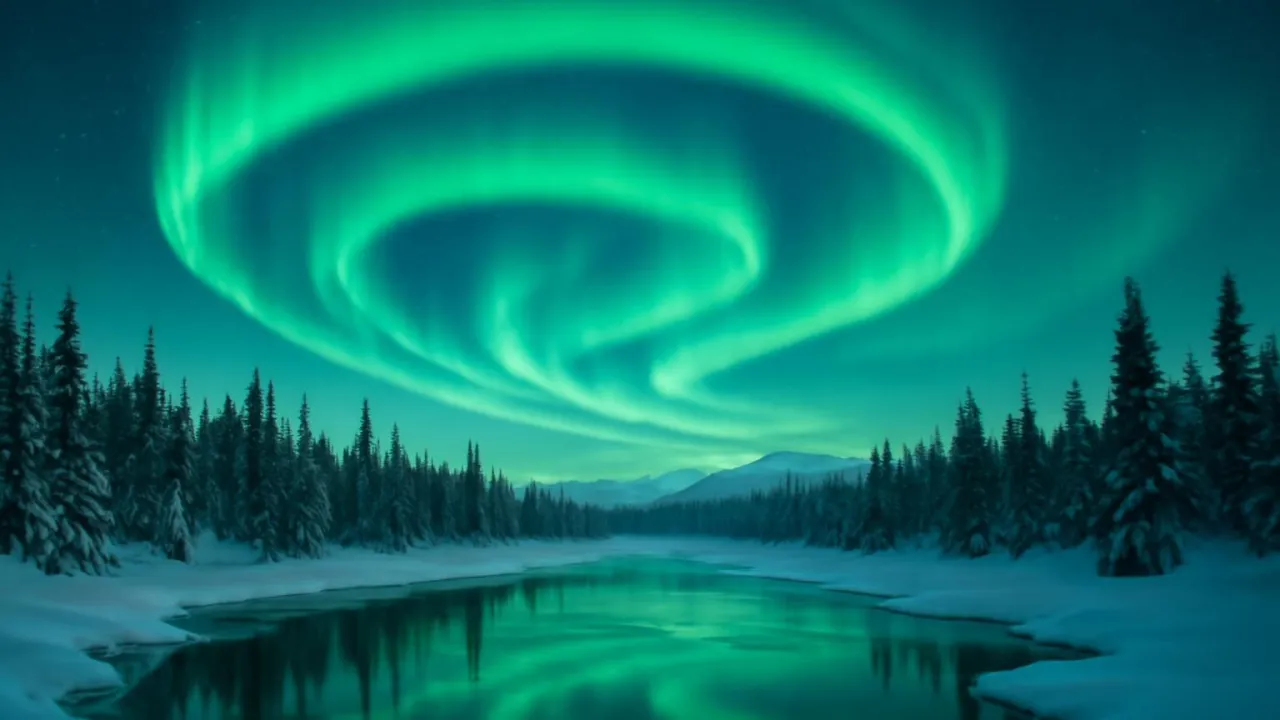
1. What colors can you see in the Northern Lights?
2. Where do people watch the Northern Lights?
🤯 Mind-Blowing Fact • Grade 2
The Northern Lights can be so bright, people can read a book by their glow!
✨ Word Sparks (Grade 2 Glossary)
Tap 🔊 to hear
particle
A tiny piece of something
ribbon
A long, wavy strip
glow
To shine softly with light
🪝
Have you ever seen the sky light up with dancing colors at night?
1
A Sky Full of Colors
At night, waves of green and pink lights move across the sky. These lights are called the Northern Lights, or Aurora Borealis. They look like glowing and sometimes even make shapes.
2
Where and When to Watch
People travel to cold places near the North Pole to see them. The best time is during dark, clear winter nights. Sometimes, the lights last for just a few minutes, but other times they shine for hours.
3
What Makes the Lights
The Sun sends tiny to Earth, which hit the air high above us. When these particles touch the air, they make the sky with beautiful colors. This special show happens only in certain places on our planet.
2. When is the best time to see the Northern Lights?
🤯 Mind-Blowing Fact • Grade 3
Some auroras make crackling or hissing sounds that people can sometimes hear on very quiet nights!
✨ Word Sparks (Grade 3 Glossary)
Tap 🔊 to hear
atmosphere
The layer of air around Earth
solar wind
Energy and particles from the Sun
phenomenon
Something amazing that happens in nature
🪝
Imagine standing outside on a freezing night when the sky suddenly bursts into glowing green waves—what causes this magical show?
1
Nature’s Nighttime Light Show
The Aurora Borealis fills the night sky with moving colors like green, pink, and purple. These lights often look like curtains, ribbons, or even swirling spirals above snowy forests. People travel to places like Alaska, Norway, and Canada to see them. The best views happen far from city lights on cold, clear nights.
2
How the Aurora Forms
The Sun sends out a stream of energy called the . When these charged particles reach Earth, they hit gases in our . This collision causes the air to glow in bright, shifting colors. The area where this happens is called the auroral oval.
3
Colors and Patterns Explained
The most common aurora color is green, but red, purple, and blue sometimes appear. The color depends on which gas in the is hit by the . Oxygen makes green and red, while nitrogen creates purple and blue. These colors can stretch across the entire sky, forming huge, moving shapes.
4
A Global Wonder
The Northern Lights are not just beautiful—they help scientists study space weather and Earth’s magnetic field. People from all over the world visit the Arctic to see this natural . The aurora has inspired stories and legends for thousands of years. Seeing the lights is a dream for many sky watchers.
During powerful solar storms, the Northern Lights have been seen as far south as Virginia and Texas!
✨ Word Sparks (Grade 4 Glossary)
Tap 🔊 to hear
magnetic field
Invisible force around Earth that attracts things
collision
When two things bump into each other
solar storm
A burst of energy from the Sun
🪝
What if you could watch the sky come alive with shifting curtains of color, all powered by the Sun’s invisible energy?
1
The Science Behind the Spectacle
The Aurora Borealis, or Northern Lights, is an atmospheric phenomenon that creates glowing waves of color in the polar night sky. This spectacle happens when charged particles from the Sun, called the solar wind, are pulled toward Earth’s magnetic poles. As these particles collide with gases like oxygen and nitrogen high in the atmosphere, they transfer energy, causing the air to emit shimmering lights. The auroral oval marks the region where these lights are most likely to appear.
2
Colors, Patterns, and Physics
The most common aurora color is green, caused by oxygen molecules about 60 miles above Earth. Red auroras appear when oxygen is excited even higher up, while nitrogen produces purple and blue hues. The lights often form arches, rays, and spirals that move and change shape as the solar wind’s intensity shifts. Sometimes, the aurora is so bright that it can be seen far from the poles.
3
A Window into Space Weather
Auroras help scientists study space weather and the strength of Earth’s . When send powerful bursts of particles, auroras can be seen farther south than usual. These storms can also affect satellites, power grids, and even radio signals on Earth, making the aurora both beautiful and important for science.
4
Cultural Legends and Global Impact
People from many cultures have told stories about the Northern Lights for thousands of years. Some believed the lights were spirits dancing, while others thought they were messages from the gods. Today, the aurora draws visitors from around the world, supporting tourism and inspiring artists, scientists, and storytellers everywhere.
The energy released by a strong aurora can equal the power used by a large city for several hours!
✨ Word Sparks (Grade 5 Glossary)
Tap 🔊 to hear
magnetosphere
Earth’s protective magnetic bubble in space
photon
A tiny particle of light
coronal mass ejection
A huge burst of solar particles
🪝
What hidden forces turn the polar night sky into a living canvas of color, and how do scientists decode this dazzling natural phenomenon?
1
Solar Wind Meets Earth’s Shield
Every second, the Sun ejects a stream of charged particles known as the solar wind, which travels through space at speeds up to 1.8 million miles per hour. When these energetic particles reach Earth, they are guided by the planet’s , a powerful magnetic field that acts like an invisible shield. The magnetosphere redirects most particles toward the polar regions, forming the auroral ovals around the North and South Poles. This interaction is a dramatic example of electromagnetic forces at work in our solar system.
2
The Physics of Light Emission
As solar wind particles spiral along magnetic field lines, they collide with atoms and molecules in the upper atmosphere, mainly oxygen and nitrogen. These collisions excite the atmospheric gases, causing them to emit —tiny packets of light energy. Green auroras, the most common, occur when oxygen atoms about 60 miles above Earth are excited. Red auroras are produced by oxygen at even higher altitudes, while nitrogen creates blue and purple hues. The specific colors and patterns depend on the energy of the particles, the type of gas struck, and the altitude of the collision.
3
Auroras and Space Weather Science
Scientists study auroras to better understand space weather, which can impact technology and life on Earth. Powerful solar storms, known as , can intensify the aurora and push the oval farther from the poles. These storms can disrupt satellite operations, navigation systems, and even electrical power grids. By monitoring auroras and solar activity, scientists can help predict and prepare for these effects, making the study of the Northern Lights vital for modern society.
4
Cultural Significance Across Millennia
For thousands of years, the Aurora Borealis has inspired awe, myths, and scientific curiosity in cultures across the Northern Hemisphere. Indigenous peoples, such as the Sámi of Scandinavia and the Inuit of Canada, have woven the lights into their folklore, often viewing them as spirits or celestial messages. In recent centuries, artists, poets, and scientists have sought to capture and explain the aurora’s beauty. Today, the Northern Lights attract tourists, photographers, and researchers from around the globe, fueling both local economies and scientific discovery.
5
Quantifying the Aurora’s Magnitude
The auroral oval can stretch up to 1,550 miles (2,500 kilometers) across, with individual auroral arcs sometimes spanning hundreds of miles. The brightness of an aurora is measured in kilorayleighs, and the most intense displays can reach over 1000 kilorayleighs—bright enough to cast shadows on snowy landscapes. During extreme solar storms, auroras have been observed as far south as the Mediterranean and southern United States. This makes the Aurora Borealis one of the largest and most spectacular natural light shows on Earth.