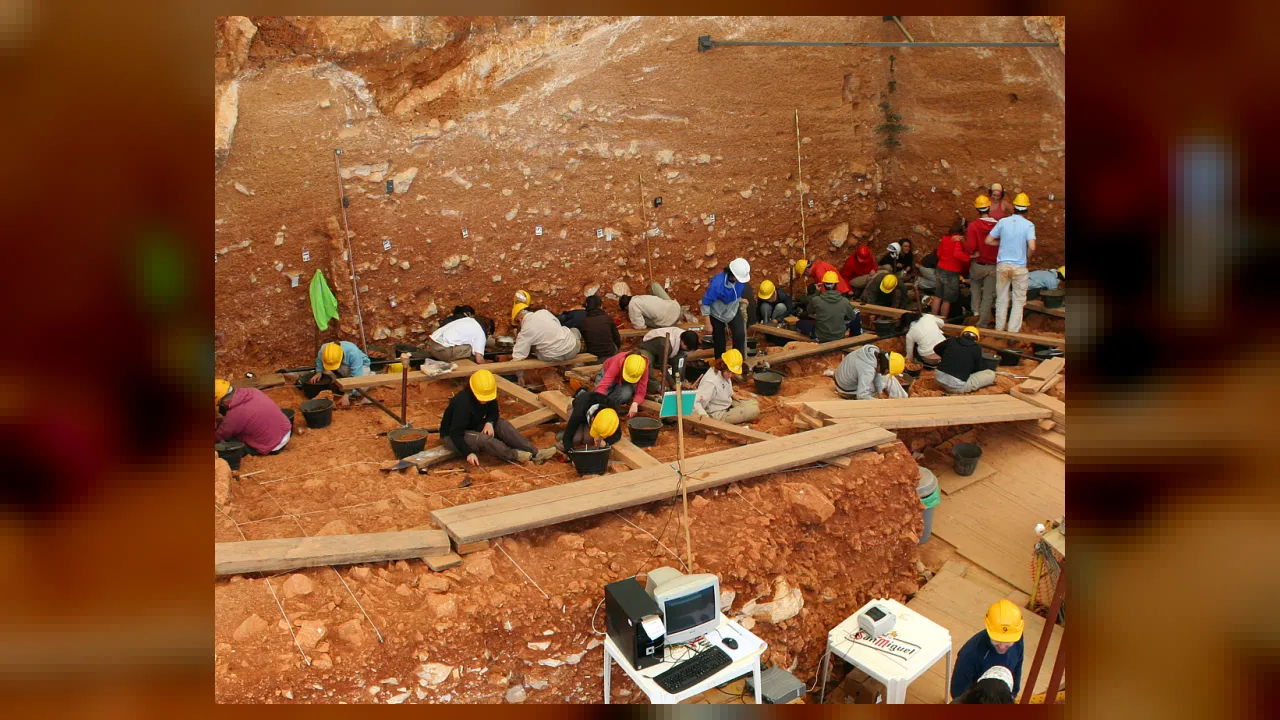
⚡ Everyday Impact SparkReads broken pottery, tools, and buried walls to reconstruct forgotten human stories
🤯 Mind-Blowing Fact • Grade 1
Archaeologists don't dig up dinosaurs—they only study things made and left behind by humans!
✨ Word Sparks (Grade 1 Glossary)
Tap 🔊 to hear
trowel
A small flat hand tool for digging
clue
A piece of evidence solving a mystery
sieve
A mesh screen that separates tiny objects
🪝
What old secrets hide right under the dirt beneath your feet?
1
Brush Away the Dirt
Scrape, brush, peek! Under warm brown soil, a painted clay bowl peeks out. Kneeling in the sun, an archaeologist smiles at the .
2
Clues About People
Unlike dinosaur hunters, these scientists study people from long ago. They find stone arrowheads, glass beads, and old coins. Shaking dirt through a screen catches tiny treasures.
3
Drawing Every Find
Every single piece gets measured and drawn in a notebook. Together, the tell how families cooked, worked, and played!
1. What do archaeologists search for when they dig?
2. Why do archaeologists shake dug-up soil through a mesh screen?
🤯 Mind-Blowing Fact • Grade 2
At Historic Jamestowne in Virginia, archaeologists uncovered the exact wooden postholes of the original 1607 fort that people once thought had washed into the river!
✨ Word Sparks (Grade 2 Glossary)
Tap 🔊 to hear
grid
Even squares marked with string for mapping
excavate
To uncover buried items slowly and carefully
shipwreck
The sunken remains of an old ship
🪝
Why do archaeologists dig with tiny hand trowels and paintbrushes instead of big bulldozers?
1
Slow and Careful Wins
Imagine trying to unwrap a fragile birthday gift hidden inside hard mud! If you smashed it with a shovel, it would break. That is why an archaeologist scrapes away thin layers of dirt with a flat hand trowel and a soft paintbrush.
2
Mapping Square by Square
Before digging begins, the team stretches bright string across the ground to make neat squares called a . Whenever someone uncovers a clay pot or rusted buckle, they photograph and map its exact square before lifting it out.
3
Underwater Explorers Too
Not every dig happens on dry land—maritime archaeologists wear scuba gear to explore wooden resting on the ocean floor!
1. Why do archaeologists stretch string squares across a dig site?
2. Where do maritime archaeologists do their fieldwork?
🤯 Mind-Blowing Fact • Grade 3
Buried trash pits—called middens—are an archaeologist's favorite discovery because broken dishes, shells, and animal bones reveal exactly what ancient families ate every day!
✨ Word Sparks (Grade 3 Glossary)
Tap 🔊 to hear
strata
Stacked layers of earth built over time
context
Exact location and surroundings of a find
sherd
A broken piece of historic clay pottery
🪝
How can layers of dirt read like chapters in a giant underground history book?
1
Reading Layers of Time
Look closely at the side wall of an excavation pit and you will spot stripes of dark ash, sandy clay, and crushed shells. To an archaeologist, those soil layers—called —work like pages in a calendar: deeper layers usually hold older clues than layers near the grass!
2
Why Context Matters Most
Finding a silver coin is exciting, yet where it sits matters even more. If that coin rests beside hearth stones and charred corn kernels, its reveals when people cooked at that fireplace and whom they traded with.
3
Peeking Underground Without Digging
Before turning over a single clump of sod, modern teams often roll ground-penetrating radar across a field. Safe radio waves bounce off buried brick foundations to create an underground map!
4
Back to the Lab
For every week spent digging outside, archaeologists spend several weeks in the lab washing, labeling, and fitting pottery back together.
1. In undisturbed soil layers (strata), where are the oldest artifacts usually found?
2. How does ground-penetrating radar help before a dig starts?
🤯 Mind-Blowing Fact • Grade 4
Using airborne LiDAR lasers over Guatemala, archaeologists recently mapped more than 60,000 ancient Maya houses, causeways, and plazas hidden beneath thick rainforest trees!
✨ Word Sparks (Grade 4 Glossary)
Tap 🔊 to hear
radiocarbon dating
Measuring carbon decay to find an age
LiDAR
Laser scanning that maps land beneath trees
midden
An old trash heap holding daily clues
🪝
How do lasers shot from airplanes and atomic clocks inside charcoal reveal lost cities and early American settlements?
1
Uncovering Voices Left Out of Books
Written history only tells part of the human story, because millions of everyday farmers, Indigenous builders, craftspeople, and enslaved workers never had their daily lives recorded on paper. Stepping in to recover those missing chapters, an archaeologist studies physical traces preserved in the ground.
2
Virginia's Living Outdoor Classrooms
Across Virginia—from ancient Indigenous villages at Werowocomoco on the York River to 1607 Jamestown and historic plantations like Monticello and Mount Vernon—archaeologists have reshaped what students learn in social studies. Soil stains from wooden palisades, trade copper, and hand-molded colonoware pottery show how Powhatan, European, and African communities interacted.
3
High-Tech Dating and LiDAR
In the laboratory, scientists measure tiny amounts of carbon-14 remaining in ancient wood, bone, or seeds. Because carbon-14 decays at a steady rate, pinpoints how many centuries ago a campfire burned! Overhead, aircraft equipped with fire millions of harmless laser pulses through thick jungle canopies to map hidden Maya pyramids and causeways in crisp three dimensions.
4
Preserving Sites for the Future
Because excavation permanently removes soil layers, ethical archaeologists leave large portions of historic sites untouched for future researchers and partner respectfully with Indigenous nations and local descendant communities.
1. Why is archaeology especially important for understanding everyday people in history?
2. What can radiocarbon (carbon-14) dating tell an archaeologist?
🤯 Mind-Blowing Fact • Grade 5
Dendrochronology—tree-ring dating—is so precise that archaeologists could tell timbers cut for Pueblo Bonito in New Mexico were felled in the exact spring or autumn of specific years over 900 years ago!
✨ Word Sparks (Grade 5 Glossary)
Tap 🔊 to hear
stratigraphy
Studying stacked soil layers to order events
dendrochronology
Dating old wood using annual tree rings
photogrammetry
Combining overlapping photos into 3D site maps
🪝
Why do archaeologists say excavation is a controlled scientific experiment that can only be performed once?
1
Reading a Three-Dimensional Puzzle
Five feet beneath a Virginia riverbank, a faint dark circle in yellow clay marks where a cedar post rotted away four centuries ago. Beside it lie flint flakes and charred hickory nutshells. Recording every millimeter with a laser total station, an archaeologist reconstructs an entire house floor from subtle stains and fragments most eyes would miss.
2
Stratigraphy and the Law of Superposition
Scientific archaeology rests on and the geological Law of Superposition: in undisturbed deposits, lower soil horizons formed earlier than upper ones. Because digging removes those layers forever, researchers document every stratum using Munsell soil-color charts, overlapping 3D models, and water flotation tanks that float microscopic pollen and charred grains gently to the surface.
3
Archaeometry and Molecular Clues
Modern fieldwork merges humanities with chemistry and physics. Radiocarbon accelerator mass spectrometry dates organic samples back roughly 50,000 years, while matches tree-ring widths to exact calendar years! Organic residue analysis can even detect ancient cocoa, beeswax, or olive oil molecules trapped inside porous clay jars for millennia.
4
Cultural Resource Management and Ethics
Most professional archaeologists in the United States work in Cultural Resource Management (CRM), surveying land ahead of new highways, solar farms, or pipelines under the National Historic Preservation Act of 1966. Equally vital, teams collaborate with Sovereign Tribal Nations and local descendants to honor sacred sites and steward heritage ethically.
5
Humanity's Long Mirror
Spanning more than three million years—from East African stone tools and Mesopotamian irrigation canals to Industrial Era mills—archaeology reveals how human communities adapt, innovate, and endure across changing climates.