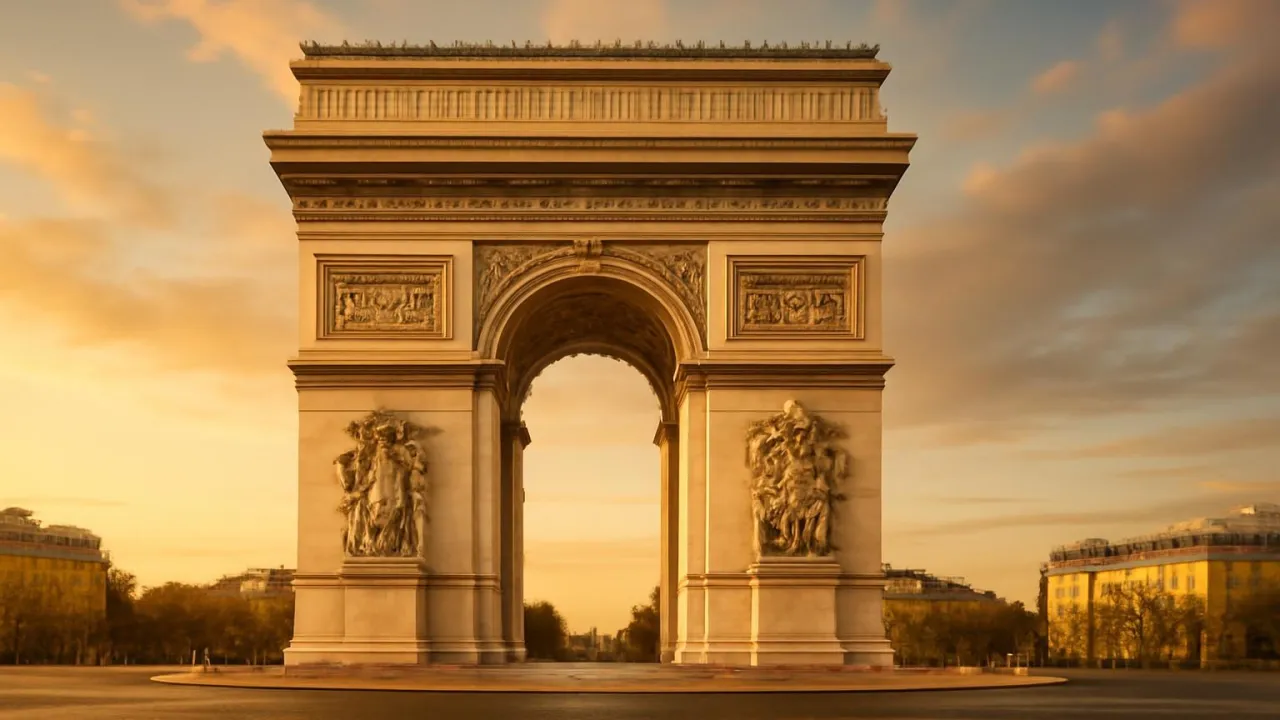
The Arc de Triomphe took 30 years to finish building!
✨ Word Sparks (Grade 2 Glossary)
Tap 🔊 to hear
relief
A picture raised from stone
soldier
A person who fights for a country
view
What you see from a place
🪝
What if you could walk under a giant stone arch in the heart of Paris?
1
A Giant in the City
The Arc de Triomphe stands tall above the busy streets of Paris. Twelve roads connect at its base, making it a famous meeting place. People and cars move in circles around the monument every day.
2
Stories in Stone
The Arc is covered with carvings that show and important events. These stone pictures tell stories about French history and celebrate bravery. Visitors love to look up and find all the details.
3
Climbing for a View
You can climb over 280 steps to reach the top. From there, you see the city stretching out in every direction. The is amazing, especially at sunset when Paris glows with golden light.
The Arc de Triomphe is almost as tall as a 15-story building!
✨ Word Sparks (Grade 3 Glossary)
Tap 🔊 to hear
limestone
A type of strong, pale rock
relief
A raised stone picture or design
avenue
A wide street in a city
🪝
If you stood under the Arc de Triomphe, would you feel tiny or tall?
1
A Parisian Landmark
The Arc de Triomphe rises high above the Place Charles de Gaulle in Paris. Built to honor French soldiers, it is one of the most famous monuments in the world. Twelve wide stretch out from the Arc like the spokes of a giant wheel. Visitors from everywhere come to see its impressive shape and size.
2
How Does the Arch Stand?
The Arc is made from blocks stacked into a massive arch. The curved shape lets the weight push down and out, making it strong and stable. This is called an 'arch,' a design used since ancient times for bridges and buildings. The Arc de Triomphe is a great example of this engineering.
3
Stories Carved in Stone
All around the Arc, you see sculptures showing soldiers, battles, and important names. These carvings celebrate victories and remember those who served France. The details are so fine you can see the folds in uniforms and the expressions on faces. The monument is like a giant stone storybook.
4
Climbing to the Top
Inside, a spiral staircase leads you up 284 steps to the roof. At the top, you get a panoramic view of Paris, with the Eiffel Tower and city streets below. The wind feels cool and fresh so high up. Many people take photos and enjoy the beautiful cityscape.
The Arc’s design inspired arches and memorials in cities all over the world.
✨ Word Sparks (Grade 4 Glossary)
Tap 🔊 to hear
keystone
The top stone locking an arch
ceremony
A special event to remember something
memorial
A place to honor people or events
🪝
Imagine the echo of marching boots beneath a stone arch as wide as a school gym—what stories would you hear?
1
A Monument to Memory
The Arc de Triomphe stands at the center of Paris, where twelve grand avenues meet in a star-shaped pattern. Commissioned by Napoleon in 1806, it was built to honor the soldiers who fought for France, especially during the Napoleonic Wars. The monument took thirty years to complete, finally opening in 1836 after many changes in French leadership. Today, it is both a symbol of national pride and a place for important ceremonies.
2
The Physics of the Arch
The Arc’s design uses the ancient engineering principle of the arch, which distributes weight outward and downward. This allows the structure to stand without needing extra supports, even though it is 164 feet tall and made of heavy limestone. The at the top of the arch locks all the stones together, making the monument stable for centuries. Engineers use similar arch shapes in bridges and tunnels around the world.
3
Sculpted Stories in Stone
Detailed relief sculptures cover the Arc’s four massive pillars, showing scenes of battles, soldiers, and famous generals. The names of 660 generals and many important battles are carved into the stone. These images and words turn the Arc into a giant history book, helping visitors remember the people and events it honors. Every year, a special flame is lit at the Arc to remember unknown soldiers from World War I.
4
A View Across Paris
Visitors climb a winding staircase of 284 steps to reach the viewing platform. From the top, you can see the Eiffel Tower, the Louvre, and the city’s grand avenues stretching out like sunbeams. The Arc’s location and height make it a perfect spot for watching parades and city celebrations. At night, the monument glows with lights, making it a magical sight in the heart of Paris.
1. How does the keystone help the Arc stay strong?
2. Why do people light a flame at the Arc?
🤯 Mind-Blowing Fact • Grade 5
The Arc de Triomphe's design inspired monuments like New York’s Washington Square Arch and India Gate in New Delhi.
✨ Word Sparks (Grade 5 Glossary)
Tap 🔊 to hear
neoclassical
A style copying ancient Greek and Roman buildings
inscription
Words carved into stone or metal
allegorical
A picture or statue showing an idea or feeling
🪝
If you stood in the center of Paris as history marched by, what secrets would the Arc de Triomphe reveal about engineering, memory, and national pride?
1
A Symbol Forged in Stone and History
Commissioned by Napoleon Bonaparte in 1806 following his victory at Austerlitz, the Arc de Triomphe was envisioned as a monumental gateway to honor French military achievements. Its construction spanned three decades, enduring political upheaval before completion in 1836 under King Louis-Philippe. The Arc’s location at Place Charles de Gaulle, where twelve avenues radiate outward, was deliberately chosen to create a powerful visual and symbolic axis through Paris. Today, the Arc stands as a testament to both French resilience and the evolving meaning of national remembrance.
2
Engineering the Giant Arch
Standing 164 feet (50 meters) tall and 148 feet (45 meters) wide, the Arc de Triomphe is a masterpiece of engineering. Its self-supporting arch relies on the precise arrangement of limestone blocks, each shaped to transfer weight outward and downward. The keystone at the apex is crucial, locking the entire structure together and preventing collapse. This ancient engineering principle, refined by Roman architects, allows the Arc to bear immense loads without the need for internal supports or steel reinforcement.
3
Reliefs and Inscriptions: Stone Chronicles
The four massive pillars are adorned with high-relief sculptures depicting pivotal battles, figures, and scenes of victory and mourning. Over 660 generals’ names and dozens of significant battles are inscribed on the inner and outer surfaces. The most famous relief, 'La Marseillaise,' shows citizens rallying to defend France, capturing both the emotion and energy of the era. These detailed carvings serve as a permanent visual record of France’s military and cultural legacy.
4
The Arc as a Living Memorial
Beneath the Arc lies the Tomb of the Unknown Soldier from World War I, marked by an eternal flame first lit in 1923. This solemn memorial draws millions each year, serving as the site for national ceremonies and international commemorations. The tradition of rekindling the flame every evening ensures that the sacrifices of unnamed soldiers are never forgotten. The Arc’s role as a living memorial connects past and present, uniting visitors in shared reflection and respect.
5
A Panoramic Parisian Experience
Climbing the Arc’s 284-step spiral staircase rewards visitors with breathtaking 360-degree views of Paris. The monument’s central position reveals the city’s grand urban design, with avenues radiating like spokes from a wheel. From the top, landmarks such as the Eiffel Tower, the Louvre, and the distant Sacré-Cœur basilica are visible, offering a unique perspective on Paris’s history and architecture. The Arc de Triomphe, illuminated at night, stands as both a beacon and a bridge between centuries of French achievement.