🪐 Scale / Diameter~590 million mi (950 million km) diameter • ~680× Sun's width • 12–15 solar masses
☄️ Composition & Orbit75,000× Sun-luminous aging supergiant + hot blue companion Antares B
⚡ Cosmic SparkGlows so ruby-red near Planet Mars's sky path that ancient Greeks named it 'Rival of Mars'
🤯 Mind-Blowing Fact • Grade 1
You could pour more than 300 million Suns inside the giant puffy ball of Antares!
✨ Word Sparks (Grade 1 Glossary)
Tap 🔊 to hear
rival
Competitor matching another in look or skill
Scorpius
Curving summer star group shaped like scorpion
ruby
Deep sparkling red color like a gem
🪝
Why did skywatchers name one fiery summer star the 'Rival of Mars'?
1
Heart of the Starry Scorpion
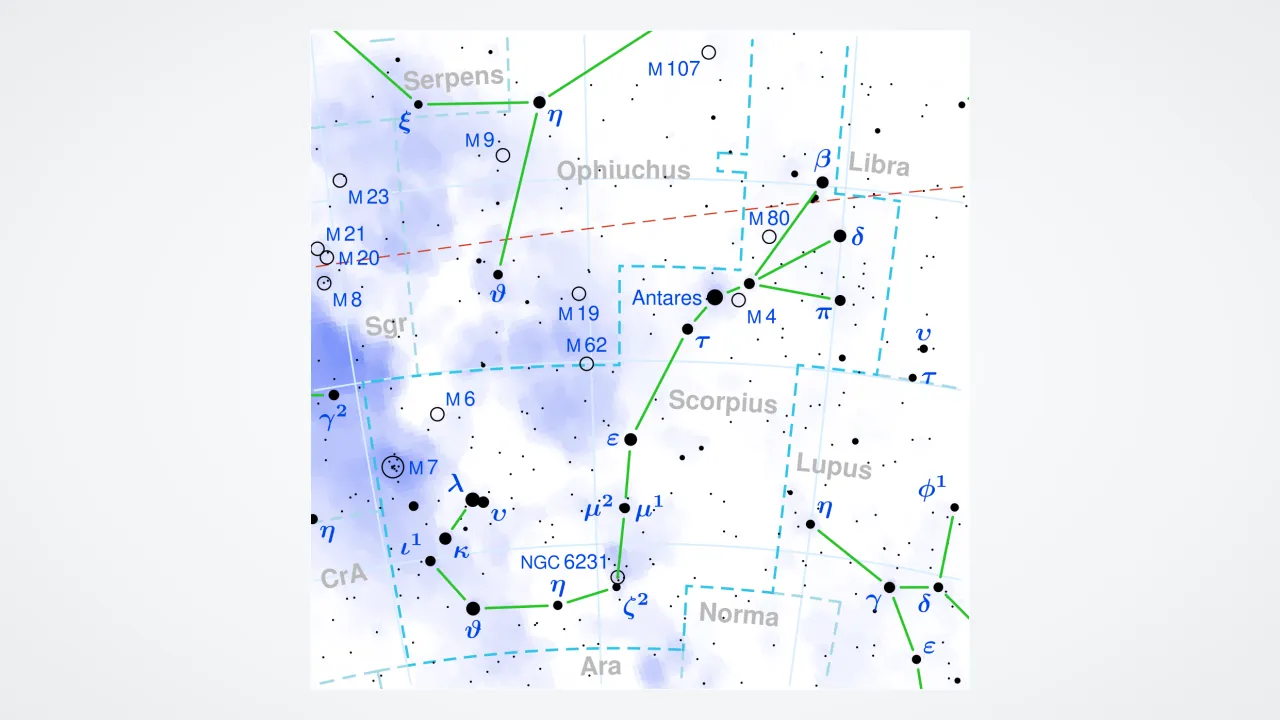
Peek low in the warm summer sky for a curving hook of stars shaped like a scorpion! Right in its chest beats a glowing star called Antares. Its red-orange color looks almost just like Planet Mars!
2
Twin Colors in the Sky
Sometimes red Mars glides right past this red star in the night sky, like two campfires side by side!
3
Bigger Than Mars's Path
Up close, this puffy giant star is wider than Mars's whole trip around our Sun!
1. Why did ancient Greek stargazers name Antares 'Rival of Mars'?
2. Inside which animal-shaped constellation does Antares shine as the glowing heart?
🤯 Mind-Blowing Fact • Grade 2
When the Moon briefly passed in front of Antares in 1819, red supergiant glare vanished for a few seconds and revealed hidden blue partner star Antares B for the very first time!
✨ Word Sparks (Grade 2 Glossary)
Tap 🔊 to hear
eclipse
When one space object passes before another
emerald
Rich sparkling green color like a jewel
supergiant star
Enormous aging star hundreds of suns wide
🪝
How can you tell Planet Mars apart from its fiery star twin when they meet in the sky?
1
Star Versus Planet Showdown
Every couple of years, rusty-red Planet Mars marches right past Scorpius in the evening sky! Ancient Greeks called Mars 'Ares,' so they named the Scorpion's bright red heart 'Antares'—meaning Rival of Mars. Here is a neat trick to tell them apart: close-by Mars shines with a steady beam, while faraway Antares twinkles fiercely!
2
Nearly Seven Hundred Suns Wide
Floating roughly 550 light-years from Earth, this red supergiant has puffed out nearly 700 times wider than our Sun! Placed in the middle of our Solar System, its cool red surface would swallow Mercury, Venus, Earth, and Mars.
3
A Secret Blue-Green Partner
Hiding beside the red giant orbits a smaller, hot blue-white star named Antares B that looks green next to its bright orange neighbor!
1. What easy stargazing clue helps you tell red Antares apart from red Planet Mars?
2. How did astronomer Johann Tobias Bürg first spot faint partner star Antares B in 1819?
🤯 Mind-Blowing Fact • Grade 3
To human eyes peeking through telescopes, blue-white Antares B looks bright emerald green—both from color contrast beside orange Antares A and from glowing ionized iron gas between them!
✨ Word Sparks (Grade 3 Glossary)
Tap 🔊 to hear
Atacama Desert
High, dry Chilean desert ideal for telescopes
turbulent
Churning wildly with uneven, swirling gas motion
ionized
Energized atoms stripped of electrons by radiation
🪝
How did telescopes in Chile snap the sharpest map ever made of any star beyond our Sun?
1
Fifteenth Brightest in Earth's Sky
Glowing 550 light-years away in the southern constellation Scorpius, Alpha Scorpii—Antares—ranks fifteenth among all nighttime stars. Though its cool 6,100°F (3,660 K) surface looks gentle ruby-orange to human eyes, including invisible infrared heat pushes its true output to an astonishing 75,000 times our Sun's power!
2
Zooming In With Virtual Giant Mirrors
In 2017, astronomers linked four telescopes in Chile's into one virtual 650-foot mirror called the Very Large Telescope Interferometer. They captured the most detailed surface velocity map ever created of any star outside our Solar System!
3
Turbulent Gas Plumes
That historic map showed giant plumes of gas churning up and down across Antares faster and farther out than ordinary convection alone could explain.
4
Painting a Nebula With Two Stars
Orbiting 500 astronomical units away, 18,000-kelvin blue-white companion Antares B zaps iron atoms inside Antares A's dusty wind, lighting up a glowing little green nebula between them!
1. Why does Antares shine 75,000 times more powerfully than our Sun when scientists count all light types?
2. What special milestone did Chile's Very Large Telescope Interferometer achieve with Antares in 2017?
🤯 Mind-Blowing Fact • Grade 4
Radio telescopes ALMA and VLA mapped Antares's outer atmosphere stretching out twelve times wider than the giant star itself—meaning its wispy wind zone could swallow Neptune's entire Solar System orbit!
Why is Antares wrapped in a mysterious lukewarm atmosphere twelve times wider than the monster star itself?
1
Leader of the Scorpius-Centaurus Star Nursery
Roughly eleven to fifteen million years ago, a giant molecular cloud condensed into thousands of hot young stars known today as the Scorpius-Centaurus —the closest massive star-forming group to Earth! Anchoring its Upper Scorpius subgroup ~550 light-years away is its heaviest surviving star, Alpha Scorpii A. Having exhausted core hydrogen millions of years ago, this 12-to-15-solar-mass heavyweight swelled to ~680 solar diameters while painting neighboring Rho Ophiuchi dust clouds warm golden-yellow.
2
ALMA and VLA Map the 'MOLsphere'
In 2020, radio astronomers pointed both the Atacama Large Millimeter Array (ALMA) in Chile and New Mexico's Very Large Array (VLA) at Antares to measure temperatures layer by layer above its surface. They mapped a warm heating up to 6,400°F (3,800 K) at 2.5 stellar radii, surrounded by a sprawling lukewarm wind zone stretching twelve times wider than the supergiant itself!
3
Mystery Force Lifting Stellar Winds
When ESO's VLTI tracked molecules rising and falling at 20 kilometers per second inside Antares's extended molecular atmosphere ('MOLsphere'), normal convection fell short of lifting gas that high—pointing to magnetic waves or pulsations helping drive mass loss!
4
Twin Supernova Contest With Betelgeuse
Racing neck-and-neck with Orion's Betelgeuse toward core collapse within the next million years, Antares will someday blaze rivaling Earth's full Moon before leaving behind a compact neutron star.
1. To which nearby family of young stars does Antares belong as the heaviest surviving member?
2. What puzzled astronomers when VLTI mapped rising and sinking carbon monoxide clouds above Antares?
🤯 Mind-Blowing Fact • Grade 5
Only three stars in the entire universe appear wider in angular size from Earth than Antares: our own daytime Sun, southern red giant R Doradus, and Orion's Betelgeuse!
✨ Word Sparks (Grade 5 Glossary)
Tap 🔊 to hear
lunar occultation
Passage of Earth's Moon directly across star
ecliptic
Sky path traced by Sun and planets
MOLsphere
Extended molecular gas shell around cool supergiants
🪝
How do infrared interferometry, millimeter radio thermometry, and an ionized forbidden-iron nebula inside a binary wind illuminate red-supergiant mass loss?
1
Cross-Cultural Sky Lore and Ecliptic Geometry
Lying less than five degrees south of the plane in Scorpius, Alpha Scorpii regularly undergoes dramatic planetary conjunctions with Mars and . Known to Chinese astronomers since the Shang dynasty as Da Huo ('the Great Fire' at the heart of the Azure Dragon) and to Maori navigators as Rehua, its Western name Antares derives from Greek Antares—'equal to' or 'rival of Ares (Mars).' Hipparcos parallax places this M1.5Iab-Ib supergiant roughly 550 light-years (~170 parsecs) away as the most evolved massive member of the Upper Scorpius subgroup of Scorpius-Centaurus.
Subtending ~37 milliarcseconds on Earth's sky—second in apparent stellar angular diameter only to the Sun, R Doradus, and Betelgeuse—Antares A spans ~680 solar radii (~3.17 AU) and radiates ~75,900 bolometric solar luminosities from a 3,660-kelvin photosphere. In 2017, Keiichi Ohnaka's team combined three Auxiliary Telescopes at ESO's Very Large Telescope Interferometer using the AMBER near-infrared instrument across carbon-monoxide first-overtone lines, reconstructing the sharpest velocity-resolved surface image ever achieved for an extrasolar star.
3
Thermal Stratification Mapped by ALMA and the VLA
Complementing infrared maps, 2020 multi-wavelength radio observations with ALMA and the Jansky Very Large Array resolved Antares's chromosphere and wind thermally for the first time: above the 3,660-K photosphere, gas cools inside an extended CO ',' warms to a patchy ~3,800-K chromosphere at 2.5 stellar radii—much cooler than earlier ultraviolet models guessed—and tapers into a lukewarm ionized wind traceable past 12 stellar radii.
4
Forbidden Iron Emission From Companion Antares B
Projected 2.7 arcseconds (~530 AU) west orbits 5.5-magnitude B2.5V main-sequence companion Antares B (~7 solar masses, ~18,500 K) on a multi-millennial loop. Immersed deep inside Antares A's dense mass-loss outflow (~10⁻⁶ solar masses/year), Antares B's ultraviolet photons carve out a localized H II cavity glowing in forbidden singly ionized iron ([Fe II]) lines.
5
Core-Collapse Trajectory
Synthesizing heavy elements inside its ~12-to-15-solar-mass interior, Antares A will terminate in a brilliant Type II supernova within roughly one million years, enriching the Gould Belt with freshly forged metals.