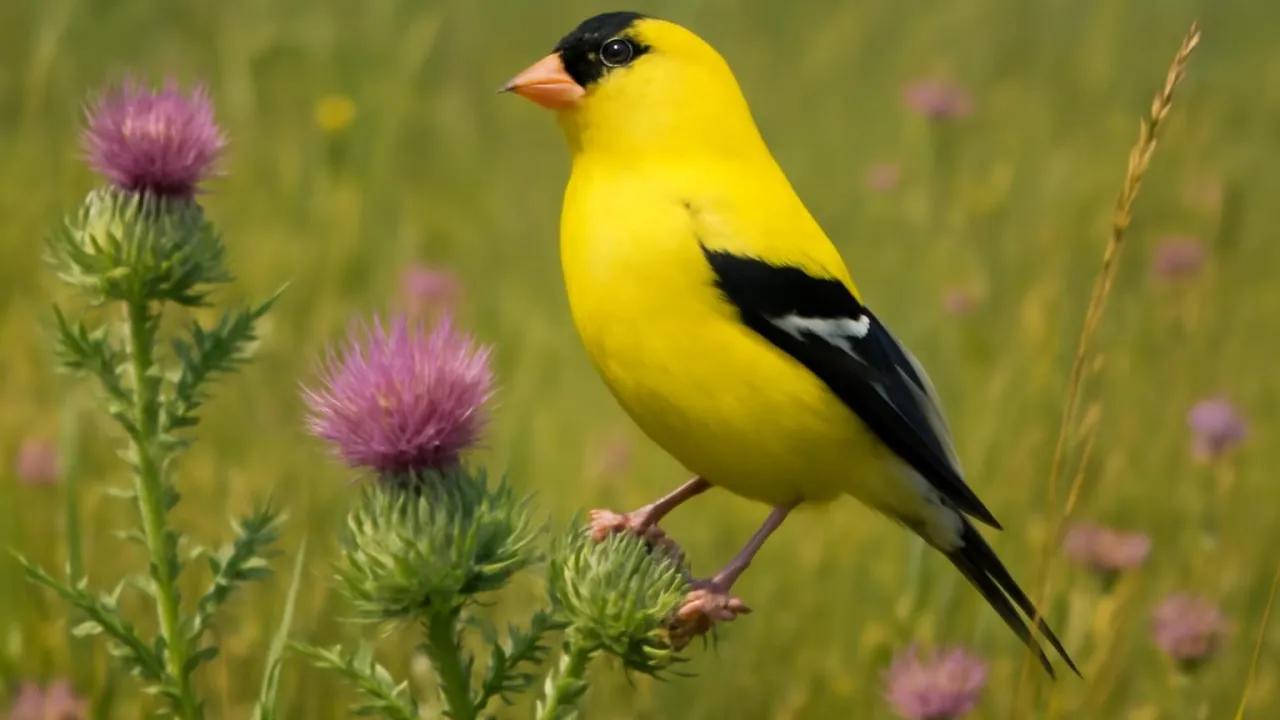
1. What color is the American Goldfinch in summer?
2. What does the goldfinch like to eat?
🤯 Mind-Blowing Fact • Grade 2
American Goldfinches molt twice a year, changing feather colors with seasons!
✨ Word Sparks (Grade 2 Glossary)
Tap 🔊 to hear
feathers
Soft parts that cover birds' bodies
nest
A bird's home made from twigs and grass
seeds
Tiny parts plants use to grow new plants
🪝
Have you heard the cheerful song of a bright yellow bird?
1
Bright Colors and Song
The American Goldfinch has bright yellow and black wings. It sings a cheerful song to attract friends. Its colors help it stand out in summer fields.
2
Where It Lives and Grows
This bird lives in open fields, gardens, and near water. It builds in shrubs and trees during spring. Baby goldfinches grow quickly by eating soft .
3
Special Seed Eater
Goldfinches mainly eat from plants like thistles and sunflowers. They have strong beaks to crack open tough seed shells. Their diet helps plants spread seeds across fields.
1. What do American Goldfinches use their strong beaks for?
2. Where do goldfinches build their nests?
🤯 Mind-Blowing Fact • Grade 3
American Goldfinches are the only finches in North America that molt twice a year!
✨ Word Sparks (Grade 3 Glossary)
Tap 🔊 to hear
adaptation
A change that helps animals survive better
camouflage
Colors or patterns that help hide animals
ecosystem
All living things and their homes together
🪝
Did you know the American Goldfinch changes color to survive?
1
Bright Colors and Camouflage
The American Goldfinch has bright yellow feathers in summer that help it attract mates. In winter, its feathers turn dull brown to from predators. This color change is an important for survival.
2
Habitat and Food Sources
These birds live in open fields, gardens, and near water where thistle plants grow. They mainly eat seeds, especially from thistles and sunflowers, which provide vital nutrients. Their strong beaks help them crack hard seed shells efficiently.
3
Life Cycle and Nesting
Goldfinches build cup-shaped nests in shrubs or small trees during spring. The female lays eggs that hatch into chicks after about two weeks. Both parents feed the young with soft seeds until they can fly and find food themselves.
4
Role in the Ecosystem
By eating seeds and moving around, goldfinches help spread plants like thistles across fields. This seed dispersal supports plant growth and maintains healthy . They also serve as prey for predators, balancing the food web.
1. Why do American Goldfinches change feather colors?
2. How do goldfinches help plants in the ecosystem?
🤯 Mind-Blowing Fact • Grade 4
American Goldfinches are unique for molting twice yearly, changing feathers for camouflage and mating!
✨ Word Sparks (Grade 4 Glossary)
Tap 🔊 to hear
biodiversity
Many kinds of plants and animals living together
conical
Shaped like a cone, sharp at one end
fledge
When young birds learn to fly from the nest
🪝
How does the American Goldfinch’s bright color help it live safely?
1
Seasonal Color Changes and Survival
The American Goldfinch’s bright yellow feathers during summer attract mates and signal health. When winter arrives, its feathers become dull brown to blend into the bare branches and dry plants. This seasonal color change reduces the risk of being seen by predators, increasing survival chances.
2
Habitat, Diet, and Seed Dispersal
Goldfinches inhabit open fields, gardens, and wetlands across much of North America. Their diet consists mainly of seeds from plants like thistles and sunflowers, which they crack open with their strong, beaks. By consuming seeds and moving from place to place, they help disperse seeds, promoting plant growth and .
3
Nesting Behavior and Life Cycle
During spring and summer, goldfinches build delicate cup-shaped nests in shrubs or small trees, often using plant fibers and spider silk. Females lay eggs that hatch after approximately two weeks, and both parents feed the chicks soft seeds. The young in about three weeks, learning to fly and forage independently.
4
Ecosystem Role and Human Impact
American Goldfinches play a vital role in food webs as both seed dispersers and prey for birds of prey. Human activities like habitat loss and pesticide use can affect their populations, but planting native plants and providing feeders can support their survival. Their presence indicates healthy ecosystems and balanced .
1. What is one reason goldfinches change feather colors in winter?
2. How do goldfinches help plants grow?
🤯 Mind-Blowing Fact • Grade 5
American Goldfinches are the only North American finches that molt twice yearly, balancing bright mating colors with winter camouflage.
✨ Word Sparks (Grade 5 Glossary)
Tap 🔊 to hear
carotenoid
Pigments that give birds bright yellow or red colors
molting
Shedding old feathers to grow new ones
propagation
Spreading seeds or plants to grow new life
🪝
What makes the American Goldfinch a remarkable example of seasonal adaptation?
1
Taxonomy and Scientific Classification
The American Goldfinch, Spinus tristis, belongs to the finch family Fringillidae within the order Passeriformes. It is the only finch species in North America that undergoes a complete molt twice annually. This unique trait distinguishes it taxonomically and functionally among related species. Its classification helps scientists understand its evolutionary relationships.
2
Physiological Adaptations and Molting
This bird’s bright yellow summer plumage results from pigments obtained through its seed-based diet. During fall, it molts into a dull olive-brown winter plumage, reducing visibility to predators. The biannual molt requires significant energy but enhances survival by balancing mating success and camouflage. This physiological process is vital for its yearly life cycle.
3
Ecological Role and Seed Dispersal Mechanics
American Goldfinches primarily consume seeds from thistles and sunflowers, using their strong conical beaks to crack tough seed coats. Their feeding behavior facilitates seed dispersal by dropping or transporting seeds to new locations, thus contributing to plant and ecosystem biodiversity maintenance. This interaction supports healthy habitats and food webs.
4
Conservation Status and Human Interactions
Currently, the American Goldfinch is classified as Least Concern by conservation organizations due to its wide range and stable populations. However, habitat loss, pesticide use, and climate change pose localized threats. Human efforts such as planting native wildflowers and providing feeders support their populations. Conservation actions help maintain ecological balance.
5
Quantitative Comparisons and Behavior
Adult goldfinches measure approximately 4.3 to 5.1 inches (11 to 13 centimeters) and weigh about 0.3 ounces (8 to 12 grams). They can fly at speeds up to 30 miles per hour (48 kilometers per hour). Their nests are typically 2 to 3 inches wide, constructed from plant fibers and spider silk for strength and flexibility. These measurements highlight their agility and delicate nesting skills.