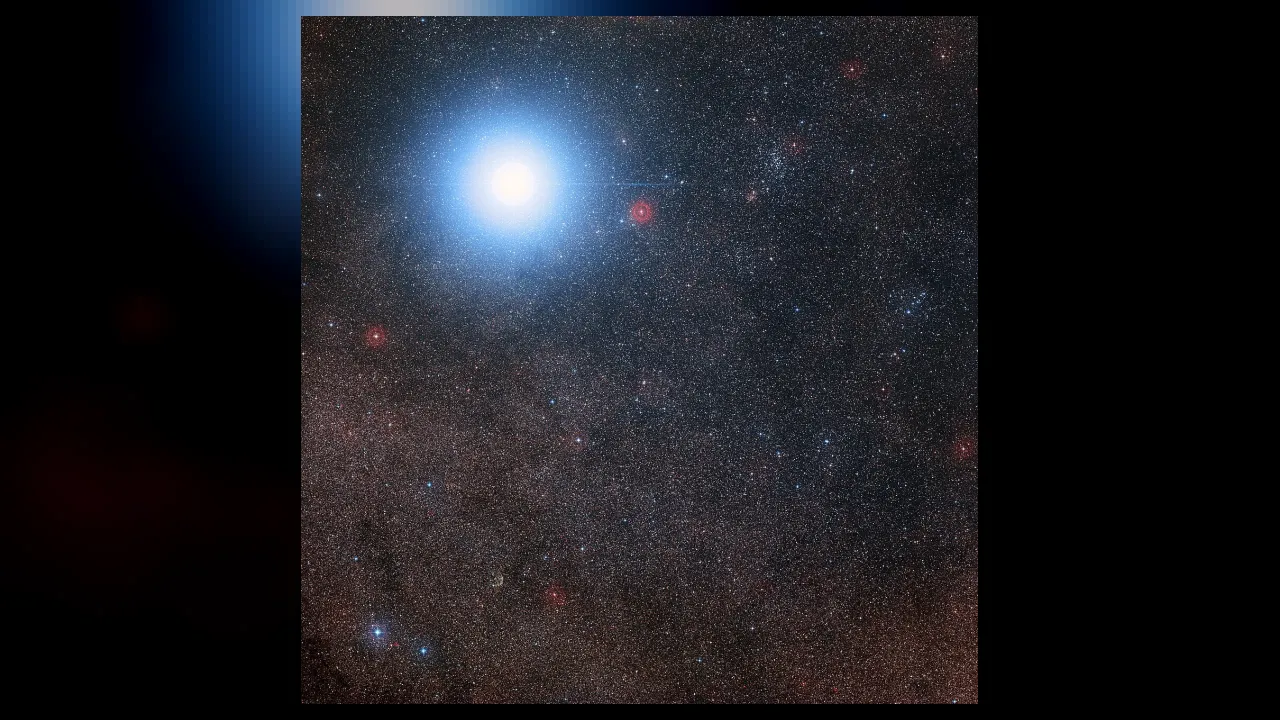
🪐 Scale / DiameterStar A: 1.05M mi (1.7M km) • Star B: 745,000 mi (1.2M km) • 2.13 total solar masses
☄️ Composition & OrbitSun-like yellow Star A & golden-orange Star B • 79.8-year shared orbit
⚡ Cosmic SparkClosest bright star system to Earth, featuring a near-twin of our own yellow Sun
🤯 Mind-Blowing Fact • Grade 1
Star A inside Alpha Centauri is the exact same warm yellow color and almost the exact same size as our own Sun!
✨ Word Sparks (Grade 1 Glossary)
Tap 🔊 to hear
twin
Something that looks almost just like another
star system
Stars circling together as one cosmic family
golden
Glowing with a warm yellow-orange light
🪝
What if one bright star in the night sky turned out to be three suns?
1
A Bright Surprise in the South
Look up at the bright southern night sky! One point shines almost brighter than any other star. To your eyes it looks like one dot, yet Alpha Centauri is really three stars living together!
2
Twin Suns Dancing Close
Two big stars—one yellow like our Sun and one warm orange—spin around each other in a slow dance.
3
Little Red Tagalong
Far out on the edge, tiny red Proxima Centauri circles them both as our closest star family!
1. How many stars actually make up the full Alpha Centauri family?
2. Which star in our Solar System looks almost just like Alpha Centauri A?
🤯 Mind-Blowing Fact • Grade 2
Ancient Polynesian navigators called Alpha Centauri and nearby Beta Centauri 'Kamailehope' and 'Kamailemua,' using them as guideposts to steer canoes to the Southern Cross!
✨ Word Sparks (Grade 2 Glossary)
Tap 🔊 to hear
double star
Two stars appearing right next to each other
navigator
Traveler who finds direction using stars and maps
solar twin
Distant star closely matching our own yellow Sun
🪝
Why did an explorer pointing a small telescope at one southern star suddenly see double?
1
Seeing Double Through a Telescope
In December 1689, astronomer Jean Richaud was watching a passing comet from India when he aimed his telescope at bright Alpha Centauri. Surprise! Instead of a single point of light, two dazzling stars gleamed side by side.
2
Rigil Kentaurus and Toliman
Astronomers call the bright yellow twin Rigil Kentaurus (Alpha Centauri A) and its slightly smaller orange partner Toliman (Alpha Centauri B). Every eighty years, these two suns swing close—about as near as Saturn is to our Sun—and then glide out as far as Pluto!
3
Third-Brightest Nighttime Beacon
Combined together at just 4.37 light-years away, their twin starlight shines as the third-brightest star in Earth's entire night sky!
1. About how long does it take Alpha Centauri A and B to finish one orbit around each other?
2. Where does Alpha Centauri rank in brightness among all stars in Earth's night sky?
🤯 Mind-Blowing Fact • Grade 3
If you stood on a planet orbiting Alpha Centauri A, orange partner star Alpha Centauri B would shine 2,500 times brighter than Earth's full Moon!
✨ Word Sparks (Grade 3 Glossary)
Tap 🔊 to hear
oval orbit
Stretched egg-shaped path bringing partners close then far
coronagraph
Telescope mask blocking bright starlight to spot planets
Southern Cross
Famous kite-shaped southern star pattern near Centaurus
🪝
Could a planet safely orbit one sun when a second blazing sun swings past every eighty years?
1
A Cosmic Trio 4.37 Light-Years Away
Anchored in the southern constellation Centaurus—forming the bright front 'pointer' toward the —Alpha Centauri lies 4.37 light-years (25.7 trillion miles) from Earth. Its main pair consists of yellow G2V star Rigil Kentaurus (1.1 solar masses) and orange K1V star Toliman (0.91 solar masses), circled far out by red dwarf Proxima Centauri.
2
Swinging From Saturn to Pluto Distance
Rather than tracing neat circles, Alpha Centauri A and B follow a stretched lasting 79.8 years. At their closest pass, they come within 1.0 billion miles (11 astronomical units)—roughly Saturn's distance from our Sun—before drifting out to 3.3 billion miles (35.6 AU), near Pluto's distance!
3
Stable Zones for Possible Worlds
Computer simulations show that even with a partner sun swinging by, each star keeps a 'safe zone' out to about twice Earth's distance from the Sun where rocky or gas planets could orbit stably for billions of years.
4
Hunting Next-Door Exoplanets
The James Webb Space Telescope has already aimed its infrared at Alpha Centauri A to search for warm giant planets hiding in its glare!
1. How close do Alpha Centauri A and B get to each other at the nearest point of their orbit?
2. What special tool on a telescope blocks blinding starlight so astronomers can hunt faint planets around Alpha Centauri A?
🤯 Mind-Blowing Fact • Grade 4
Astronomers measure sound waves ringing inside Alpha Centauri A and B—a technique called asteroseismology—to tell their age and inner density just like geologists use earthquakes to map inside Earth!
✨ Word Sparks (Grade 4 Glossary)
Tap 🔊 to hear
asteroseismology
Studying star interiors through tiny surface sound ripples
S-type orbit
Planet path circling one star in binary pair
skeptic
Thinker who asks for clear proof before believing
🪝
How did racing astronomers in the 1830s use Alpha Centauri to measure the mind-boggling gulf to the stars?
1
The Great 19th-Century Parallax Race
For centuries after Copernicus placed the Sun at the center of our Solar System, asked a fair question: if Earth really circles a 186-million-mile-wide orbit every year, why don't nearby stars appear to shift against distant background stars? Working from Cape Town, South Africa, between 1832 and 1833, Scottish astronomer Thomas Henderson carefully logged Alpha Centauri's position, announcing its tiny annual parallax shift in January 1839—just weeks after Friedrich Bessel published 61 Cygni—proving stars sit trillions, not millions, of miles away!
2
Comparing Two Slightly Older Sibling Suns
—measuring tiny sound-wave vibrations rippling across stellar surfaces—shows Alpha Centauri A and B are roughly five to six billion years old, slightly more mature than our 4.6-billion-year-old Sun, and enriched with about 70 percent more iron and heavy planet-building elements. Luminous yellow Star A shines 1.5 times brighter than our Sun, while cooler K-dwarf Star B radiates half our Sun's power with steady, gentle X-ray behavior.
3
S-Type Orbits and Candidate Giant Worlds
Inside wide binary pairs, astronomers call planets circling just one star 'S-type' worlds. Because anything orbiting beyond ~2.5 AU around Star A or B would get flung loose by the partner star's 79.8-year tug, habitable-zone orbits around 1.25 AU (for A) and 0.7 AU (for B) sit safely inside stable territory.
4
Breakthrough Watch and Webb's Mid-Infrared Eyes
Direct thermal imaging with Chile's Very Large Telescope and JWST's MIRI coronagraph has uncovered intriguing mid-infrared clues of a Saturn-mass giant candidate orbiting ~1 to 2 AU from Alpha Centauri A!
1. What historic breakthrough did Thomas Henderson's 1830s measurements of Alpha Centauri achieve?
2. How do Alpha Centauri A and B compare in heavy planet-building elements to our Sun?
🤯 Mind-Blowing Fact • Grade 5
Streaming steadily closer at 14 miles (22.4 km) per second, Alpha Centauri will pass within 3.0 light-years of our Sun in about 27,700 years—drifting out of Centaurus into the constellation Hydra!
✨ Word Sparks (Grade 5 Glossary)
Tap 🔊 to hear
barycenter
Shared balance point that orbiting bodies circle around
hierarchical triple
Close star pair circled far out by third
axial precession
Slow 26,000-year wobble of Earth's spinning axis
🪝
Why does a hierarchical triple system 1.34 parsecs away serve as humanity's ultimate benchmark for stellar physics, direct exoplanet imaging, and relativistic sail flight?
1
Ancient Wayfinding to Precision Astrometry
Revered in Arabic astronomy as Rigil Kentaurus ('Foot of the Centaur') and Toliman ('The Ostriches'), Alpha Centauri shines at combined apparent visual magnitude -0.27—outshone only by Sirius and Canopus. Because its declination sits near -60 degrees, Earth's 25,770-year carried it south of Mediterranean horizons after classical antiquity, though it remained indispensable to Southern Hemisphere mariners. Following Jean Richaud's 1689 telescopic resolution from Puducherry and Thomas Henderson's 1832–1839 parallax campaign at the Cape Observatory, modern interferometry and radial velocities fix the AB at 4.365 light-years (1.339 parsecs).
2
Hierarchical Triple Architecture and Orbital Mechanics
Alpha Centauri exemplifies a stable system: inner components A (spectral type G2V, 1.079 solar masses, 1.52 solar luminosities) and B (K1V, 0.909 solar masses, 0.50 solar luminosities) revolve around their shared center of mass every 79.76 years with orbital eccentricity e = 0.519, oscillating between 11.2 AU periastron and 35.6 AU apastron. Separated by ~13,000 AU (0.21 light-years), red dwarf Alpha Centauri C (Proxima) orbits the AB pair every ~550,000 years.
3
Asteroseismic Calibration of Stellar Structure
Because we know the masses, interferometric radii (1.217 and 0.859 solar radii), and high metallicity ([Fe/H] ≈ +0.23) of A and B with sub-percent precision, acoustic p-mode oscillations recorded by high-resolution spectrographs test stellar interior models alongside our Sun, dating the system at 5.3 ± 0.3 billion years.
4
Circumstellar Dynamical Truncation and JWST Coronagraphy
Gravitational perturbations during 11.2-AU periastron passages truncate stable circumstellar planetary orbits beyond ~2.5 to 3 AU around either star, yet leave both stars' liquid-water habitable zones dynamically tranquil. Mid-infrared coronagraphic campaigns with VLT/NEAR and JWST's MIRI have probed the 1–2 AU zone around Alpha Centauri A for warm giant planets.
5
Approaching the Apex in 29,700 CE
Approaching our Solar System at 22.4 kilometers per second, the Alpha Centauri system will reach minimum separation—roughly 2.97 light-years—around the year 29,700 CE, briefly gleaming at magnitude -0.86 in Hydra.