👷 CAREERS
💼 Aviation Operations • Airspace Management, Radar & Flight Separation
VA Economics, Civics & Career Readiness SOL K.8, 1.8, 2.8, 3.9
Air Traffic Controller
Tower and Radar Guardians Choreographing Busy Skies
Grade 4 • Expanding • 198 words
🧭 Career FieldFederal Aviation Safety, Airspace Control & Airport Operations
🛠️ Key Tools & Skills360-degree tower windows, radar scopes, radio headsets, and light guns
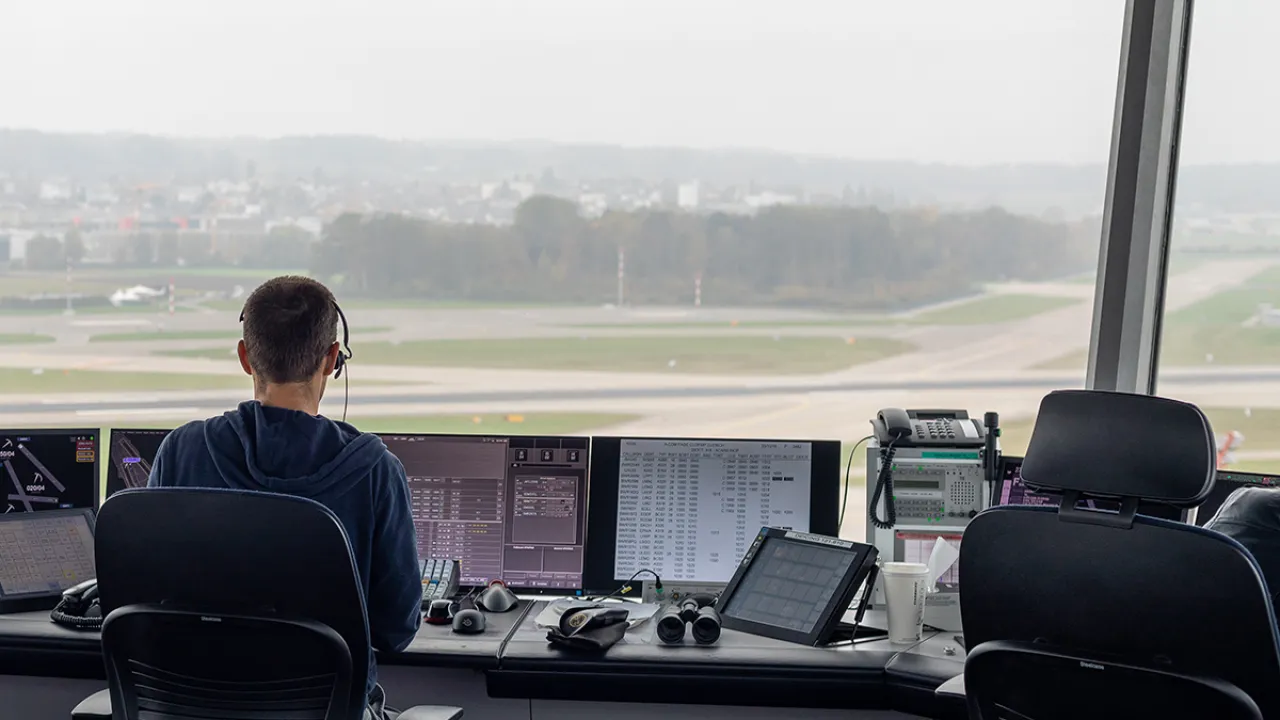
🏢 WorkplaceAirport control towers, darkened radar approach rooms, and regional air centers
⚡ Everyday Impact SparkTracks dozens of fast-moving airplanes in 3D mental maps so every flight stays miles apart
🤯 Mind-Blowing Fact • Grade 1
Every single day across the United States, air traffic controllers safely guide more than 45,000 flights carrying nearly three million travelers!
✨ Word Sparks (Grade 1 Glossary)
Tap 🔊 to hear
Control Tower
Tall glass airport building watching runways from above
Headset
Earphones with a microphone for clear radio talk
Taxiway
Airport road connecting gates to the main runway
🪝
Who sits in the tall glass tower at the airport and tells planes when to go?
1
High in the Glass Tower
Look way up at the tallest building at the airport! Big windows wrap all the way around the top. Inside, air traffic controllers watch every runway and .
2
Taking Turns in the Sky
Sky highways do not have painted lanes or red stoplights! Controllers talk to pilots on so airplanes take turns safely.
3
Safe Space Around Every Plane
Glowing radar screens show little dots for planes in the clouds. Controllers keep wide, safe space around every flight!
1. Why does an airport control tower have giant windows all the way around?
2. How do air traffic controllers talk to pilots high up in the sky?
🤯 Mind-Blowing Fact • Grade 2
Before airport radios were invented in the late 1920s, the very first 'airfield controller,' Archie League, stood beside dirt runways in St. Louis waving checkered flags under a beach umbrella!
✨ Word Sparks (Grade 2 Glossary)
Tap 🔊 to hear
Separation
Safe distance kept above, below, and between airplanes
Clearance
Official controller permission to taxi, take off, or land
Airspace
A mapped section of sky watched by controllers
🪝
How do airplanes fly through thick clouds at night without ever bumping into each other?
1
Invisible Highways in the Air
Close your eyes and picture twenty fast airplanes flying at different heights and speeds—all heading toward the very same busy airport! Air traffic controllers act like calm sky conductors, organizing invisible highways in three dimensions day and night.
2
Passing the Baton
Different controllers guide each part of an airplane trip. Ground controllers steer planes safely from passenger gates out to the runway. Tower controllers clear takeoffs and landings. Once a plane climbs into high clouds, radar controllers guide it across states!
3
Short, Clear Radio Words
Controllers speak calmly and clearly into headsets, giving pilots exact compass turns, speeds, and heights so every flight has miles of safe room.
1. What happens as a jetliner flies from one city all the way across the country?
2. What did pioneer controller Archie League use to direct airplanes before cockpit radios existed?
🤯 Mind-Blowing Fact • Grade 3
Look at the monumental control tower at Washington Dulles International Airport or Atlanta—some modern airport towers stand over 300 feet tall, as high as the Statue of Liberty!
✨ Word Sparks (Grade 3 Glossary)
Tap 🔊 to hear
Light Gun
Bright colored tower lamp signaling planes without radios
TRACON
Radar facility guiding planes approaching and departing airports
Sector
A 3D block of sky assigned to one controller
🪝
What happens if an airplane's radio ever stops working right before landing?
1
The Secret Light Gun
Hanging from the ceiling of every airport control tower is a bright spotlight-style tool called an aviation '.' If a small airplane's radio ever goes silent in flight, the tower controller aims a crisp beam of steady green light straight at the cockpit windshield—signaling 'Cleared to land!'
2
Three Kinds of Facilities
Surprise: most air traffic controllers do not actually sit in tall glass airport towers! Thousands work inside quiet, softly lit radar halls called (Terminal Radar Approach Controls) near major cities, or inside regional Route Centers that guide high-altitude jets across whole states.
3
Vertical and Horizontal Bubbles
High in cruising skies, controllers keep an invisible safety bubble around every plane—spacing jets at least 1,000 feet apart up-and-down or 5 miles apart side-to-side.
4
Calm Under Pressure
Whenever fast-moving summer thunderstorms roll across an airport, sharp-thinking controllers calmly reroute dozens of circling flights onto sunny alternate paths without missing a beat.
1. How can a tower controller signal 'Cleared to land' if a pilot's radio stops working?
2. At high cruising altitudes, how much vertical space do controllers keep between crossing jets?
🤯 Mind-Blowing Fact • Grade 4
Eastbound cruising planes fly at odd thousands of feet (like 33,000 or 35,000 feet), while westbound planes fly at even thousands (like 34,000 or 36,000 feet)—an ingenious rule keeping opposite traffic stacked safely apart!
✨ Word Sparks (Grade 4 Glossary)
Tap 🔊 to hear
Wake Turbulence
Swirling wingtip air trailing behind heavy flying jets
Transponder
Aircraft radio box sending identity and altitude to radar
Knot
Aviation speed unit equal to 1.15 miles per hour
🪝
Why must a small airplane wait extra space behind a giant jumbo jet—even after the jumbo jet has already passed?
1
Invisible Tornadoes Behind Heavy Wings
Watch a giant widebody jetliner climb out of Potomac TRACON's busy Virginia airspace near Reagan National and Washington Dulles airports. As those massive wings push tons of air downward to create lift, twin horizontal whirlwinds—called ''—spin off its wingtips and trail miles behind! Air traffic controllers carefully space smaller planes four to six miles farther back so that invisible swirling air settles harmlessly before the next plane arrives.
2
Data Tags on the Radar Scope
Every commercial aircraft carries a digital '' and satellite ADS-B transmitter. On a controller's glowing radar display, each flight appears alongside a neat data tag showing its airline callsign, exact altitude in hundreds of feet, and groundspeed in . Like playing fast three-dimensional chess in real time, approach controllers merge fast jetliners and slower propeller planes into one smooth, evenly spaced line toward the runway.
3
Coordinating National Skies in Virginia
Tucked in the foothills of Warrenton, Virginia, the Federal Aviation Administration runs its national Air Traffic Control System Command Center—where specialists monitor weather fronts and balance airline schedules across the entire United States twenty-four hours a day!
4
Training at the FAA Academy
New controllers train for months at the FAA Academy in Oklahoma City inside wraparound 360-degree tower simulators before qualifying step-by-step on live radar scopes.
1. Why do air traffic controllers add extra distance behind a 'Heavy' jumbo jet before clearing a smaller plane?
2. What national aviation hub operates in Warrenton, Virginia?
🤯 Mind-Blowing Fact • Grade 5
Over radio frequencies, air traffic controllers pronounce the number 9 as 'Niner,' 5 as 'Fife,' and 3 as 'Tree' so static can never confuse numbers with German 'Nein' or similar-sounding English words!
✨ Word Sparks (Grade 5 Glossary)
Tap 🔊 to hear
ADS-B
Satellite system broadcasting exact aircraft positions every second
Readback
Pilot repeating a controller's clearance aloud to confirm accuracy
ARTCC
Regional radar center guiding high-altitude flights between cities
🪝
How do air traffic controllers fuse satellite ADS-B surveillance, spatial math, and split-second cognitive focus to sequence thousands of flights safely?
1
Real-Time 4D Spatial Choreography
Step inside a busy Terminal Radar Approach Control (TRACON) hall or one of America's twenty-two Air Route Traffic Control Centers (), and you witness human spatial cognition operating at peak discipline. Certified controllers separate aircraft not only across three geometric dimensions—latitude, longitude, and barometric flight level—but also across the fourth dimension of time, funneling jets cruising between 250 and 500 knots onto parallel runways every sixty seconds.
2
From Rotating Radar to Satellite NextGen
For decades, air traffic surveillance relied primarily on rotating ground radar antennas whose radio echoes updated cockpit positions once every four to twelve seconds. Under the FAA's NextGen modernization, aircraft continuously broadcast Automatic Dependent Surveillance–Broadcast () satellite GPS coordinates once every single second—delivering pinpoint tracking even across radar-shadowed mountain valleys, offshore Atlantic corridors, and remote Alaskan tundra.
3
Standardized Phraseology and Readback Loops
To eliminate verbal ambiguity across international skies, controllers communicate in ultra-concise International Civil Aviation Organization (ICAO) English phraseology. Because 'five' and 'nine' sound dangerously alike through radio static, aviation pronounces 9 as 'Niner,' 5 as 'Fife,' and 3 as 'Tree.' Every safety-critical clearance—such as 'Hold short of Runway Two-Seven'—mandates an exact word-for-word '' from the flight crew, verified immediately by the controller's active 'hearback.'
4
Integrating Space Launches and Uncrewed Aircraft
Modern air traffic specialists also manage dynamic sky corridors for commercial orbital rocket launches and re-entries—including NASA and commercial spaceport missions lifting off from Wallops Island on Virginia's Eastern Shore—alongside high-altitude weather balloons and autonomous aircraft.
5
Selection, Rest Cycles, and Mastery
Candidates pass the rigorous Air Traffic Skills Biographical and Spatial exam, strict FAA medical clearances, and years of radar qualification—working carefully regulated shift schedules with mandatory recuperative breaks so mental focus stays razor-sharp.