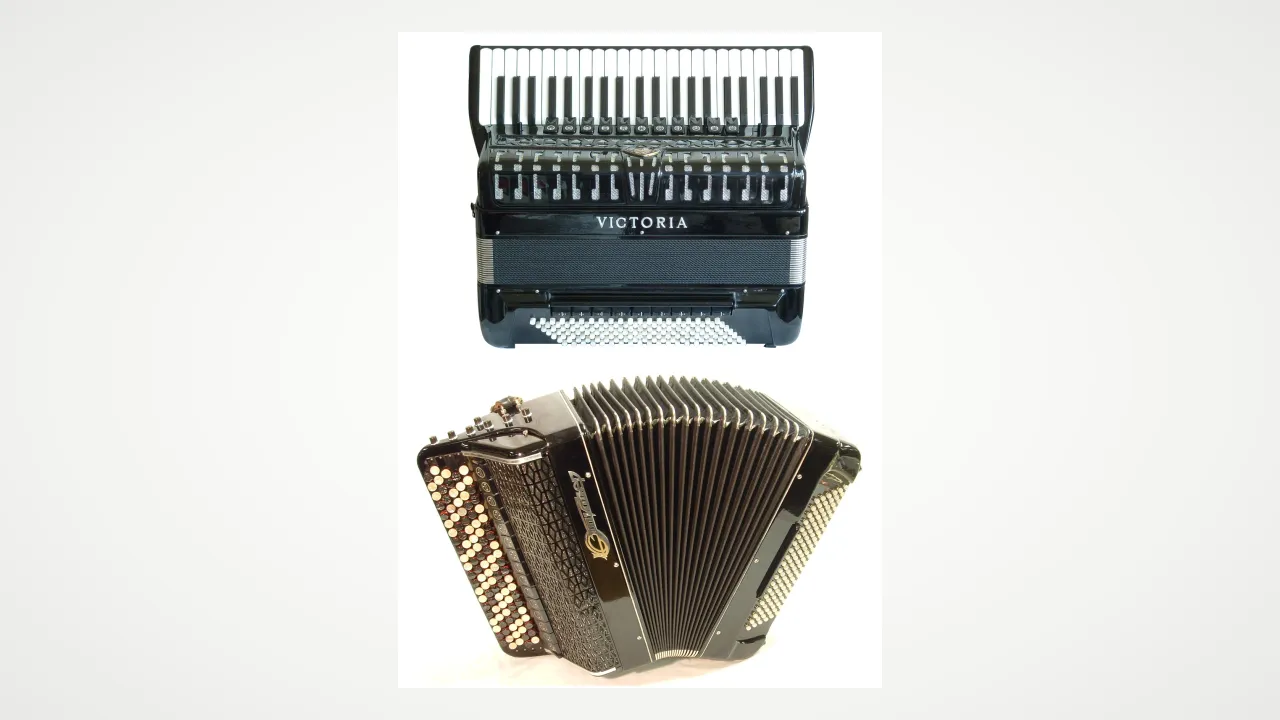
1. What pushes air through an accordion to make its reeds sing?
2. What does the player's left hand press on a classic piano accordion?
🤯 Mind-Blowing Fact • Grade 2
On the left-hand button board, the middle C button has a tiny bump or jewel dent so fingers can find home without ever peeking!
✨ Word Sparks (Grade 2 Glossary)
Tap 🔊 to hear
register
Switch choosing high or low reed sets
harmony
Pleasant blend of notes played together
portable
Easy to carry from place to place
🪝
How can one person walking down a cobblestone street sound like an entire dance band?
1
Built to Travel Anywhere
Pianos and church organs are far too heavy to carry to a picnic or boat deck. In 1829, an inventor in Vienna named Cyrillus Demian built a clever folding box that packed melody and onto two shoulder straps.
2
One Hundred Twenty Buttons!
Glance at the left side of a full-size accordion and you may spot six neat rows totaling one hundred twenty tiny buttons! Inside, slender metal rods link those buttons so a single finger tap plays a complete major or minor chord.
3
Changing Voices with Switches
Above the right-hand keys sit shiny switches called . Clicking them opens low, middle, or high reed sets to imitate a deep bassoon, a clear clarinet, or a shimmering Paris cafe!
1. How does a player's left hand find the C bass button without looking down over the bellows?
2. What do the register switches near the keyboard change?
🤯 Mind-Blowing Fact • Grade 3
Castelfidardo, a small hilltop town in Italy, became the accordion capital of the world after a local farm family repaired a traveler's broken squeezebox in 1863!
✨ Word Sparks (Grade 3 Glossary)
Tap 🔊 to hear
musette
Shimmering accordion sound from slightly detuned reeds
Stradella
Standard left-hand accordion bass and chord system
check valve
Leather flap stopping air leaking through idle reeds
🪝
Why does a French cafe accordion shimmer with a warm, wavy sparkle even when playing one steady note?
1
Inside the Reed Blocks
Unlatch the pins of a concert accordion and you will find rows of fragrant wooden blocks lined with hundreds of tempered steel free reeds. Every single note actually needs two reeds mounted head-to-toe—one for pulling the bellows open and a twin for pushing it shut—guarded by soft leather .
2
Secret of the Musette Shimmer
Have you ever heard an accordion play a dreamy Parisian waltz that sparkles like ripples on water? Makers create that famous tone by tuning two middle-octave reeds to almost—but not quite—the exact same pitch! When both sound together, their sound waves gently bump to create a warm, pulsing wave.
3
Stradella's Mechanical Computer
Named after an Italian town famous for craftsmanship, the bass machine arranges left-hand buttons in musical fifths so neighboring keys lie right beside each other.
4
Global Passport
From Mexican norteno polkas, Brazilian forro, and Louisiana zydeco to Colombian vallenato and Eastern European klezmer, communities across every continent made the lively accordion their signature dance voice.
1. Why does every single pitch in a piano accordion need at least two steel reeds?
2. How do makers create the wavy, sparkling 'musette' voice heard in French cafe music?
🤯 Mind-Blowing Fact • Grade 4
A grand concert accordion can house more than four hundred individual steel reeds plus thousands of interlocking levers, springs, and leather valves!
✨ Word Sparks (Grade 4 Glossary)
Tap 🔊 to hear
unisonoric
Playing identical pitch on push and pull
bisonoric
Playing two different pitches on push and pull
free bass
Converter mode turning chord buttons into single notes
🪝
How does a labyrinth of aluminum pallets, beeswaxed reed blocks, and steel rods pack an entire wind orchestra into twelve kilograms?
1
Anatomy of the Squeezebox
When a virtuoso snaps the bellows sharply at the start of a folk dance, pressurized air surges from a linen-and-cardboard chamber reinforced with goatskin gussets into precision-milled poplar reed blocks. Traditional luthiers hand-seal hundreds of Swedish-steel reed plates onto wooden chambers using a warm blend of beeswax and pine rosin so zero air escapes around the edges.
2
Unisonoric vs. Bisonoric Cousins
Concert piano accordions and chromatic button accordions are —meaning each key sounds the exact same pitch whether expanding or compressing the bellows. By contrast, lightweight folk button accordions favored in Cajun, Tex-Mex conjunto, and Irish music are often , packing two different notes onto every button just like a harmonica for snappy rhythmic bounce.
3
Acoustic Beating and Pipe-Organ Voicing
Borrowing pipe-organ terminology, accordion builders label reed ranks by equivalent organ pipe lengths: sixteen-foot low bassoon reeds, eight-foot middle clarinet reeds, and four-foot high piccolos. Combining an eight-foot reed at 440 hertz with a twin tuned to 443 hertz yields three gentle volume pulses per second, creating lush warmth that carries across noisy village squares!
4
Free-Bass Classical Evolution
Modern symphony soloists flip a mechanical converter switch that unlocks ',' turning pre-set left-hand chord buttons into four octaves of individual chromatic bass notes—capable of performing Johann Sebastian Bach's intricate organ fugues and modern concertos completely intact.
1. What happens acoustically when a 440-hertz reed and a 443-hertz reed vibrate side by side?
2. Why did concert soloists add a 'free-bass' converter switch to the left-hand side?
🤯 Mind-Blowing Fact • Grade 5
Instead of building 360 separate reeds for 120 left-hand buttons, the Stradella mechanical matrix ingeniously shares just 12 pitch classes of reeds wired through notched steel axles!
✨ Word Sparks (Grade 5 Glossary)
Tap 🔊 to hear
cassotto
Internal tone chamber warming harsh accordion overtones
circle of fifths
Musical pattern organizing keys five steps apart
counterpoint
Weaving independent melodies together in musical harmony
🪝
How did nineteenth-century European mechanics merge pipe-organ registration, circle-of-fifths combinatorics, and free-reed aeroacoustics into a wearable instrument?
1
Pneumatic Coupling and Dynamic Expression
Unlike a traditional church organ whose windchest stays at rigid mechanical pressure, the accordion (Hornbostel-Sachs 412.132) wires its wind supply directly to the musician's left forearm. Every nuance of bellows velocity immediately governs sound pressure level and harmonic richness: gentle draw strokes yield whispered flute-like fundamentals, whereas explosive bellows shakes and ricochets unleash brassy upper partials across high-carbon steel reeds.
2
Cassotto Tone Chambers and Reed Ranks
In flagship concert instruments crafted in Castelfidardo and Klingenthal, up to four or five treble reed ranks—spanning 16-foot bassoon, multiple 8-foot clarinet, and 4-foot piccolo octaves—sit governed by sliding aluminum register shutters and chin switches. To tame shrill upper frequencies above 3,000 hertz, master Italian builders route select ranks through a ninety-degree recessed acoustic cavity called a (tone chamber), imparting a dark, woody, clarinet-like warmth.
3
Combinatorial Genius of the Stradella Matrix
Engineered around 1880 in northern Italy, the 120-button Stradella bass mechanism functions as an analog mechanical computer. Twenty diagonal columns step chromatically around the (from D-flat through C to F-sharp), while six horizontal rows couple precision steel pistons so depressing any chord button lifts exactly three out of twelve shared octave-reed pallets—forming major, minor, dominant-seventh, or diminished triads without duplicating hundreds of heavy bass reeds.
4
Bayan and Converter Innovations
Eastern European and Russian virtuosos refined the chromatic button bayan—whose five-row isomorphic treble grid packs over five octaves under one hand span and mounts large multi-reed plates rather than single pairs—while pioneering converter mechanisms that switch instantaneously between Stradella accompaniment and single-note Bassetti free bass spanning E1 (41.2 hertz) to C6 (1,046.5 hertz).
5
Vernacular Soul to Avant-Garde Stage
From Cyrillus Demian's 1829 Viennese patent to Colombian vallenato kings, Mexican norteño ensembles, Louisiana Creole zydeco pioneers like Clifton Chenier, and Sofia Gubaidulina's searing twentieth-century orchestral scores, few instruments bridge folk dancefloors and modernist concert halls with equal authority.