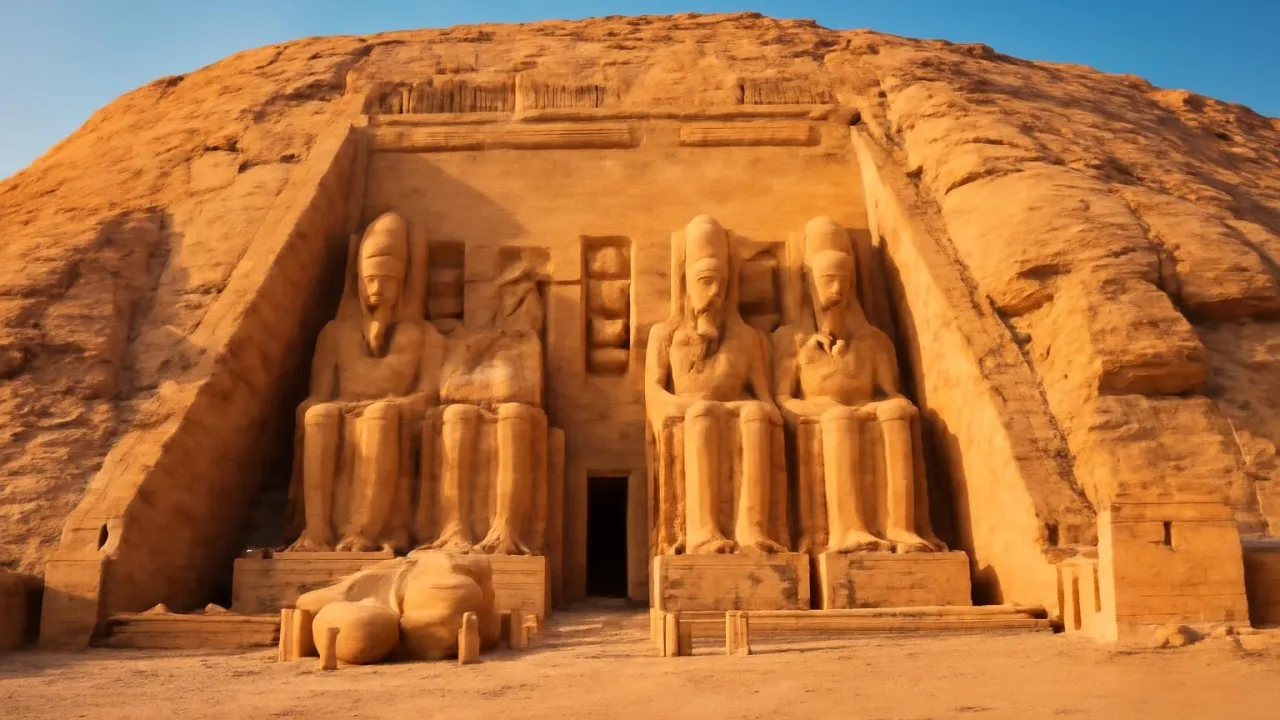
Sunlight lights up the temple’s inner statues only twice each year!
✨ Word Sparks (Grade 2 Glossary)
Tap 🔊 to hear
pharaoh
An ancient king of Egypt
carved
Cut or shaped from stone
hallway
A long path inside a building
🪝
Can you imagine sunlight lighting up a secret statue?
1
Giant Statues in the Sand
Four tall statues sit outside the temple, watching over the desert. Each statue shows a with a calm face. People come from all over to see these giant stone kings. The statues are right into the rock.
2
A Magical Sun Show
Twice a year, sunlight shines deep inside the temple. The light travels through a long and touches three special statues. This amazing event happens only on two days every year. Visitors wait to see the golden glow.
3
Saved by Teamwork
Long ago, a new lake almost covered the temple with water. People from many countries worked together to move the whole temple. They took it apart and rebuilt it higher up. Now, Abu Simbel is safe for everyone to visit.
1. What does the sunlight touch inside the temple?
2. Why did people move the temple?
🤯 Mind-Blowing Fact • Grade 3
Each statue at Abu Simbel is as tall as a six-story building!
✨ Word Sparks (Grade 3 Glossary)
Tap 🔊 to hear
colossal
Very, very big or huge
solar alignment
When sunlight lines up just right
sanctuary
A quiet, special room inside
🪝
What happens when ancient sunlight travels through a temple’s secret passage?
1
The Watchful Pharaohs
Four statues of Pharaoh Ramses II guard the temple’s entrance. Each statue is over 60 feet tall and carved directly into the mountain. Their faces gaze across the desert, watching the sunrise each morning. Visitors feel tiny standing beneath these ancient stone kings.
2
A Sunbeam’s Journey
Twice a year, a beam of sunlight travels down the temple’s long corridor. This light reaches the and illuminates statues of Ramses II and Egyptian gods. The careful alignment shows ancient Egyptians understood solar movement and geometry. This event is called a .
3
Rescue and Reconstruction
In the 1960s, the rising waters of Lake Nasser threatened to flood Abu Simbel. Engineers cut the temple into large blocks and moved it to higher ground. This monumental project took years and involved experts from many countries. The temple was reassembled with its preserved.
4
A Monument for the World
Abu Simbel is a UNESCO World Heritage Site, visited by people from everywhere. The temple’s art and architecture show the skill of ancient builders. Its rescue is a symbol of international teamwork and engineering. Today, Abu Simbel inspires curiosity about Egypt’s history and achievements.
The Abu Simbel rescue used more than 3,000 workers and took four years to complete!
✨ Word Sparks (Grade 4 Glossary)
Tap 🔊 to hear
sandstone
A kind of soft, yellowish rock
archaeologist
A scientist who studies old places
phenomenon
A special event or happening
🪝
Can you picture sunlight traveling 200 feet to awaken ancient statues?
1
Guardians of the Desert
The Abu Simbel Temples feature four enormous statues of Pharaoh Ramses II carved into a cliff. Each statue stands about 66 feet tall, their faces gazing east to greet the rising sun. These colossal figures were designed to display the pharaoh’s power and protect the temple’s entrance. The site’s remote location in Nubia helped preserve its grandeur for thousands of years.
2
The Solar Miracle
Twice every year, the sun’s rays travel through the temple’s 200-foot-long corridor. On these special mornings, sunlight illuminates the sanctuary’s statues of Ramses II, Ra-Horakhty, and Amun. Only the statue of Ptah, the god of darkness, remains in shadow. This precise solar alignment demonstrates ancient Egyptians’ advanced understanding of astronomy and engineering.
3
A Race Against the Water
In the 1960s, the creation of Lake Nasser threatened to submerge Abu Simbel forever. An international team of engineers and cut the temples into over 1,000 blocks, each weighing up to 30 tons. They carefully reassembled the entire complex 213 feet higher and 656 feet farther back from the river. The rescue preserved both the temple’s structure and its solar .
4
Global Legacy and Inspiration
Today, Abu Simbel stands as a UNESCO World Heritage Site, drawing visitors and scholars from around the globe. Its preservation is considered one of the greatest feats of modern archaeological engineering. The temples inspire wonder about ancient Egypt’s achievements in art, science, and architecture. Abu Simbel’s story encourages global cooperation to protect world treasures for future generations.
1. Which god’s statue stays in shadow during the solar event?
2. What made the Abu Simbel rescue so challenging?
🤯 Mind-Blowing Fact • Grade 5
During the rescue, engineers used computer models—the first time ever for a heritage monument!
✨ Word Sparks (Grade 5 Glossary)
Tap 🔊 to hear
resonance
When sound or light echoes in a space
orientation
The exact direction something faces
conservation
Protecting and saving important things
🪝
What secrets did ancient engineers use to make sunlight travel 200 feet into solid rock?
1
Colossal Guardians of Nubia
Approaching Abu Simbel at sunrise, you’re greeted by four colossal statues of Pharaoh Ramses II, each towering 66 feet (20 meters) high and carved directly from the Nubian sandstone cliff. These monumental sculptures, completed around 1244 BCE, were designed to awe visitors and demonstrate Ramses II’s authority over Egypt and Nubia. The façade’s symmetry and precise carving reflect advanced ancient engineering skills. The statues’ serene faces and detailed crowns reveal the artistry and symbolism of New Kingdom Egypt. Over millennia, wind and sand have weathered the statues, yet their grandeur remains undiminished.
2
The Solar Alignment Phenomenon
Twice a year, on or near February 22 and October 22, sunlight penetrates the temple’s 200-foot (60-meter) axis and illuminates the sanctuary’s statues. This solar alignment was engineered so that the rays would light up Ramses II, Ra-Horakhty, and Amun, while Ptah, associated with darkness, remains in perpetual shadow. Achieving this required precise of the temple’s entrance and careful calculation of the sun’s annual movement. The phenomenon demonstrates the ancient Egyptians’ sophisticated understanding of astronomy, geometry, and architectural . Today, thousands gather to witness this rare event, marveling at the interplay of science and spirituality.
3
Engineering the Great Rescue
In the 1960s, the construction of the Aswan High Dam threatened to submerge Abu Simbel beneath Lake Nasser’s rising waters. An international coalition led by UNESCO launched a historic rescue operation, cutting the temples into over 1,000 blocks weighing up to 30 tons each. Engineers used precise mapping, numbering, and three-dimensional models to ensure accurate reassembly. The entire complex was reconstructed 213 feet (65 meters) higher and 656 feet (200 meters) farther from the river, preserving its original and solar alignment. This monumental feat is celebrated as one of the greatest achievements in archaeological and civil engineering history.
4
Cultural and Scientific Legacy
Abu Simbel’s preservation is a symbol of global cooperation and the power of shared heritage. The temples are a UNESCO World Heritage Site, attracting researchers, historians, and tourists from around the world. Their art and inscriptions offer insights into Egyptian religion, politics, and daily life during the New Kingdom. The rescue operation advanced the fields of archaeology, , and engineering, setting new standards for protecting cultural monuments. Abu Simbel’s story continues to inspire international efforts to safeguard humanity’s most precious sites.
5
Abu Simbel’s Enduring Mystique
From its colossal statues to its precisely aligned sanctuary, Abu Simbel stands as a testament to ancient ingenuity and modern teamwork. The temples’ solar phenomenon remains a subject of scientific study, revealing the Egyptians’ mastery of solar geometry and architectural acoustics. Each year, the site hosts festivals, lectures, and research expeditions, deepening our understanding of ancient science and art. Abu Simbel’s journey—from its original construction to its dramatic relocation—demonstrates how engineering, astronomy, and international collaboration can preserve wonders for future generations. Its legacy encourages us to explore, protect, and celebrate the achievements of civilizations past and present.