Introduction
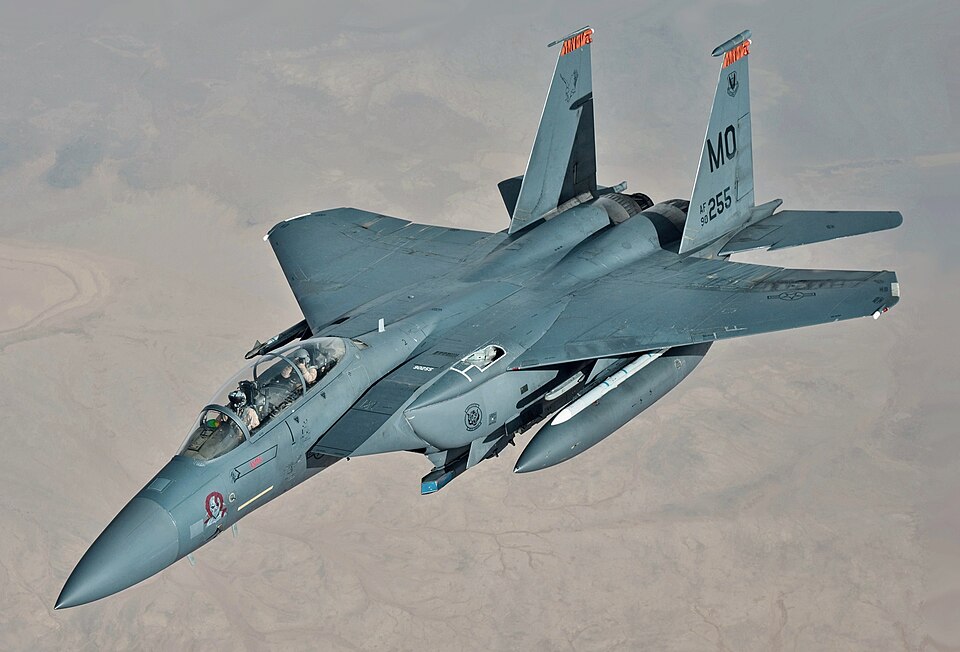
The McDonnell Douglas / Boeing F-15E Strike Eagle and its modern digital successor, the F-15EX Eagle II, are twin-engine, two-seat, all-weather supersonic fighters engineered for unmatched speed, range, and payload capacity.
A foundational concept in this investigation is (pronounced thrust too wayt RAY-shee-oh), which refers to: A comparison of engine push (thrust) to aircraft weight; when greater than 1, an aircraft can accelerate straight up vertically. Every part of F-15E Strike Eagle & F-15EX Eagle II: Mach 2.5 Twin-Engine Guardians within ✈️ U.S. Air Force Fighter Planes & Iconic Aircraft Showcase builds upon this essential concept.
In Grade 3 United States Armed Forces studies (✈️ U.S. Air Force Fighter Planes & Iconic Aircraft Showcase), understanding how , , and work together helps explain real-world patterns. As you read each chapter, notice how these key terms connect structure, process, and environment.
Key Features
Measuring 63.8 feet long with a 42.8-foot (13.05-meter) wingspan and twin vertical tails, the F-15E/EX seats a Pilot in the forward cockpit and a Weapon Systems Officer (WSO) in the aft cockpit managing multi-mode and infrared navigation pods.
To analyze these defining traits accurately, specialists examine (tuh-RAYN FOL-oh-ing RAY-dar): Radar that scans hills and valleys ahead so an aircraft can fly safely at low altitude through clouds, fog, or night. Alongside (A comparison of engine push (thrust) to aircraft weight; when greater than 1, an aircraft can accelerate straight up vertically.), these specialized characteristics set F-15E Strike Eagle & F-15EX Eagle II: Mach 2.5 Twin-Engine Guardians apart within ✈️ U.S. Air Force Fighter Planes & Iconic Aircraft Showcase.
Field Observation & Evidence: Researchers studying F-15E Strike Eagle & F-15EX Eagle II: Mach 2.5 Twin-Engine Guardians observe how physical form matches function in United States Armed Forces. Each observable feature provides a clear advantage that supports stability, survival, or performance across changing conditions.
How It Works
Driven by two Pratt & Whitney F100 or General Electric F110 afterburning turbofans generating up to 58,000 pounds of combined thrust, the Eagle boasts a greater than 1-to-1—allowing it to accelerate while climbing straight up vertically and reach a top speed of Mach 2.5 (1,875 mph) with a 60,000-foot ceiling!
This step-by-step process relies on (pronounced fly by wy-er), defined as: A digital flight control system where computers translate the pilot's control stick movements into electronic signals for the wing flaps and rudders. Each stage of the process prepares the way for the next phase to unfold.
Cause-and-Effect Balance: When conditions remain balanced, and interact inside the to keep the system running smoothly. If any single link in this sequence is disrupted, the entire pace of activity shifts.
In Our World
In 1975, a specially prepared F-15 "Streak Eagle" broke eight world time-to-climb records, rocketing from the runway to 98,425 feet (nearly 19 miles high!) in just 3 minutes and 27 seconds. Today's F-15EX Eagle II adds digital controls and the ADCP-II processor executing 87 billion instructions per second.
Understanding how F-15E Strike Eagle & F-15EX Eagle II: Mach 2.5 Twin-Engine Guardians functions in real environments also involves (tuh-RAYN FOL-oh-ing RAY-dar): Radar that scans hills and valleys ahead so an aircraft can fly safely at low altitude through clouds, fog, or night. Even when surrounding conditions shift across seasons or regions, the interaction between , Terrain-Following Radar, and helps sustain balance and resilience in the wider environment.
Global & Practical Significance: F-15E Strike Eagle & F-15EX Eagle II (Twin-Engine All-Weather Fighters) operates as Boeing F-15E Strike Eagle & F-15EX Eagle II All-Weather Fighters supporting High-Speed Mach 2.5 All-Weather Patrol, Long-Range Escort & Heavy Payload. Furthermore, Key technical specification: Top Speed: Mach 2.5 (1,875 mph) • Wingspan: 42.8 ft • Twin-Seat Crew & Digital .
Amazing Facts
1. Remarkable Scale & Numbers: Because its two engines produce more pounds of thrust than the jet weighs, an F-15 can point its nose 90 degrees straight up and accelerate faster and faster as it climbs! This discovery highlights why is central to understanding F-15E Strike Eagle & F-15EX Eagle II: Mach 2.5 Twin-Engine Guardians.
2. Extraordinary Adaptation & Design: The "Streak Eagle" climbed to nearly 100,000 feet faster than the Apollo Saturn V Moon rocket did during its first 19 miles of launch! Specialized conditions involving make these adaptations possible.
3. Surprising Scientific & Historical Record: The new F-15EX Eagle II's onboard computer ("Advanced Display Core Processor II") processes 87 billion instructions every second! Over time, processes linked to leave a lasting mark across ✈️ U.S. Air Force Fighter Planes & Iconic Aircraft Showcase.
Read & Review
Chapter Synthesis: Throughout this investigation of F-15E Strike Eagle & F-15EX Eagle II: Mach 2.5 Twin-Engine Guardians in United States Armed Forces (✈️ U.S. Air Force Fighter Planes & Iconic Aircraft Showcase), we examined its core foundations, defining traits, step-by-step mechanisms, and real-world connections using key terms like , , and .
Academic Vocabulary Review: • (thrust too wayt RAY-shee-oh): A comparison of engine push (thrust) to aircraft weight; when greater than 1, an aircraft can accelerate straight up vertically. • (tuh-RAYN FOL-oh-ing RAY-dar): Radar that scans hills and valleys ahead so an aircraft can fly safely at low altitude through clouds, fog, or night. • (fly by wy-er): A digital flight control system where computers translate the pilot's control stick movements into electronic signals for the wing flaps and rudders.
Critical Thinking Check: (1) What is the primary classification and role of F-15E Strike Eagle & F-15EX Eagle II (Twin-Engine All-Weather Fighters)? — Boeing F-15E Strike Eagle & F-15EX Eagle II All-Weather Fighters — High-Speed Mach 2.5 All-Weather Patrol, Long-Range Escort & Heavy Payload. (2) Which key engineering or performance specification defines F-15E Strike Eagle & F-15EX Eagle II (Twin-Engine All-Weather Fighters)? — Top Speed: Mach 2.5 (1,875 mph) • Wingspan: 42.8 ft • Twin-Seat Crew & Digital .