Introduction
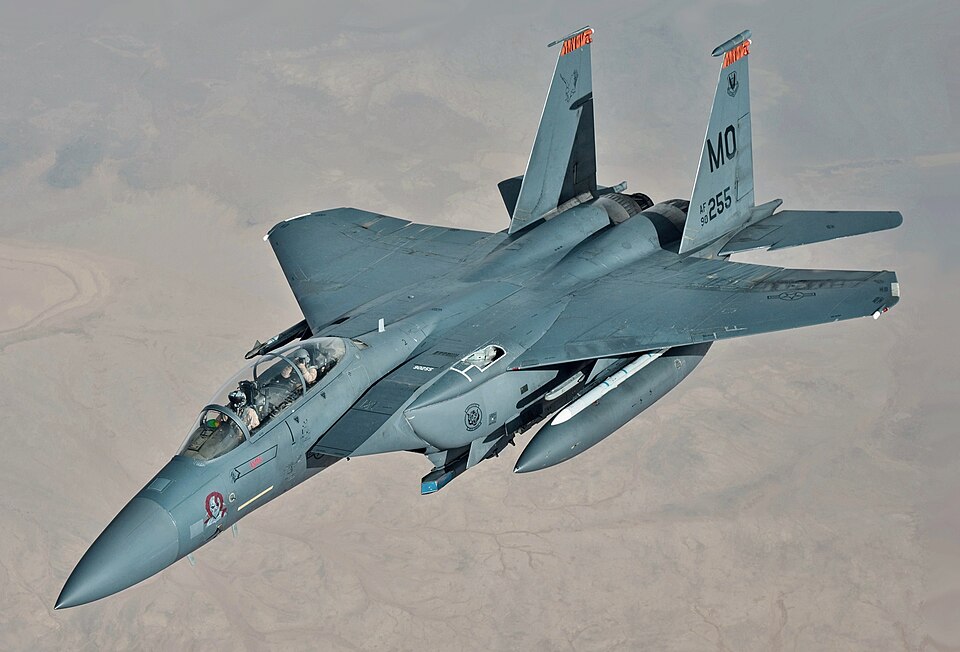
The F-15E Strike Eagle and the newest F-15EX Eagle II are the fastest fighter jets in the U.S. Air Force—capable of reaching Mach 2.5 (nearly 1,900 miles per hour)!
An important word to know in this book is (thrust too wayt RAY-shee-oh). Thrust-to-Weight Ratio means: A comparison of engine push (thrust) to aircraft weight; when greater than 1, an aircraft can accelerate straight up vertically. Learning about Thrust-to-Weight Ratio helps us understand how F-15E Strike Eagle & F-15EX Eagle II: Mach 2.5 Twin-Engine Guardians fits into ✈️ U.S. Air Force Fighter Planes & Iconic Aircraft Showcase.
Key Features
With a 42.8-foot wingspan, two giant engines, and a two-person cockpit (a Pilot in front and a Weapon Systems Officer in back), the Strike Eagle can fly in any weather, day or night.
Scientists and explorers also look closely at (tuh-RAYN FOL-oh-ing RAY-dar), which means: Radar that scans hills and valleys ahead so an aircraft can fly safely at low altitude through clouds, fog, or night. These special traits make F-15E Strike Eagle & F-15EX Eagle II: Mach 2.5 Twin-Engine Guardians easy to spot and study.
How It Works
Its twin engines are so powerful that their thrust is greater than the weight of the airplane—meaning the F-15 can point its nose straight up like a rocket and accelerate vertically into the sky!
Here is another helpful term: (fly by wy-er). It means: A digital flight control system where computers translate the pilot's control stick movements into electronic signals for the wing flaps and rudders. Step by step, and Fly-By-Wire work together.
In Our World
The brand-new F-15EX Eagle II features the world's fastest mission computer—capable of processing 87 billion instructions per second!
Understanding how F-15E Strike Eagle & F-15EX Eagle II: Mach 2.5 Twin-Engine Guardians works in our world also involves (tuh-RAYN FOL-oh-ing RAY-dar): Radar that scans hills and valleys ahead so an aircraft can fly safely at low altitude through clouds, fog, or night. Even when surrounding conditions shift across seasons or regions, the interaction between , Terrain-Following Radar, and helps sustain balance and resilience in the wider environment.
Amazing Facts
Amazing Fact #1: Because its two engines produce more pounds of thrust than the jet weighs, an F-15 can point its nose 90 degrees straight up and accelerate faster and faster as it climbs!
Amazing Fact #2: The "Streak Eagle" climbed to nearly 100,000 feet faster than the Apollo Saturn V Moon rocket did during its first 19 miles of launch!
Amazing Fact #3: The new F-15EX Eagle II's onboard computer ("Advanced Display Core Processor II") processes 87 billion instructions every second!
Read & Review
Let's review what we discovered about F-15E Strike Eagle & F-15EX Eagle II: Mach 2.5 Twin-Engine Guardians! In this book, we explored how , , and connect to ✈️ U.S. Air Force Fighter Planes & Iconic Aircraft Showcase.
Key Question #1: What is the primary classification and role of F-15E Strike Eagle & F-15EX Eagle II (Twin-Engine All-Weather Fighters)? Answer: Boeing F-15E Strike Eagle & F-15EX Eagle II All-Weather Fighters — High-Speed Mach 2.5 All-Weather Patrol, Long-Range Escort & Heavy Payload. F-15E Strike Eagle & F-15EX Eagle II (Twin-Engine All-Weather Fighters) operates as Boeing F-15E Strike Eagle & F-15EX Eagle II All-Weather Fighters supporting High-Speed Mach 2.5 All-Weather Patrol, Long-Range Escort & Heavy Payload.
Key Question #2: Which key engineering or performance specification defines F-15E Strike Eagle & F-15EX Eagle II (Twin-Engine All-Weather Fighters)? Answer: Top Speed: Mach 2.5 (1,875 mph) • Wingspan: 42.8 ft • Twin-Seat Crew & Digital . Key technical specification: Top Speed: Mach 2.5 (1,875 mph) • Wingspan: 42.8 ft • Twin-Seat Crew & Digital Fly-By-Wire.