Introduction
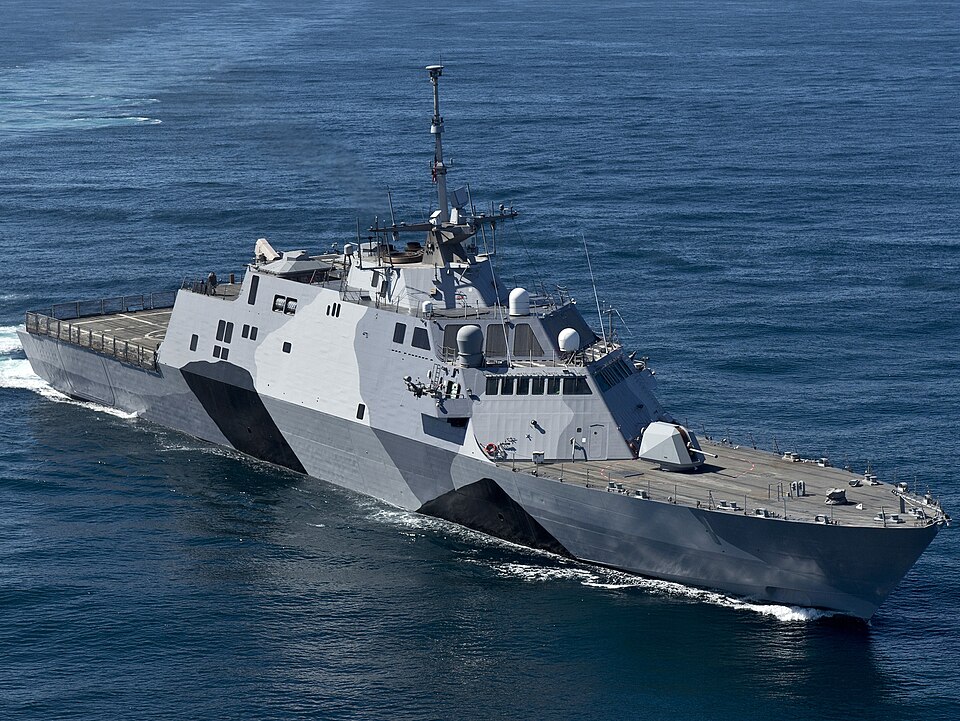
Littoral Combat Ships (LCS) are the sports cars of the U.S. Navy! "Littoral" means shallow coastal water near the shore, and these ships can race across the waves at over 40 knots (46 mph)!
An important word to know in this book is (LIT-er-ul zohn). Littoral Zone means: The shallow coastal ocean waters near the shoreline, harbors, and island straits. Learning about Littoral Zone helps us understand how Littoral Combat Ships (LCS): Freedom Monohull & Independence fits into 🚢 U.S. Navy Surface Fleet, Submarines ("The Silent Service") & Hospital Ships.
Key Features
The Navy built two cool shapes: the Freedom-class has a sleek single steel hull, while the Independence-class is an aluminum "" with three hulls side-by-side and a giant helicopter deck!
Scientists and explorers also look closely at (TRY-muh-ran), which means: A multi-hulled boat or ship consisting of a main center hull and two smaller outrigger hulls ("ama") on either side for stability. These special traits make Littoral Combat Ships (LCS): Freedom Monohull & Independence Trimaran easy to spot and study.
How It Works
Instead of regular propellers sticking down below the hull, Littoral Combat Ships use four giant steerable waterjets—like a giant jet ski!—so they can sail in water only 15 feet deep.
Here is another helpful term: (WAW-ter-jet proh-PUL-shun). It means: A marine propulsion system that draws water in from beneath the hull and blasts it out through steerable nozzles at high speed. Step by step, and Waterjet Propulsion work together.
In Our World
Because of their modular mission bays, LCS crews can load unmanned underwater robots to find sea mines or deliver fast emergency supplies to shallow island harbors.
Understanding how Littoral Combat Ships (LCS): Freedom Monohull & Independence works in our world also involves Trimaran (TRY-muh-ran): A multi-hulled boat or ship consisting of a main center hull and two smaller outrigger hulls ("ama") on either side for stability. Even when surrounding conditions shift across seasons or regions, the interaction between , Trimaran, and helps sustain balance and resilience in the wider environment.
Amazing Facts
Amazing Fact #1: The four waterjets on a Littoral Combat Ship pump enough water every minute to fill an entire Olympic-sized swimming pool!
Amazing Fact #2: Because waterjets sit flush with the hull instead of hanging underneath like propellers, an LCS can safely enter shallow 15-foot island harbors that deeper warships cannot reach.
Amazing Fact #3: The word "littoral" comes from the Latin word "litus," meaning the seashore or coast!
Read & Review
Let's review what we discovered about Littoral Combat Ships (LCS): Freedom Monohull & Independence ! In this book, we explored how , Trimaran, and connect to 🚢 U.S. Navy Surface Fleet, Submarines ("The Silent Service") & Hospital Ships.
Key Question #1: What is the primary classification and role of Littoral Combat Ships (LCS): Freedom-Class & Independence-Class? Answer: Freedom-Class (Monohull) & Independence-Class () LCS — High-Speed Shallow-Water Patrol, Mine Countermeasures & Coastal Agile Operations. Littoral Combat Ships (LCS): Freedom-Class & Independence-Class operates as Freedom-Class (Monohull) & Independence-Class (Trimaran) LCS supporting High-Speed Shallow-Water Patrol, Mine Countermeasures & Coastal Agile Operations.
Key Question #2: Which key engineering or performance specification defines Littoral Combat Ships (LCS): Freedom-Class & Independence-Class? Answer: 40+ Knots High Speed • • Monohull & Designs. Key technical specification: 40+ Knots High Speed • Waterjet Propulsion • Monohull & Trimaran Designs.