How do you brush a hippo's giant teeth or weigh a tiger without anyone getting hurt?
1
Every Meal Custom-Weighed
Step inside a zoo's giant kitchen, where stainless-steel counters sparkle! Flamingos need shrimp-rich pellets to keep their feathers pink, koalas eat only fresh eucalyptus leaves, and penguins catch whole fish one by one so keepers can count every bite.
2
Clicker Training With Rewards
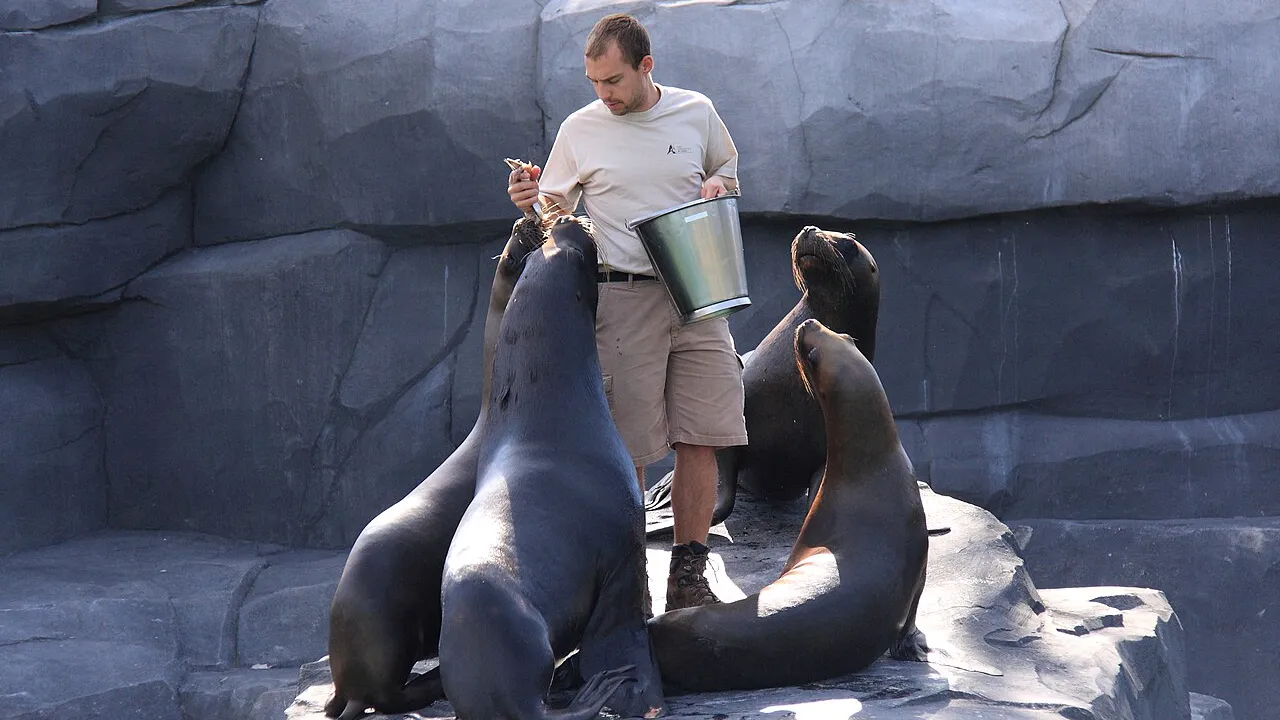
How does a vet check an elephant's foot or look inside a hippo's mouth? Keepers use positive reinforcement! Touching a soft target stick with a nose earns a gentle click sound and a tasty melon treat—teaching animals to step onto scales voluntarily.
3
Teachers for Conservation
Out on shaded pathways, keepers share stories about their animals' wild cousins and show visitors how everyday choices protect rainforests and oceans.
1. How do keepers encourage a hippo to open its mouth wide for a tooth check?
2. Why do keepers often hand-feed penguins one fish at a time?
🤯 Mind-Blowing Fact • Grade 3
Giant octopuses in aquariums and zoos are so smart that keepers give them twist-top jars with snacks inside—and the octopuses unscrew the lids in minutes!
✨ Word Sparks (Grade 3 Glossary)
Tap 🔊 to hear
husbandry
scientific daily care and feeding of animals
biome
large natural climate zone like rainforest
foraging
searching around actively to find food
🪝
Why do modern zoos look like lush savannas and misty rainforests instead of old concrete cages?
1
Designing Living Biomes
Fifty years ago, many city zoos kept animals in plain tiled rooms. Today's accredited zoos recreate rich natural habitats! Keepers team up with horticulturists and engineers to maintain heated basking rocks for Komodo dragons, chilled salt pools for gentoo penguins, and tall climbing vines for orangutans.
2
Five Kinds of Daily Enrichment
Wild animals spend hours exploring, sniffing, and solving problems—so keepers invent fresh daily enrichment! One afternoon brings frozen fruit ice blocks in summer heat; the next brings cinnamon scents on logs, woven bamboo feeders, or new climbing perches.
3
Daily Logs and Sharp Observation
Because wild prey animals naturally hide weakness, keepers become master observers. Every afternoon they log behavior notes, stool health, social interactions, and weights in computerized animal-care records.
4
Ark for Rare Species
Many zoo caretakers specialize in breeding critically endangered frogs, red pandas, and Arabian oryx—helping rebuild populations that nearly disappeared in the wild!
1. Why must keepers watch wild herd animals extra closely for tiny behavior changes?
2. Which of these is an example of sensory or food enrichment for zoo animals?
🤯 Mind-Blowing Fact • Grade 4
Scimitar-horned oryx antelope once went completely extinct in the wild—until zoo breeding centers, including Smithsonian's campus in Front Royal, Virginia, raised healthy herds that now roam free in Chad again!
✨ Word Sparks (Grade 4 Glossary)
Tap 🔊 to hear
herpetology
branch of zoology studying reptiles and amphibians
accredited
officially certified for meeting high welfare standards
anesthesia
medicine putting patients safely to sleep
🪝
How did zoo professionals in Virginia's Blue Ridge foothills help save clouded leopards, red pandas, and black-footed ferrets for the whole world?
1
Science Behind Modern Animal Care
Most professional keepers today earn university degrees in zoology, biology, or animal science before specializing in mammals, birds, (reptiles and amphibians), or aquatics. Rather than cuddling wild animals like pets, keepers respect wild instincts—working safely through protected barriers with big cats, bears, and elephants while building deep trust through calm routines.
2
Operant Conditioning Saves Stress
Fifty years ago, drawing blood from a gorilla or taking an ultrasound of an expectant rhino required darts, which carried health risks. Today keepers use operant conditioning: bridging desired behaviors with a whistle or clicker so a silverback gorilla calmly rests his arm in a sleeve for a voluntary blood draw or stethoscope listen while munching leafy browse!
3
Species Survival Plans and Front Royal
Zoos by the Association of Zoos and Aquariums (AZA) cooperate through Species Survival Plans—computerized family trees that match genetically unrelated mates across North America. Nestled in Front Royal, Virginia, the Smithsonian Conservation Biology Institute serves as a world-famous breeding and research campus where keepers have raised black-footed ferrets, Przewalski's wild horses, and scimitar-horned oryx returned to African grasslands!
4
Inspiring Millions of Conservation Allies
More than 180 million visitors walk through zoos and aquariums yearly, turning keeper talks into powerful sparks for global habitat protection.
1. How does operant conditioning (clicker training) improve veterinary care for large zoo animals?
2. What major conservation milestone sits in Front Royal, Virginia?
🤯 Mind-Blowing Fact • Grade 5
Female giant pandas are fertile for only twenty-four to seventy-two hours once a whole year—so zoo keepers and endocrinologists track tiny daily hormone shifts in urine to time conservation breeding!
How do zoological scientists use non-invasive hormone chemistry, global studbooks, and behavioral ethograms to safeguard Earth's rarest vertebrates?
1
From Royal Menageries to Conservation Arks
Centuries ago, royal menageries displayed exotic animals purely as symbols of curiosity or wealth, with scant understanding of ecological physiology or behavioral psychology. Over the past half-century, accredited zoological institutions underwent an ethical and scientific revolution—transforming into ('off-site') conservation centers governed by rigorous Association of Zoos and Aquariums (AZA) welfare standards. Today's zoological specialists synthesize comparative nutrition, , ethology, and genetics in daily animal care.
2
Quantitative Ethograms and Five-Domains Welfare
Evaluating animal well-being goes far beyond checking food bowls. Keepers and welfare scientists record timed digital —tracking exactly how an Andean bear, okapi, or Bali mynah budgets its day across foraging, locomotion, social grooming, and rest across 3D habitat zones. Guided by the Five Domains animal-welfare model (nutrition, physical environment, health, behavioral agency, and mental state), keepers engineer choice-based habitats where animals control their own access to shade, heated rock ledges, misting showers, and quiet off-view dens.
3
Non-Invasive Endocrinology and Nutrition Science
How do keepers pinpoint the exact forty-eight-hour annual window when a female giant panda can conceive, or confirm whether a moved herd animal feels calm? Instead of stressful blood draws, keepers collect morning fecal, urine, or saliva samples for enzyme immunoassay lab testing—tracking progesterone, testosterone, and glucocorticoid stress hormones completely non-invasively! Meanwhile, clinical zoo nutritionists balance calcium-to-phosphorus ratios, amino acids, and UV-B vitamin D synthesis for hundreds of evolutionary niches.
4
Global Studbooks and Amphibian Biosecurity
Through the Zoological Information Management System (ZIMS)—connecting over 1,300 institutions across one hundred countries—keepers log life histories and mean kinship scores so Species Survival Plans preserve ninety percent of wild genetic diversity for a century. Inside biosecure 'amphibian pods,' specialized keepers maintain assurance colonies of Panamanian golden frogs and Appalachian hellbenders shielded from deadly chytrid fungi until wild streams can be restored.
5
The 'One Plan' Conservation Bridge
Modern keepers frequently travel directly to field reserves—fitting radio transmitters on head-started bog turtles, rehabilitating cold-stunned Kemp's ridley sea turtles, and linking zoo assurance populations with wild rangers into one unified lifeline for global biodiversity.