🎵 INSTRUMENTS
🎶 Pitched Struck Idiophone • Mallet Percussion
VA Music, Fine Arts & Sound Physics SOL 5.5
Xylophone
Dancing Wooden Bars With Crisp Singing Pop
Grade 5 • Advanced • 327 words
🎶 Instrument Family & OriginMallet percussion family • Ancient Southeast Asia and West Africa to modern orchestras
🪵 Materials & RangeRosewood or synthetic bars over metal tubes • 3.5 to 4 octaves (C4–C8, sounding an octave higher)
🔊 How Sound Is MadeHard mallets strike tuned wooden bars carved underneath to project a bright, dry pop
⚡ Signature Sound SparkDelivers playful, sparkling wooden notes sharp enough to leap over a hundred instruments
🤯 Mind-Blowing Fact • Grade 1
The word xylophone comes from two ancient Greek words that literally mean 'wood sound'!
✨ Word Sparks (Grade 1 Glossary)
Tap 🔊 to hear
mallets
Sticks with round heads used to tap bars
bars
Smooth wooden blocks tuned to musical notes
pitch
How high or low a musical note sounds
🪝
How can smooth blocks of wood sing high and low notes like a piano?
1
Plink, Plonk, Pop!
Plink, plonk, pop! Two round sticks bounce fast down a row of wooden . Each tap jumps out crisp and bright! Welcome to the playful world of the xylophone.
2
Long Bars, Short Bars
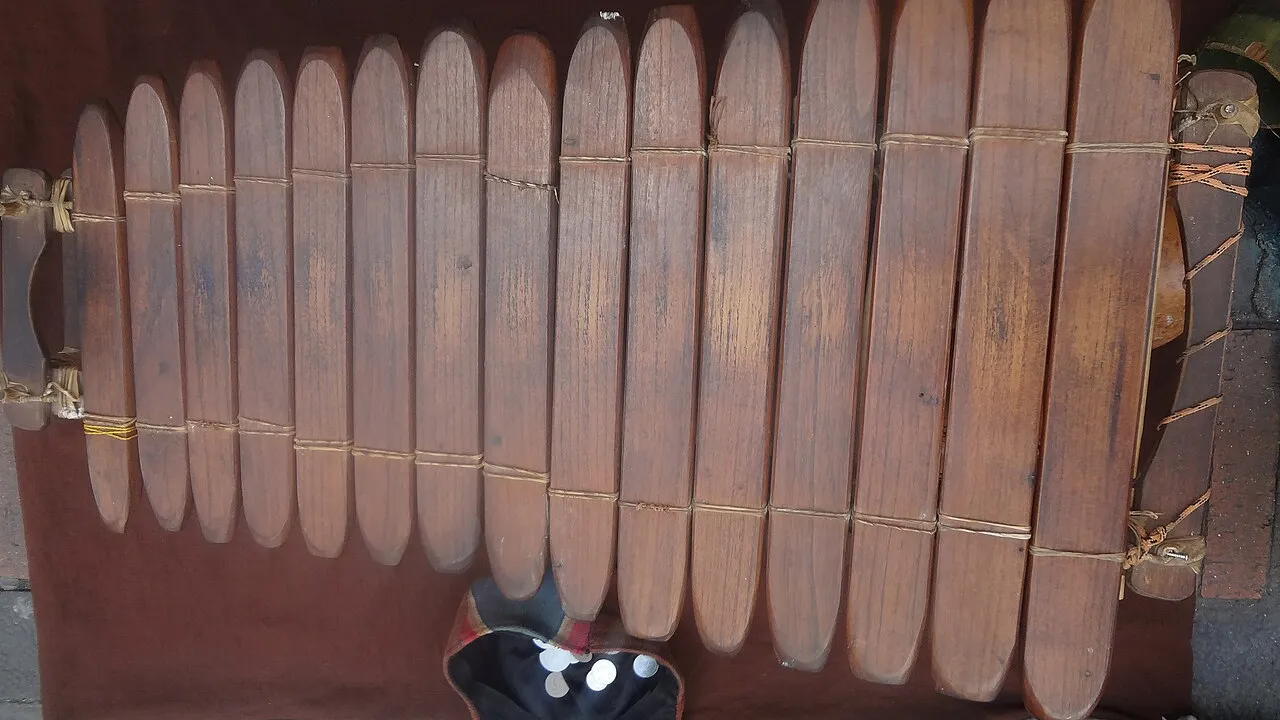
Look closely at the smooth wood keys. Long sing lower notes. Short bars sing higher notes! Shiny tubes hang underneath to help every note ring out.
3
Sticks That Dance
Players hold light sticks called . One quick tap makes the wood shake and sing a cheerful tune!
1. Which bars on a xylophone play the highest musical notes?
2. What do musicians hold in their hands to play a xylophone?
🤯 Mind-Blowing Fact • Grade 2
French composer Camille Saint-Saëns made audiences giggle and gasp in 1874 by using a xylophone to imitate rattling dancing skeletons!
✨ Word Sparks (Grade 2 Glossary)
Tap 🔊 to hear
hardwood
Dense, strong wood from slow-growing leafy trees
vibrate
Move back and forth fast to make sound
tube
A hollow cylinder hanging below each wooden bar
🪝
Why do colourful toy bars in music class have shiny metal xylophones when true xylophones are made of wood?
1
Wood That Pops and Sparkles
Clack-ity, pop, ping! Imagine raindrops made of polished bouncing across a stage. Many tiny toy instruments with metal keys get called xylophones by mistake, yet a real xylophone always sings with bars of wood or wood-like material!
2
Built Like a Giant Wooden Keyboard
A concert xylophone lines up its wooden bars just like the white and black keys on a piano. Long bars on the left play lower notes, and short bars on the right climb higher. Underneath each bar hangs a hollow metal that boosts the sound.
3
Bouncing Mallets
Musicians strike the center of the bars with hard rubber or plastic mallets, pulling up right away so the wood can freely and brightly.
1. What material are the bars on a real concert xylophone traditionally made from?
2. Why does a player lift the mallet right away after tapping a bar?
🤯 Mind-Blowing Fact • Grade 3
West African balafon makers attach thin spider-egg membranes over tiny holes in their gourd resonators to give every wooden note a warm, buzzing shimmer!
✨ Word Sparks (Grade 3 Glossary)
Tap 🔊 to hear
resonator
A hollow chamber or tube that boosts sound
timbre
The unique tone quality of an instrument's voice
amplify
Make a quiet sound louder and fuller
🪝
How do hollow gourds in West Africa connect to the glittering concert xylophone in a modern symphony?
1
Crisp Notes That Leap Across the Hall
Tik-tak-ping! Quick as a woodpecker and playful as a skipping stone, a stream of wooden notes dances right over a booming brass section. Even without electricity, a concert xylophone projects crisp melodies to the very back row of an auditorium.
2
Keyboard Layout and Resonator Tubes
Modern orchestral xylophones arrange dense rosewood or synthetic bars in two rows matching a piano's natural and sharp keys. Cords suspend the bars at special quiet spots near their ends so they can ring freely. Directly beneath each bar hangs a hollow metal tube filled with air tuned to match and that exact pitch.
3
Hard Mallets for Bright Timbre
Percussionists choose mallets with hard rubber, acrylic, or wooden heads to bring out the xylophone's signature dry, brittle . Unlike its deeper, mellower cousin the marimba, the xylophone speaks in a high, snappy voice whose notes vanish quickly after each strike.
4
Global Roots in Asia and Africa
Centuries before entering European orchestras, musicians in Southeast Asia and West Africa crafted brilliant wooden-bar instruments like the balafon, hanging dried hollow gourds underneath every bar as natural .
1. What did early West African balafon builders hang under their wooden bars to boost the sound?
2. How does a xylophone's sound compare to its cousin the marimba?
🤯 Mind-Blowing Fact • Grade 4
Concert xylophone music is written one full octave lower than it actually sounds—its highest bar rings at the very top note of a grand piano!
✨ Word Sparks (Grade 4 Glossary)
Tap 🔊 to hear
nodes
Still points along a vibrating bar or string
fundamental
The lowest main pitch of a musical note
transposing
Sounding higher or lower than the written note
🪝
Why do xylophone makers carve a shallow curve underneath every wooden bar—and why must cords touch only two exact spots?
1
Precision Carpentry Meets Acoustic Science
Snap, sparkle, pop! When an orchestral percussionist launches into a dazzling solo from Gershwin's Porgy and Bess or Stravinsky's Firebird, forty-plus wooden bars turn rapid wrist strokes into laser-sharp melody. Behind that effortless brilliance hides astonishing mathematical woodworking.
2
Nodes, Undercuts, and Harmonic Tuning
If you lay a wooden bar flat on a table and tap it, the table smothers the vibration into a dull thud. However, when a bar vibrates in its main bending mode, two points located about twenty-two percent in from each end barely move at all! Builders drill holes through these motionless spots—called —and thread suspension cords through them so the bar rings freely. Underneath the center, artisans carve a shallow arch. Removing wood from the middle lowers the pitch while tuning the bar's prominent overtone an octave plus a fifth higher, creating the xylophone's unmistakable bright, penetrating bite.
3
Stopped Tubes and Transposing Scores
Closed-bottom aluminum or brass tubes suspended below the bars trap columns of air that vibrate in sympathy with the wood above, reinforcing volume. Concert xylophones typically span three and a half to four octaves and act as instruments, sounding a full octave higher than the notes printed on the page to keep music readable without endless ledger lines.
4
Journeys Across Continents
Originating in ancient Southeast Asia and thriving across Africa in instruments like the Mandinka balafon and Chopi timbila orchestras, wooden keyboard percussion traveled to Europe by the early 1500s and earned permanent symphony seating in the nineteenth century.
1. Why are suspension cords threaded about twenty-two percent in from each end of a xylophone bar?
2. What does carving a shallow arch on the underside of a xylophone bar accomplish?
🤯 Mind-Blowing Fact • Grade 5
Honduras rosewood (Dalbergia stevensonii) is prized for concert xylophones because its dense natural resins withstand thousands of hard mallet strikes while ringing with unmatched clarity—though modern synthetic fiberglass-kelon bars were invented to survive outdoor stadium weather!
✨ Word Sparks (Grade 5 Glossary)
Tap 🔊 to hear
inharmonic
Having overtones that are not neat pitch multiples
twelfth
An interval spanning one octave plus a fifth
sympathetic
Vibrating automatically in response to matching sound waves
🪝
What hidden difference in overtone tuning makes a rosewood xylophone pop like brittle glass while a rosewood marimba hums like a warm organ?
1
The Acoustic Paradox of Two Rosewood Keyboards
Set a concert xylophone beside a concert marimba under stage lights and both appear to share the same DNA: graduated Honduras rosewood bars suspended over gleaming metal resonator tubes. Yet the instant hard rubber mallets strike the xylophone, out leaps an incisive, woody crackle capable of slicing straight through brass fanfares and timpani rolls.
2
Twelfth-Harmonic Tuning vs. Octave Tuning
Unlike a stretched violin string, whose overtones fall naturally into neat whole-number multiples of the fundamental frequency, an uncarved rectangular wooden bar produces wildly upper bending modes. To tame those clashing frequencies, master tuners mill an arch beneath the center of each bar. On a marimba, a deep parabolic arch lowers the first overtone to two octaves above the fundamental (a 4:1 frequency ratio). On a Western concert xylophone, a much shallower undercut tunes that prominent overtone to a —one octave plus a perfect fifth above the fundamental (a 3:1 ratio)—giving every note its characteristic crisp, piquant edge.
3
Nodal Suspension and Quarter-Wave Resonators
Classified in organology as a pitched struck idiophone (111.212), a standard 3.5-octave (F4–C8) or 4-octave (C4–C8) concert xylophone sounds one octave above written notation, peaking at C8 (4,186 hertz). Braided cords support each bar at its fundamental nodal lines, located 22.4 percent from either end. Beneath the lower and middle registers hang cylindrical tubes sealed at the bottom; each behaves as a stopped quarter-wavelength pipe whose enclosed air column enters resonance with the bar's fundamental, boosting amplitude while shortening decay.
4
Mallet Hardness and Contact Physics
Percussionists sculpt articulation by swapping mallets tipped with vulcanized rubber, Delrin, acrylic, or rosewood. Harder, lighter spheres rebound in less than a millisecond, exciting high-frequency flexural modes before vanishing cleanly.
5
Global Lineage From Balafon to Modern Stage
Early xylophones flourished across Southeast Asia by the ninth century CE and reached extraordinary sophistication in Africa—from the pentatonic and heptatonic Mandinka balafon to Mozambique's massive Chopi timbila ensembles. Documented in Germany by Arnold Schlick in 1511 as hültze glechter ('wooden clatter'), the chromatic concert model crystallized through nineteenth-century virtuosi like Michał Józef Guzikow and twentieth-century builders such as J.C. Deagan.