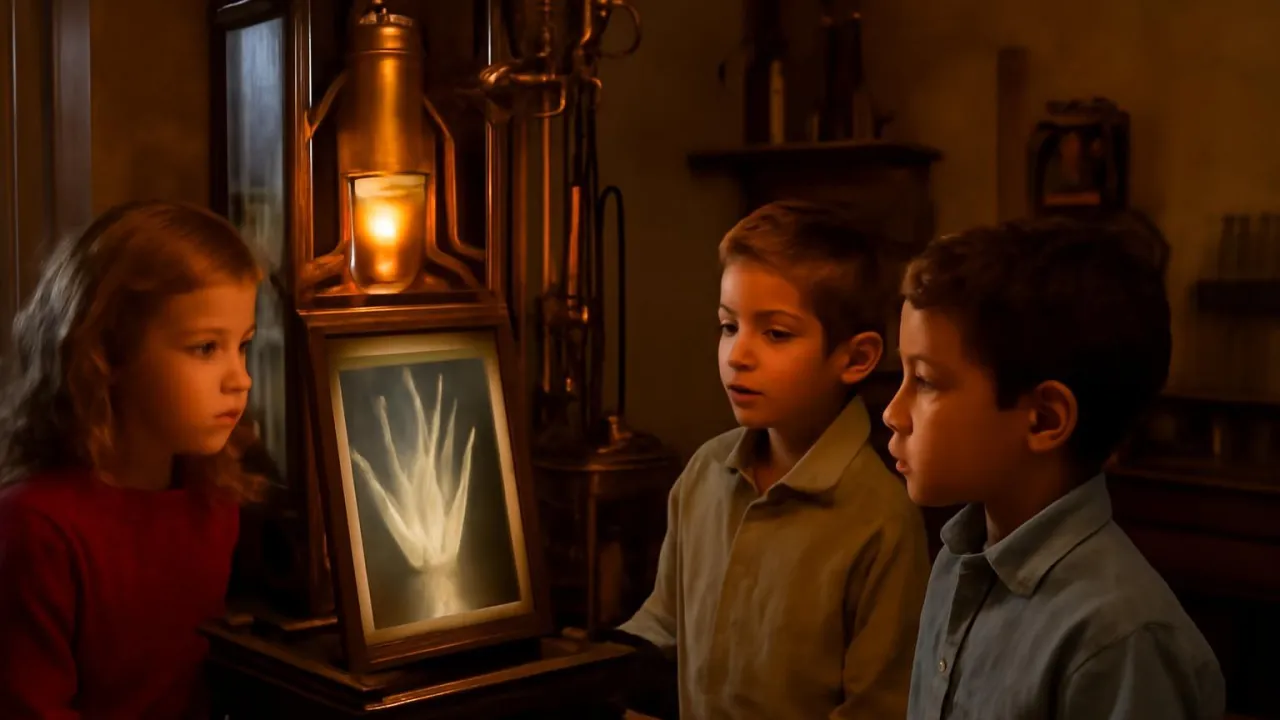
The very first X-ray picture ever made showed a woman’s wedding ring on her finger!
✨ Word Sparks (Grade 2 Glossary)
Tap 🔊 to hear
invisible
Something you cannot see
scientist
A person who studies science
machine
A tool that helps people work
🪝
Have you ever wondered how doctors see your bones without cutting you open?
1
The Secret Picture
An X-ray uses a special kind of light. This light can pass through soft skin, but it cannot go through hard bones. That is why your bones show up as white shapes on the X-ray picture.
2
How It Helps
Doctors use X-rays to look for broken bones or teeth problems. The takes a quick picture while you stay very still. This helps doctors know how to help you get better soon.
3
A Surprising Discovery
A named Wilhelm Röntgen found X-rays over one hundred years ago. He was amazed when he saw the bones in his wife’s hand. His discovery changed medicine forever.
X-rays can reveal fossils hidden inside rocks without breaking them open!
✨ Word Sparks (Grade 3 Glossary)
Tap 🔊 to hear
electromagnetic
Energy that travels in waves
frequency
How fast something moves back and forth
film
A special sheet for taking pictures
🪝
What would it be like to see the hidden skeleton inside your own hand?
1
Invisible Light Revealed
When you visit the doctor for an X-ray, you might hear a gentle hum from the machine. The X-ray machine sends out invisible rays, which are a type of energy called waves. These rays travel right through soft tissue but are blocked by dense things like bones. That’s why bones appear bright white on an X-ray image.
2
How Does It Work?
Inside the X-ray machine, electricity makes a glass tube glow with energy. This energy creates X-rays, which vibrate at very high frequencies. When the rays hit your body, some pass through and some are stopped, creating a shadow picture on a special or digital screen.
3
A Scientific Surprise
Wilhelm Röntgen, a German scientist, discovered X-rays by accident in 1895 while experimenting with electric currents. He noticed a glowing screen across the room and realized something invisible was traveling through the air. His first X-ray photo showed the bones and wedding ring in his wife’s hand, amazing the world.
4
Helping People Everywhere
Doctors use X-ray machines to find broken bones, check teeth, and even spot lung problems. X-rays are also used at airports to scan luggage for safety. This invention helps millions of people by making the invisible visible.
X-rays helped scientists discover the double-helix shape of DNA by revealing its hidden structure!
✨ Word Sparks (Grade 4 Glossary)
Tap 🔊 to hear
contrast
How things look different from each other
detector
A tool that finds or measures something
cavity
A small hole in your tooth
🪝
Imagine a world where you could see through walls—what secrets might you discover with invisible light?
1
The Science of Seeing Inside
X-ray machines use electromagnetic waves with much higher energy than visible light, allowing them to penetrate soft tissue but not dense bone. When X-rays pass through the body, they are absorbed by bones and some organs, creating a image on special film or digital sensors. The resulting image shows bones as bright white shapes, while softer tissues appear darker or gray. This unique power lets doctors examine injuries or illnesses without surgery.
2
How the Machine Works
An X-ray machine contains a vacuum tube where electricity heats a metal filament, releasing electrons. These electrons are accelerated and slam into a metal target, producing X-rays that vibrate at extremely high frequencies. The rays travel in straight lines and are directed toward the body part being examined, and a captures the pattern of rays that pass through. The image forms because bones absorb more X-rays than muscles or fat.
3
A Discovery That Changed Medicine
Wilhelm Conrad Röntgen made his accidental discovery in 1895 while experimenting with cathode rays in his laboratory in Germany. He noticed that a fluorescent screen glowed even when shielded, revealing a new kind of invisible light. Röntgen’s first X-ray image of his wife’s hand, showing her bones and wedding ring, stunned the world and quickly led to the use of X-rays in hospitals.
4
Global Impact and Other Uses
Today, X-ray machines are used worldwide to diagnose broken bones, find dental cavities, and even detect pneumonia. Scientists also use X-rays to study fossils, inspect artwork, and scan luggage at airports for safety. The invention of the X-ray machine opened up a whole new way to explore and understand the hidden parts of our world.
1. What makes X-rays different from regular light?
2. How did X-rays help scientists learn about DNA?
🤯 Mind-Blowing Fact • Grade 5
More than 20 Nobel Prizes have been awarded for discoveries using X-ray technology in science and medicine!
✨ Word Sparks (Grade 5 Glossary)
Tap 🔊 to hear
radiograph
A picture made with X-rays
anode
The part that collects electrons in a tube
crystallography
A way to see tiny structures using X-rays
🪝
What mysteries could you solve if you could see through solid objects using waves you can’t see or feel?
1
Unveiling the Invisible: The Physics of X-Rays
X-rays are a form of electromagnetic radiation with wavelengths ranging from 0.01 to 10 nanometers, making them much shorter and more energetic than visible light. When high-voltage electricity passes through a vacuum tube in the X-ray machine, electrons are emitted from a heated tungsten filament and rapidly accelerated toward a metal . When these high-speed electrons collide with the anode, their sudden deceleration produces X-ray photons, which can penetrate materials based on their density and atomic number. Bones, which are dense and rich in calcium, absorb more X-rays and appear white, while softer tissues absorb less and appear gray or black on the resulting .
2
Engineering the First X-Ray Machine
Wilhelm Conrad Röntgen constructed the earliest X-ray apparatus in 1895 using a Crookes tube, barium platinocyanide screen, and photographic plates. His experiments revealed that X-rays could pass through books, wood, and even flesh, but not metal or bone. The first clinical use of X-rays allowed doctors to locate bullets, fractures, and foreign objects without surgery, revolutionizing medical diagnostics. Over time, engineers improved the safety and clarity of X-ray machines by adding lead shielding, adjustable voltage controls, and digital detectors.
3
From Medicine to Modern Marvels
Beyond medicine, X-ray technology has transformed fields like airport security, industrial inspection, and paleontology. Airport scanners use X-rays to distinguish organic materials, plastics, and metals inside luggage by analyzing how different substances absorb X-rays. In paleontology, X-rays reveal fossilized bones and ancient creatures hidden within rocks, while art historians use X-ray imaging to study layers beneath famous paintings. X-ray , a specialized technique, enabled scientists like Rosalind Franklin to visualize the double-helix structure of DNA, unlocking secrets of life itself.
4
Safety, Innovation, and Global Impact
Although X-rays are powerful, excessive exposure can damage living tissue, so modern machines use precise doses and protective barriers. Radiology, the medical specialty that uses X-rays, now includes advanced imaging like CT scans, which combine many X-ray images to create 3D pictures of the body. The World Health Organization estimates that over 3.6 billion medical X-rays are performed annually, saving countless lives by detecting diseases early. X-ray machines are essential tools in hospitals, research labs, airports, and even space missions.
5
The Future of X-Ray Technology
Recent innovations include portable digital X-ray systems, ultra-low dose imaging, and synchrotron sources that generate extremely bright X-rays for scientific research. Engineers are developing new detectors that provide sharper images with less radiation, making diagnostics safer for everyone. X-ray astronomy allows scientists to study distant stars, black holes, and galaxies by detecting X-rays from space. The journey from Röntgen’s glowing screen to today’s advanced imaging proves how one discovery can illuminate the hidden wonders of our universe.