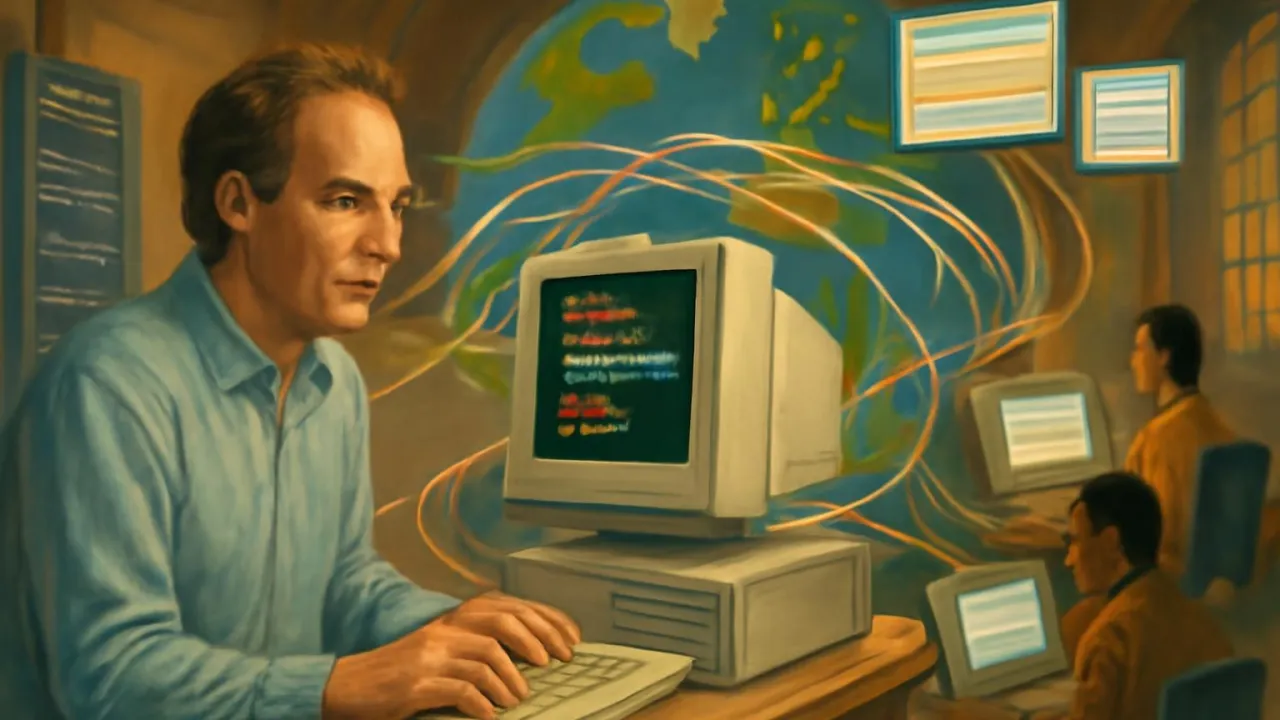
The first web page only had words and links—no pictures at all!
✨ Word Sparks (Grade 2 Glossary)
Tap 🔊 to hear
server
A computer that stores web pages
link
A button you click to go somewhere new
HTTP
A code that helps send web pages
🪝
Have you ever wondered how a picture gets from one computer to another in seconds?
1
The Web’s Secret Pathways
When you click a , your computer sends a message. The message travels on wires and through the air. It visits special computers called that hold web pages. The web brings back the page to you in a flash.
2
The Magic of HTML and HTTP
Web pages use a code called HTML to show words and pictures. Another code, called , helps send these pages between computers. These codes help everyone see the same pages, no matter where they are.
3
A World Connected
People everywhere use the web to learn, play, and talk. You can visit museums, watch videos, or talk to friends far away. The web makes our big world feel much closer.
The web was invented at CERN, where scientists study the tiniest parts of the universe!
✨ Word Sparks (Grade 3 Glossary)
Tap 🔊 to hear
protocol
A set of rules for computers
server
A computer that sends web pages
hyperlink
A clickable word or picture
🪝
Imagine if every library, game, and friend’s story could reach you with just one click—how does that happen?
1
A Giant Web Across the World
The World Wide Web is like a giant invisible net. It connects millions of computers all over the planet. When you visit a website, your computer sends a request using a special language called HTTP. This lets you see and use web pages from anywhere.
2
HTML: The Building Blocks
Web pages are made with a code called HTML, which stands for HyperText Markup Language. HTML tells your computer how to show words, pictures, and links. Every time you see a web page, you are looking at HTML in action. This code makes the web easy for everyone to use.
3
How Does It Work?
When you click a link, your device sends a message to a . The server is a powerful computer that stores web pages and sends them back using HTTP. This process is super fast, so you can see new pages in seconds.
4
Changing How We Learn and Share
The web lets people share ideas, games, and news instantly. You can learn about dinosaurs, watch science videos, or talk to friends far away. The World Wide Web has changed how people connect and learn all over the globe.
The World Wide Web’s first image was of a comedy band made by CERN staff!
✨ Word Sparks (Grade 4 Glossary)
Tap 🔊 to hear
protocol
Rules for how computers talk
browser
A program to view web pages
network
A group of linked computers
🪝
Can you picture millions of invisible messages zooming across the world every second—what makes that possible?
1
Invisible Messages, Real Connections
Picture a burst of light traveling through a cable, carrying a message from your computer to another far away. That’s how the World Wide Web connects people everywhere, using speedy signals and clever computer rules. Tim Berners-Lee dreamed up this idea at CERN, a science lab in Switzerland, in the late 1980s. Today, the web’s invisible messages help us share ideas, art, and discoveries with anyone, anywhere.
2
The Secret Language: HTML
Every web page you visit is built with HTML, or HyperText Markup Language, which acts like a set of instructions for . HTML tags tell browsers where to put pictures, videos, words, and links, making each page unique and interactive. Without HTML, web pages would just show plain text and nothing more. This language lets creators build colorful, exciting sites for all to explore.
3
HTTP and Servers: The Web’s Highways
Whenever you click a link, your device sends a special HTTP request to a server, which is a powerful computer storing web pages. The server finds the right page and sends it back, and your uses HTML to turn it into something you can see and use. This all happens in the blink of an eye, thanks to fast and smart technology.
4
A Smaller, More Connected World
The web has changed how people learn, play, and share with others around the globe. Students can research any topic, families can video chat from far apart, and friends can share photos in seconds. The World Wide Web makes our huge planet feel smaller and brings people together like never before.
The World Wide Web connects over 5 billion people and more than 1.8 billion websites worldwide!
✨ Word Sparks (Grade 5 Glossary)
Tap 🔊 to hear
hyperlink
Clickable text or image that jumps to another page
HTML5
A newer, more powerful version of HTML
digital divide
The gap between those with and without internet access
🪝
What if every book, video, and idea on Earth could travel to your screen in seconds—how did humanity make that possible?
1
A Digital Revolution Begins
In 1989, British computer scientist Tim Berners-Lee proposed a system for sharing information across computers at CERN, the European physics laboratory. He envisioned a network where documents could be linked together using clickable text, creating a 'web' of knowledge. By 1991, the first website went live, using a new language called HTML and a protocol named HTTP. This invention became the World Wide Web, a digital revolution that changed how humans communicate and learn.
2
HTML and HTTP: The Web’s Core Technologies
HTML, or HyperText Markup Language, provides the structure for web pages, using tags to organize text, images, and links. HTTP, or HyperText Transfer Protocol, is the set of rules computers use to request and deliver these pages over the internet. When you type a web address or click a , your browser sends an HTTP request to a server, which responds with an HTML file that your computer displays as a web page. These technologies work together to make the web interactive and accessible.
3
How the Web Works: Servers, Browsers, and Networks
The web relies on millions of servers—special computers that store and transmit web pages—and browsers, which interpret HTML to show content in a user-friendly way. Data travels through networks of cables, satellites, and wireless signals, following precise protocols to reach your device. Each web page is a combination of text, images, and code, delivered in fractions of a second thanks to high-speed connections and efficient data routing. This complex system allows billions of people to access information from anywhere in the world.
4
Impact on Society and Global Communication
The World Wide Web has transformed education, business, science, and social life by making information instantly available. Students can research any subject, scientists can share discoveries, and families can connect across continents. The web supports online learning, e-commerce, news, entertainment, and even social movements. Its global reach has made the world more connected, but it also brings challenges like privacy concerns and between countries.
5
The Ongoing Evolution of the Web
Since its creation, the web has evolved from simple text pages to complex interactive sites using images, video, and real-time communication. New versions of HTML, such as , allow for animations, games, and apps to run directly in browsers. The web now supports billions of users and devices, with over 1.8 billion websites online as of 2024. As technology advances, the World Wide Web continues to shape how people learn, create, and connect across the globe.