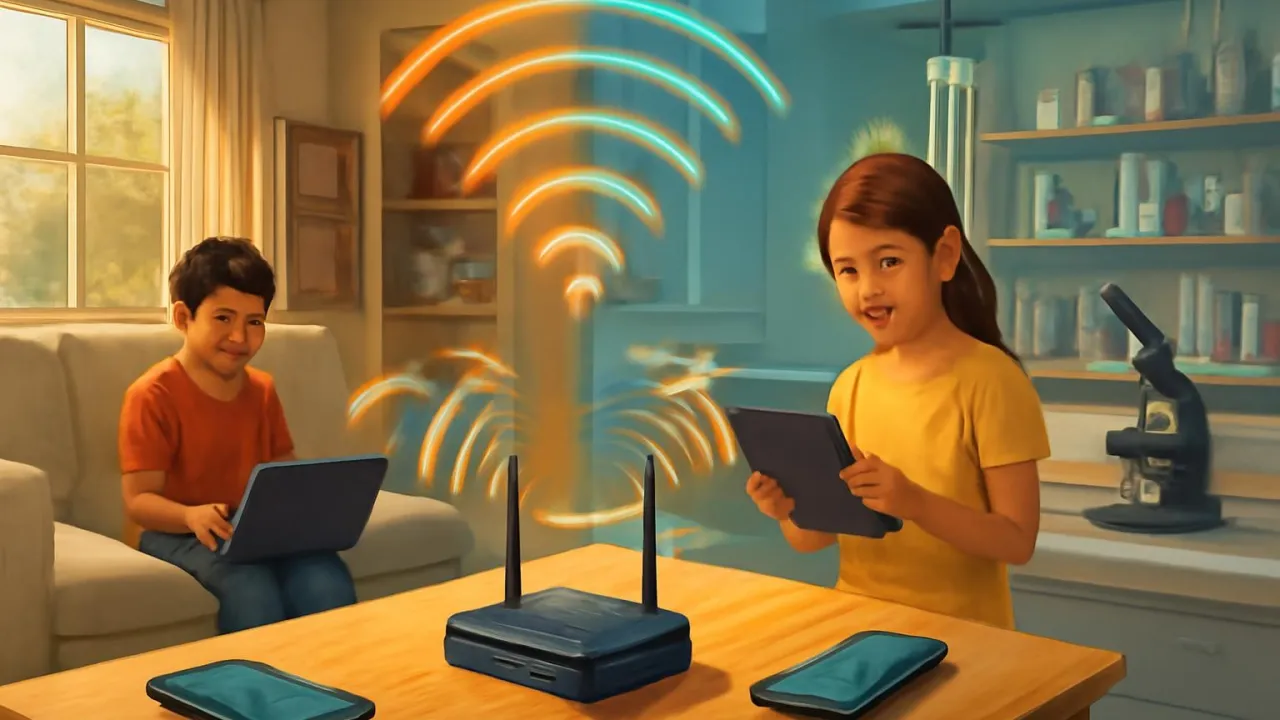
The first Wi-Fi was made to help astronomers study black holes!
✨ Word Sparks (Grade 2 Glossary)
Tap 🔊 to hear
router
A box that gives out Wi-Fi waves
internet
A giant network of computers
device
A thing like a tablet or phone
🪝
Can you imagine sending your voice through the air?
1
Invisible Helpers
Wi-Fi uses invisible radio waves to send information. These waves travel through the air quickly. You can use Wi-Fi to play games or watch videos. It helps you talk to friends far away.
2
How Does Wi-Fi Work?
A Wi-Fi box, called a , sends out radio waves. Your tablet or computer catches these waves to get messages. The router connects to the with a cord, but your does not need one. This lets you move around while you use it.
3
Wi-Fi Everywhere
Wi-Fi is found in homes, schools, and libraries. Many people use it every day for work and fun. It makes sharing pictures and videos fast and easy. Wi-Fi helps connect people all over the world.
Wi-Fi signals can travel up to 150 feet indoors and even farther outside!
✨ Word Sparks (Grade 3 Glossary)
Tap 🔊 to hear
vibration
A fast back-and-forth movement
antenna
A part that sends or gets waves
transmission
Sending something from one place to another
🪝
What if you could send your ideas through invisible waves?
1
The Mystery of Wireless Waves
Imagine hearing a song or seeing a picture appear on your tablet without any wires. Wi-Fi makes this possible by using radio waves, which are invisible moving through the air. These waves travel at the speed of light, carrying information from one device to another. You cannot see or touch them, but they work all around you every day.
2
How Wi-Fi Connects Devices
A device called a router sends out Wi-Fi signals using special . Your computer, phone, or tablet has a receiver that picks up these signals. The router is connected to the internet with a cable, but your device connects wirelessly. This lets you move around your home or school while staying online.
3
The Science Behind Wi-Fi
Wi-Fi uses radio frequency waves, which are a type of electromagnetic energy. These waves vibrate quickly to send digital data, like videos and messages. When your device receives these waves, it changes them back into pictures, sounds, or words. This process is called wireless data .
4
Wi-Fi Changes Our World
Wi-Fi was invented in 1997 by scientists in Australia. It quickly became popular because it made connecting to the internet much easier. Today, Wi-Fi connects billions of devices in homes, schools, and cities. It helps people share ideas, learn new things, and talk to friends everywhere.
Wi-Fi was inspired by a project to study black holes in space!
✨ Word Sparks (Grade 4 Glossary)
Tap 🔊 to hear
gigahertz
A way to measure wave speed
decode
To change signals into words or pictures
patent
A special award for inventors
🪝
What if every device in your house could talk without any wires at all?
1
Invisible Bridges in the Air
Wi-Fi lets devices communicate by sending and receiving electromagnetic waves through the air, instead of using physical wires. These radio waves vibrate at frequencies of 2.4 or 5 , allowing them to carry large amounts of digital data rapidly. When you watch a video or play an online game, these waves transmit information between your device and the router. It feels like magic, but it is really science in action all around us.
2
The Engineering Behind Wi-Fi
A Wi-Fi router uses antennas to broadcast strong radio signals in all directions, creating a wireless network. Devices like laptops and smartphones have their own antennas to catch these signals and the information. The router itself is connected to the internet through a wired cable, but everything else happens wirelessly. This system allows you to walk from room to room without losing your connection.
3
The Story of Wi-Fi’s Invention
Wi-Fi was invented in 1997 by Dr. John O’Sullivan and his team at CSIRO in Australia. Their research began as a way to detect exploding black holes, but the technology became perfect for wireless networking. The team received a for their invention, and soon Wi-Fi spread to homes, schools, and businesses worldwide. Today, almost every modern device depends on this breakthrough.
4
Wi-Fi’s Global Impact
Wi-Fi has changed how people learn, work, and play by making the internet available almost everywhere. It connects billions of devices, from computers to smart refrigerators, and helps people share information instantly. Wi-Fi has made remote learning, online teamwork, and smart homes possible. As technology grows, Wi-Fi will keep connecting more people and places around the world.
Wi-Fi routers can handle over 100 connected devices at once in busy places like airports!
✨ Word Sparks (Grade 5 Glossary)
Tap 🔊 to hear
modulate
To change waves to carry information
latency
The delay before data moves
beamforming
Focusing signals to reach devices better
🪝
Imagine if every message, video, or song you enjoy could soar invisibly through the air—how does it work?
1
The Physics of Wireless Networking
Wi-Fi operates by transmitting data as electromagnetic waves, specifically in the radio frequency bands of 2.4 GHz and 5 GHz. These frequencies are chosen because they allow for both high data speeds and reasonable travel distances, even through walls and floors. The router digital information into these radio waves, which then propagate through the air. Devices equipped with wireless network cards use antennas to detect, demodulate, and decode these signals back into usable data. This seamless transmission enables real-time streaming, video calls, and file sharing without any physical cables.
2
Engineering Marvel: The Wi-Fi Router
At the heart of every wireless network is the Wi-Fi router, which acts as a central hub and traffic director. Routers use multiple antennas and advanced protocols like IEEE 802.11 to manage simultaneous connections from dozens of devices. Each device is assigned a unique address, ensuring data packets reach the correct destination without interference. Modern routers can support speeds over 1 gigabit per second, thanks to technologies such as MIMO (Multiple Input, Multiple Output) and , which focus signals for maximum efficiency.
3
From Astronomy to Everyday Life
Wi-Fi’s origins trace back to radio-astronomy research led by Dr. John O’Sullivan and colleagues at CSIRO in Australia during the early 1990s. Their initial goal was to detect faint signals from black holes, but their patented technology for reducing radio signal distortion became the foundation for wireless networking. The first commercial Wi-Fi standard was released in 1997, and it rapidly transformed how people accessed and shared information. Today, Wi-Fi is recognized as one of the most important inventions of the digital age.
4
A World Connected by Invisible Waves
Wi-Fi has revolutionized communication, education, and industry by enabling billions of devices to connect without wires. It powers smart homes, remote learning, telemedicine, and the global economy by making high-speed internet available almost everywhere. The technology is constantly evolving, with new standards like Wi-Fi 6 and Wi-Fi 7 promising even faster speeds, lower , and greater reliability. As more devices join the Internet of Things, Wi-Fi’s role in connecting people and machines will only grow.
5
The Science and Future of Wi-Fi
Wi-Fi’s effectiveness depends on understanding electromagnetic wave behavior, including reflection, absorption, and interference from objects in the environment. Engineers use mathematical models to optimize signal strength and coverage, often employing mesh networks to blanket large areas with seamless connectivity. As demand for wireless data increases, researchers are exploring higher frequency bands and new modulation techniques to increase capacity. The future of Wi-Fi will likely include integration with 5G networks and advanced security protocols, ensuring safe, fast, and universal access for all.