W.E.B. Du Bois
Pioneering Scholar and Co-Founder of the NAACP
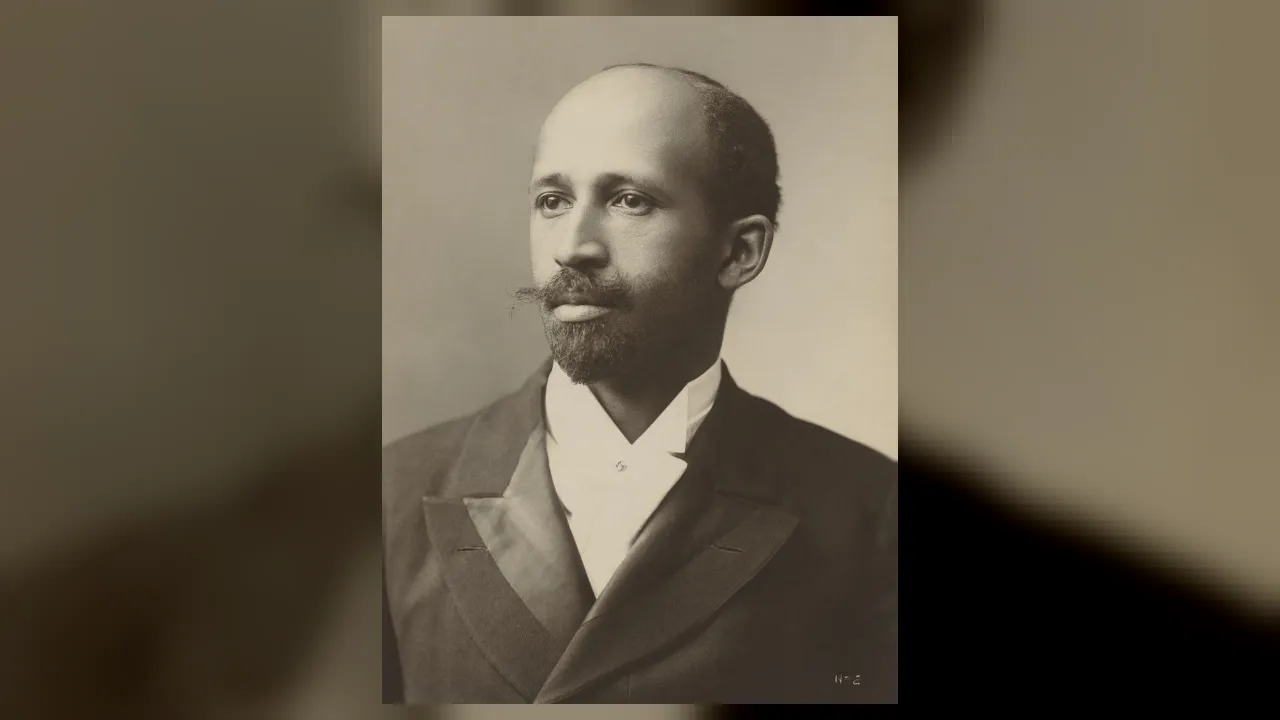
W.E.B. Du Bois's 1896 Harvard dissertation, The Suppression of the African Slave-Trade to the United States of America, 1638–1870, was so thorough that Harvard selected it as Volume 1—the very first book ever published—in the prestigious Harvard Historical Studies series!
1 Transatlantic Formation of a Scholar-Activist
Study Plate 31 of 'The Exhibit of American Negroes' preserved in the Library of Congress—a bold modernist spiral painted in primary gouache for the 1900 Paris Exposition to chart sixty-three years of rising Black property ownership and literacy in Georgia. Born in Great Barrington, Massachusetts, on February 23, 1868—months before ratification of the Fourteenth Amendment—William Edward Burghardt Du Bois earned community scholarships to Fisk University in Nashville (B.A., 1888), where teaching summer school in rural Wilson County, Tennessee, revealed the lived realities of post-Reconstruction sharecroppers. Completing a second bachelor's and master's at Harvard under philosopher William James and historian Albert Bushnell Hart, pursuing two years of empirical political economy at Friedrich Wilhelm University in Berlin, and defending his doctoral thesis in 1895, Du Bois became the first African American awarded a Harvard Ph.D., publishing his dissertation as Volume 1 of the Harvard Historical Studies series.
2 Inventing American Urban Sociology
At age twenty-eight, hired as a temporary 'assistant in sociology' by the University of Pennsylvania, Du Bois personally conducted door-to-door interviews across 2,500 households—roughly 9,600 individuals—in Philadelphia's Seventh Ward. The resulting 500-page , The Philadelphia Negro (1899), combined demographic , occupational tables, and historical analysis to demonstrate that structural exclusion in hiring and unions—not innate deficiency—explained urban inequality. Moving to Atlanta University in 1897, he convened annual Atlanta University Conferences producing sixteen pioneering empirical studies of Black education, business, artisans, and health.
3 'The Souls of Black Folk' and Constitutional Citizenship
In 1903, Du Bois published The Souls of Black Folk, blending sociological rigor, spirituals ('sorrow songs'), and lyrical essays articulating ''—the experience of viewing oneself both as an American citizen and through a veil of prejudice. In his celebrated chapter 'Of Mr. Booker T. Washington and Others,' Du Bois praised Washington's energy while arguing that no people could safeguard property or industrial gains while surrendering three essentials: political suffrage, civil equality, and higher liberal-arts education needed to cultivate teachers, physicians, and jurists.
4 Niagara, the NAACP, and Editing 'The Crisis'
Co-founding the Niagara Movement with William Monroe Trotter in July 1905—whose second annual assembly at Harpers Ferry in 1906 declared, 'We claim for ourselves every single right that belongs to a freeborn American, political, civil and social'—Du Bois joined an interracial vanguard including Ida B. Wells-Barnett, Mary White Ovington, Moorfield Storey, and Oswald Garrison Villard in 1909 to establish the NAACP. Serving as the association's Director of Publicity and Research from 1910 to 1934, he built The Crisis into a powerhouse journal peaking at 100,000 monthly copies, backing early Supreme Court victories like Guinn v. United States (1915, striking down grandfather clauses), championing the 19th Amendment for women's suffrage, and—alongside literary editor Jessie Redmon Fauset—publishing Langston Hughes, Countee Cullen, Zora Neale Hurston, and Jean Toomer.
5 Ninety-Five Years Spanning Reconstruction to the March on Washington
Returning later to chair sociology at Atlanta University and pursuing global scholarship and international peace initiatives before spending his final two years compiling an Encyclopedia Africana in Ghana, Du Bois died on August 27, 1963, at age ninety-five—hours before 250,000 Americans gathered at the Lincoln Memorial to fulfill the constitutional vision he had championed for seven decades.
1. Which historic 1915 U.S. Supreme Court victory, celebrated in The Crisis, struck down state 'grandfather clauses' that unfairly blocked Black citizens from voting?
2. Who served alongside W.E.B. Du Bois as literary editor of The Crisis and co-creator of The Brownies' Book, helping discover and publish key Harlem Renaissance writers?