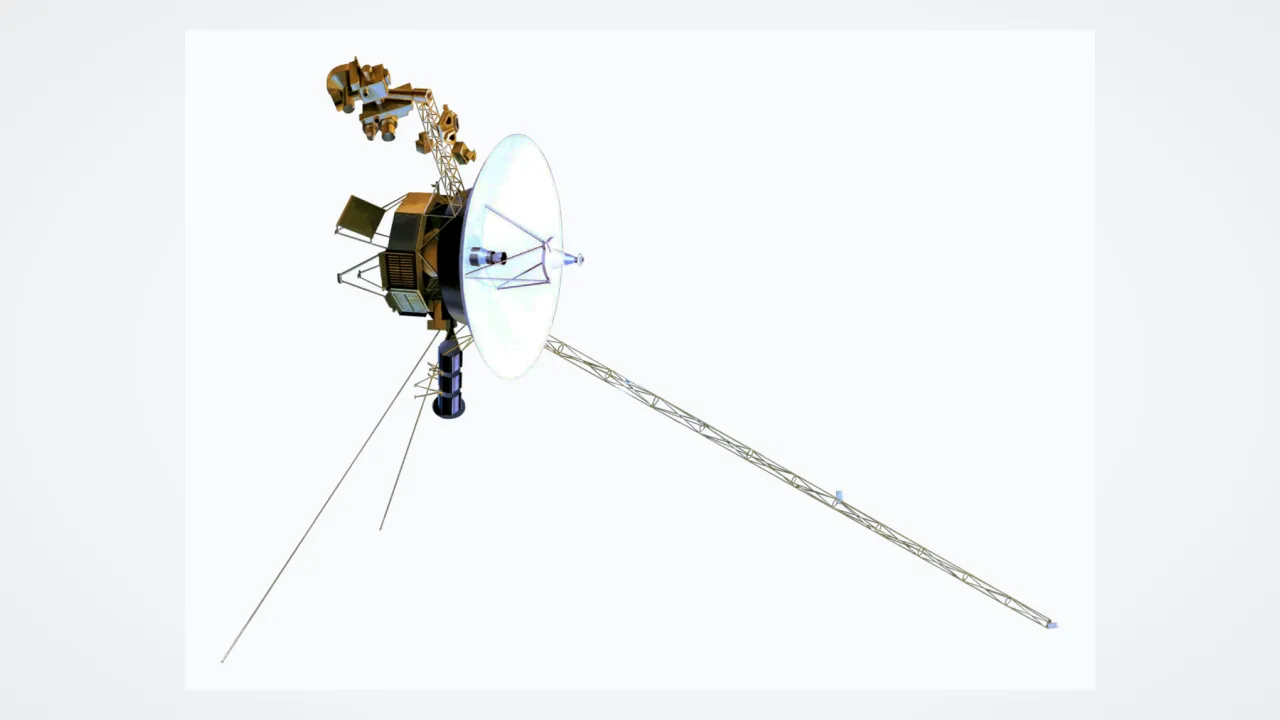
1. How many giant outer planets did Voyager 2 visit on its Grand Tour?
2. Which two distant blue planets has ONLY Voyager 2 ever visited up close?
🤯 Mind-Blowing Fact • Grade 2
Voyager 2 discovered 16 brand-new moons during its journey—three at Jupiter, three at Saturn, eleven at Uranus, and six at Neptune (with some counted alongside rings)!
✨ Word Sparks (Grade 2 Glossary)
Tap 🔊 to hear
alignment
lining up in a helpful pattern
geyser
fountain shooting gas or liquid upward
slingshot
gravity boost flinging a craft faster
🪝
Why did Voyager 2 launch BEFORE Voyager 1—and how did it visit two extra planets?
1
A Rare 176-Year Lineup
Imagine four moving merry-go-rounds lining up just right so you can hop from one to the next! Once every 176 years, Jupiter, Saturn, Uranus, and Neptune curve into a neat arc that lets one spacecraft past all four.
2
Launched First, Built to Go Far
Voyager 2 actually blasted off on August 20, 1977—sixteen days before Voyager 1! It took a slightly slower, curved route so Saturn's gravity could fling it onward to sideways-spinning Uranus in 1986 and stormy blue Neptune in 1989.
3
Ice Geysers and Star Space
At Neptune's freezing moon Triton, Voyager 2 spotted dark shooting nitrogen gas five miles high! In 2018, it joined its twin out in interstellar space.
1. How often do the four outer giant planets line up for a Grand Tour like Voyager 2's?
2. What amazing surprise did Voyager 2 spot erupting on Neptune's icy moon Triton?
🤯 Mind-Blowing Fact • Grade 3
Because Voyager 2 dove steeply south below the Solar System's planets after Neptune, only giant radio dishes in the Southern Hemisphere—in Canberra, Australia—can send commands up to it!
✨ Word Sparks (Grade 3 Glossary)
Tap 🔊 to hear
exposure
time a camera shutter stays open
supersonic
moving faster than the speed of sound
Southern Hemisphere
half of Earth south of equator
🪝
How did engineers teach an aging spacecraft billions of miles away to hold totally steady in the dark?
1
Gravity Assists Cut Travel Time
Without gravity assists from giant planets, flying from Earth to Neptune in the 1970s would have taken thirty years! By skimming Jupiter in 1979, Saturn in 1981, and Uranus in 1986, Voyager 2 stole orbital momentum from each giant world and reached Neptune in just twelve years.
2
Dim Sunlight at Uranus and Neptune
Out at Neptune—nearly three billion miles from the Sun—sunlight is 900 times dimmer than on Earth! Taking a photo there without smearing the image was like snapping a nighttime action shot from a speeding racecar. Engineers reprogrammed Voyager 2's thrusters from Earth so the whole probe smoothly tracked each target during long camera .
3
Supersonic Winds and Tilted Magnets
The sharp photos stunned scientists: Uranus had a lop-sided magnetic field tilted 59 degrees, while frigid Neptune whipped up 1,200-mile-per-hour winds and a giant storm called the Great Dark Spot!
4
Southward into Interstellar Space
Diving south past Neptune, Voyager 2 crossed the heliopause into interstellar space on November 5, 2018!
1. Why was taking sharp photos at Uranus and Neptune much harder than at Jupiter?
2. Why can only NASA's Deep Space Network station in Australia send radio commands to Voyager 2?
🤯 Mind-Blowing Fact • Grade 4
The towering ice cliff Verona Rupes photographed by Voyager 2 on Uranus's low-gravity moon Miranda is about 12 miles tall—if you stepped off the top, it would take about twelve minutes to float to the bottom!
✨ Word Sparks (Grade 4 Glossary)
Tap 🔊 to hear
cryovolcano
ice volcano erupting cold gas or slush
retrograde orbit
orbiting backward opposite planet's spin
plasma
electrified gas of charged atomic particles
🪝
How did a graduate student doing orbital math in 1965 unlock Voyager 2's legendary four-planet Grand Tour?
1
Gary Flandro's 176-Year Discovery
In the summer of 1965, Caltech graduate student Gary Flandro sat at NASA's Jet Propulsion Laboratory plotting outer-planet orbits by pencil and computer. He realized that in the late 1970s, Jupiter, Saturn, Uranus, and Neptune would align on the same side of the Sun for the first time since Thomas Jefferson was president! A single spacecraft launched in 1977 could chain three consecutive gravity assists, cutting travel time to Neptune from 30 years to 12.
2
Overcoming Glitches Along the Way
Launched August 20, 1977, Voyager 2 survived nail-biting emergencies! Its main radio receiver failed permanently in 1978, forcing controllers to talk to a damaged backup receiver for decades. Then at Saturn in 1981, its camera scan platform jammed—until JPL engineers carefully tested lubrication commands on a ground twin and freed the platform in time for Uranus!
3
Rewriting Textbooks on Ice Giants
In January 1986, Voyager 2 revealed Uranus's fractured moon Miranda—scarred with 12-mile-high ice cliffs called Verona Rupes—alongside 11 new moons and two faint rings. Skimming just 3,000 miles above Neptune's north pole in August 1989, it clocked the fastest planetary winds in the Solar System and active cryovolcanic plumes on retrograde moon Triton.
4
Direct Interstellar Plasma Readings
When Voyager 2 crossed the heliopause at 119.7 astronomical units in November 2018, its still-working Science instrument directly measured the temperature and density of interstellar plasma for the very first time!
1. Who discovered in 1965 that all four giant planets would align in the late 1970s for a single gravity-assist Grand Tour?
2. What unique advantage did Voyager 2 have over Voyager 1 when crossing the heliopause in 2018?
🤯 Mind-Blowing Fact • Grade 5
In August 2023, after an accidental command tilted Voyager 2's antenna two degrees away from Earth and cut off contact, Canberra's giant DSS-43 dish blasted a high-power 'interstellar shout' across 19.9 billion kilometers that successfully reoriented the spacecraft!
✨ Word Sparks (Grade 5 Glossary)
Tap 🔊 to hear
supercritical fluid
dense hot state mixing liquid and gas
dynamo
churning fluid layer generating magnetic fields
Kuiper Belt
icy ring of worlds beyond Neptune
🪝
Why did Uranus and Neptune turn out to be a completely different class of planet from Jupiter and Saturn—thanks solely to Voyager 2?
1
Executing the Four-Planet Gravity Chain
Approved originally only for Jupiter and Saturn as Mariner Jupiter-Saturn, Voyager 2 launched on August 20, 1977 with quiet engineering margins built to reach Neptune if spacecraft health held up. After mapping Europa's crisscrossed ice crust at Jupiter in July 1979 and profiling Saturn's ring spokes in August 1981, Voyager 2 survived a seized azimuth actuator on its scan platform. JPL engineers uploaded image-motion compensation routines, digital data-compression algorithms, and Deep Space Network arraying techniques—combining radio telescopes like Australia's Parkes dish with Canberra antennas—to boost bit rates across billions of kilometers.
2
Unveiling the Ice Giants (1986 & 1989)
Before Voyager 2's January 1986 Uranus flyby and August 1989 Neptune encounter, textbooks grouped all four outer worlds together as gas giants. Precise gravitational tracking and magnetic-field measurements from Voyager 2 overturned that picture: whereas Jupiter and Saturn are overwhelmingly hydrogen and helium, Uranus and Neptune hold massive mantles of supercritical water, ammonia, and methane 'ices,' establishing a distinct planetary class—the ice giants—which exoplanet surveys now show are among the Milky Way's most common worlds!
3
Off-Center Dynamos and Captured Triton
Both ice giants shocked geophysicists with multipolar magnetic fields tilted 59 and 47 degrees from their spin axes and offset far from their rocky cores, generated inside electrically conducting ionic-water layers. Diving 4,950 kilometers over Neptune's cloud tops, Voyager 2 swung past Triton—confirming from its retrograde orbit and cantaloupe terrain that Triton is likely a captured dwarf planet heated by past tidal dissipation.
4
Probing the Southern Heliopause
Heading 48 degrees south of the ecliptic toward constellation Pavo at 15.4 kilometers per second, Voyager 2 crossed the heliopause on November 5, 2018 at 119.7 AU. Unlike Voyager 1's northern crossing, Voyager 2's Faraday-cup Plasma Science detector measured a hotter, thinner boundary layer of 30,000-to-50,000-kelvin plasma compressed by a strong interstellar magnetic field.
5
Enduring Interstellar Legacy
Maintained exclusively via Canberra's 70-meter Deep Space Station 43—which even rescued Voyager 2 with an 'interstellar shout' after an accidental antenna tilt in 2023—the veteran explorer continues returning irreplaceable data past 138 AU.