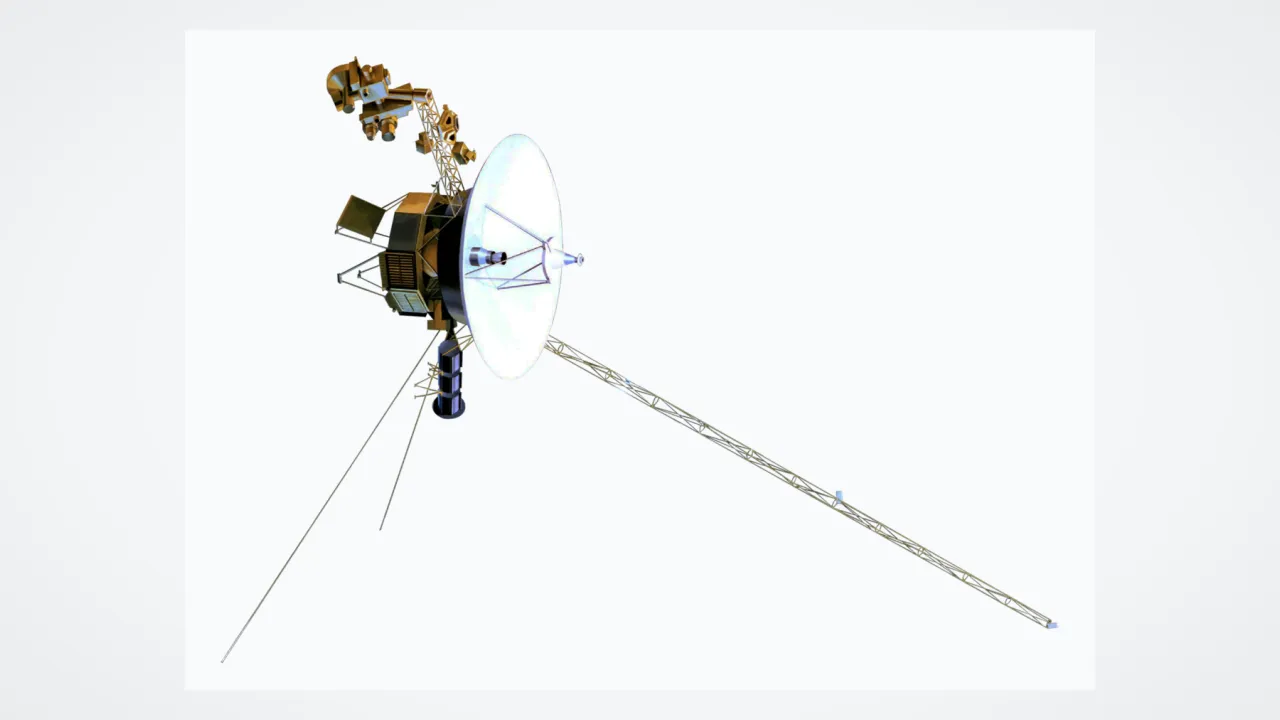
1. Which two giant planets did Voyager 1 visit up close before heading into deep space?
2. What special treasure does Voyager 1 carry on its side in case aliens ever find it?
🤯 Mind-Blowing Fact • Grade 2
Even though Voyager 1 launched 16 days after its twin Voyager 2, it flew a faster path and overtook its sibling on the way to Jupiter!
✨ Word Sparks (Grade 2 Glossary)
Tap 🔊 to hear
volcano
mountain vent shooting out hot material
flyby
close pass past a planet or moon
Golden Record
metal disc holding sounds of Earth
🪝
What did Earth look like when Voyager 1 turned around from four billion miles away?
1
Surprises at Jupiter and Saturn
Imagine launching a robot explorer smaller than a compact car on an endless one-way trip! After blasting off in September 1977, Voyager 1 spotted erupting on Jupiter's moon Io and thick orange smog blanketing Saturn's big moon Titan.
2
The Pale Blue Dot
On Valentine's Day in 1990, engineers asked Voyager 1 to turn its camera backward one last time. From nearly four billion miles out, all of planet Earth looked like a tiny 'Pale Blue Dot' floating in a sunbeam!
3
Crossing into Star Space
In August 2012, Voyager 1 made history as the first human craft to exit our Sun's protective bubble and sail into true interstellar space!
1. What famous nickname did scientists give Voyager 1's 1990 photo of distant Earth?
2. What historic milestone did Voyager 1 achieve in August 2012?
🤯 Mind-Blowing Fact • Grade 3
Your smartphone has over 100,000 times more memory than Voyager 1's onboard computers, which hold less than 70 kilobytes in total!
✨ Word Sparks (Grade 3 Glossary)
Tap 🔊 to hear
gravity assist
using planet gravity to boost speed
heliosphere
giant protective bubble of solar wind
heliopause
outer edge where solar wind stops
🪝
How can a 1970s spacecraft with less computer memory than a key fob still call Earth from 15 billion miles away?
1
Slingshotting Through the Outer Solar System
Picture stealing a boost of speed from a giant planet's gravity like cracking a whip! Launched on September 5, 1977, Voyager 1 used Jupiter's powerful to slingshot onward to Saturn, revealing intricate ringlets and studying giant moon Titan's hazy nitrogen sky.
2
Powered by Warm Plutonium
Far from the Sun, sunlight is way too dim for solar panels. Instead, Voyager 1 runs on three radioisotope generators that turn natural heat from decaying plutonium pellets into steady electricity for decades!
3
Piercing the Heliopause
Our Sun blows a giant bubble of solar wind called the . On August 25, 2012, Voyager 1 crossed its outer boundary—the —into cold, dense interstellar plasma at 38,000 miles per hour!
4
Whispering Across the Void
Voyager's radio transmitter shines at just 23 watts, dimmer than a refrigerator lightbulb! Giant 230-foot dish antennas in NASA's Deep Space Network catch its faint whispers more than 22 light-hours away.
1. Why does Voyager 1 use plutonium heat generators instead of solar panels?
2. About how strong is Voyager 1's radio transmitter sending data back to Earth?
🤯 Mind-Blowing Fact • Grade 4
In 2024, NASA engineers brilliantly rewrote computer code from 15 billion miles away to fix a broken memory chip on 46-year-old Voyager 1 and restore its science data stream!
✨ Word Sparks (Grade 4 Glossary)
Tap 🔊 to hear
radioisotope
unstable atom releasing steady natural heat
trajectory
flight path through outer space
cosmic rays
high-energy particles speeding from distant stars
🪝
Why did mission planners give up visiting Pluto with Voyager 1 just to get a close look at one hazy moon?
1
Choosing Titan Over Pluto
When Voyager 1 approached Saturn in November 1980, NASA faced a thrilling fork in the road: steer toward distant Pluto, or dive within 4,000 miles of Saturn's largest moon, Titan, which earlier Pioneer photos hinted wore an atmosphere. Scientists chose Titan! Voyager 1 proved Titan's thick nitrogen-and-methane air has higher surface pressure than Earth's, while Titan's gravity bent Voyager's 35 degrees northward above the planets' orbital plane.
2
Family Portrait of the Solar System
After discovering nine active sulfur volcanoes on Jupiter's moon Io—the first active volcanoes ever seen beyond Earth—and mapping Saturn's braided F-ring, Voyager 1 snapped its famous 60-frame 'Family Portrait' on February 14, 1990. Astronomer Carl Sagan championed the look back, capturing Earth as a 0.12-pixel Pale Blue Dot before engineers permanently powered down the cameras to save electricity.
3
Tasting Interstellar Space
At 121 astronomical units from the Sun in August 2012, cosmic ray spikes and plasma-wave vibrations confirmed Voyager 1 had crossed the heliopause into the local interstellar medium.
4
Time Capsule for Eternity
Even after its plutonium RTGs run too low to power instruments in the 2030s, Voyager 1's gold-plated copper phonograph record—curated by Carl Sagan's team with 115 images, thunder, whale songs, Bach, and Chuck Berry—will stay readable for a billion years!
1. Why didn't Voyager 1 fly on to visit Uranus, Neptune, or Pluto after passing Saturn?
2. What groundbreaking discovery did Voyager 1 make at Jupiter's moon Io in 1979?
🤯 Mind-Blowing Fact • Grade 5
By the time Voyager 1's 23-watt radio whisper crosses 24 billion kilometers to reach Earth, the signal power caught by a giant Deep Space Network dish is twenty billion times weaker than the power needed to run a digital wristwatch!
✨ Word Sparks (Grade 5 Glossary)
Tap 🔊 to hear
termination shock
zone where supersonic solar wind slows abruptly
Oort Cloud
vast outer shell of icy comets
occultation
probing an atmosphere as signals pass behind
🪝
Even though Voyager 1 crossed into interstellar space in 2012, why won't it truly exit our Solar System for another 30,000 years?
1
Celestial Mechanics and Outer-Planet Discoveries
Taking advantage of a once-every-176-year geometric alignment of the outer giants, NASA's Jet Propulsion Laboratory launched the 722-kilogram Mariner-class probe Voyager 1 atop a Titan IIIE-Centaur rocket on September 5, 1977. Racing faster than its earlier-launched twin, Voyager 1 swept past Jupiter in March 1979—revealing tidally heated volcanism on Io, fractured ice plains on Europa, and a gossamer Jovian ring—before utilizing a gravitational slingshot to reach Saturn in November 1980, where radio measured Titan's 1.5-bar nitrogen-hydrocarbon atmosphere.
2
Crossing the Termination Shock and Heliopause
Climbing 35 degrees north of the ecliptic at 17 kilometers per second—roughly 3.6 astronomical units per year—Voyager 1 crossed the solar wind's at 94 AU in December 2004, where supersonic solar wind abruptly slows into the turbulent heliosheath. On August 25, 2012, at 121.6 AU, cosmic-ray detectors registered a sharp drop in solar particles alongside a jump in galactic cosmic rays, while plasma wave antennas clocked electron oscillations forty times denser than inside the heliosphere—confirming entry into interstellar space.
3
Heliospheric vs. Gravitational Boundaries
Although Voyager 1 now sails through interstellar gas beyond the Sun's magnetic bubble—past 165 astronomical units—our Sun's gravitational dominion extends much farther across the spherical of icy comets. At its current velocity, Voyager 1 will need roughly 300 years just to reach the Oort Cloud's inner edge and 30,000 years to emerge on the far side!
4
Deep Space Network Engineering Marvels
Powered by three plutonium-238 radioisotope thermoelectric generators whose output declines by about four watts annually, Voyager 1 communicates over X-band frequencies whose arriving signal carries less than a billionth of a billionth of a watt into NASA's 70-meter Deep Space Network dishes—over 22.5 light-hours each way.
5
Drifting Among the Stars
About 40,000 years from now, long-silent Voyager 1 and its uranium-238-dated Golden Record will glide within 1.6 light-years of red dwarf star Gliese 445—humanity's enduring ambassador to the Milky Way.