🇺🇸 U.S. HISTORY
🏛️ Virginia & Constitutional Milestone • Enacted January 16, 1786
VA History & Social Science SOL K.1, 1.2, 2.4, VS.1–VS.10, USI & USII
Virginia Statute for Religious Freedom
Thomas Jefferson's Bold Law Protecting Freedom of Belief
Grade 4 • Expanding • 172 words
⏳ Era / StatehoodDrafted 1777 • Passed January 16, 1786
🗺️ Region / CapitalFredericksburg & Richmond, Virginia
📜 Key MilestoneGuaranteed Freedom of Conscience & Worship
⚡ Historical SparkDirectly inspired the religious freedom promise in the First Amendment
🤯 Mind-Blowing Fact • Grade 1
January 16 is celebrated across America every year as Religious Freedom Day to honor this Virginia law!
✨ Word Sparks (Grade 1 Glossary)
Tap 🔊 to hear
statute
A written law passed by lawmakers
belief
Something a person holds true in heart
freedom
The right to choose without unfair force
🪝
What if a law told everyone where they had to pray?
1
One Rule Long Ago
Long ago in colonial Virginia, everyone had to pay taxes for one church. People could get in trouble for choosing different .
2
Thomas Jefferson's Idea
Thomas Jefferson thought every person's mind should be free. He wrote a special Virginia law to protect of religion for everyone.
3
Freedom for All Americans
James Madison helped pass this law in Virginia. Soon, the same fair promise went into the First Amendment for the whole country!
1. Who wrote the Virginia Statute for Religious Freedom?
2. Which friend helped pass the law and later put religious freedom into the Bill of Rights?
🤯 Mind-Blowing Fact • Grade 2
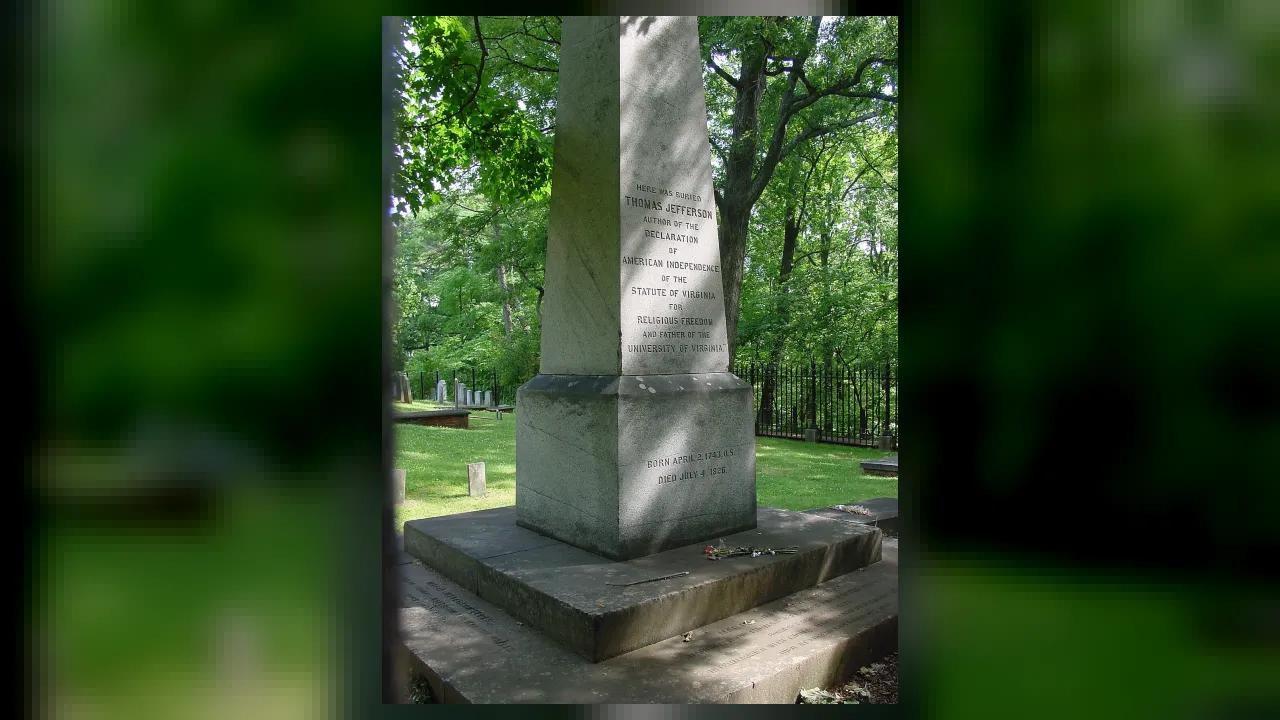
Thomas Jefferson asked for this law to be carved onto his gravestone at Monticello instead of listing that he served two terms as U.S. President!
✨ Word Sparks (Grade 2 Glossary)
Tap 🔊 to hear
worship
To honor and practice one's religious faith
debate
To discuss different sides of an important idea
citizen
A member of a state or country
🪝
Why did Thomas Jefferson care even more about this Virginia law than being President?
1
A New Idea in Fredericksburg
Picture Thomas Jefferson dipping his quill pen into ink in 1777! In colonial days, Virginia had one official church supported by everyone's tax money. Jefferson believed the government should never force anyone to attend or pay for a church.
2
Teamwork With James Madison
For nine years, lawmakers debated Jefferson's bold idea while Jefferson traveled to France. Back home in Richmond, his friend James Madison spoke up bravely until Virginia passed the law on January 16, 1786.
3
Inspiring the First Amendment
Under this new statute, all Virginians could freely—or not at all—without losing any rights as . Five years later, this Virginia promise became a model for America's First Amendment!
1. In what year did Virginia officially pass the Statute for Religious Freedom?
2. Which part of the U.S. Constitution grew out of the Virginia Statute for Religious Freedom?
🤯 Mind-Blowing Fact • Grade 3
When Thomas Jefferson sent copies of the new Virginia law to European scholars in Paris, it was translated into French and Italian and praised across Europe!
✨ Word Sparks (Grade 3 Glossary)
Tap 🔊 to hear
conscience
Inner sense of right, wrong, and personal belief
voluntary
Done by free choice rather than by force
petition
A written request signed by many citizens
🪝
How did two Virginians team up across an ocean to give America true freedom of conscience?
1
Life Under an Established Church
Imagine living in Virginia before the American Revolution, when colonial laws required every taxpayer to support one official church! Baptists, Presbyterians, Quakers, Jewish families, and nonbelievers faced fines or restrictions if they practiced outside the state-backed system.
2
Jefferson Drafts a Bold Bill
After writing the Declaration of Independence in 1776, Thomas Jefferson returned to Virginia to reform outdated colonial laws. Meeting in Fredericksburg in 1777, he drafted the Virginia Statute for Religious Freedom, declaring that Almighty God created the mind completely free.
3
Madison Wins the Vote in 1786
While Jefferson served as America's minister in Paris, some leaders proposed a new state tax to pay religious teachers. James Madison wrote a famous explaining why faith must always be , rallying citizens until the Virginia General Assembly passed Jefferson's bill on January 16, 1786.
4
A Model for the Young Nation
The statute stated that every person is free to profess and maintain religious opinions without affecting their civil capacities. In 1791, Madison carried that exact principle into the First Amendment of the U.S. Bill of Rights.
1. Where was Thomas Jefferson serving when the Virginia General Assembly finally passed his statute in 1786?
2. What did the Virginia Statute for Religious Freedom guarantee about civil rights?
🤯 Mind-Blowing Fact • Grade 4
Out of his entire life—including serving as Governor, Secretary of State, Vice President, and President—Jefferson chose only three achievements for his Monticello obelisk: the Declaration of Independence, this Statute, and founding the University of Virginia!
✨ Word Sparks (Grade 4 Glossary)
Tap 🔊 to hear
interference
Stepping in to control something without right
enact
To officially make a proposed bill into law
remonstrance
A formal written protest explaining strong objections
🪝
How did thousands of everyday Virginians signing petitions help turn Thomas Jefferson's 1777 draft into a landmark of world history?
1
Challenging Centuries of Tradition
Think about nearly every kingdom in the world in the 1700s: rulers assumed a nation would crumble unless one official state church collected taxes and enforced uniform beliefs! Even after George Mason's 1776 Virginia Declaration of Rights promised 'free exercise of religion,' Virginia still debated whether tax dollars should fund religious instruction.
2
Jefferson's Argument for a Free Mind
Drafting his statute in Fredericksburg in 1777 and introducing it in 1779, Thomas Jefferson argued that forcing people to fund opinions they disbelieve is unfair, and that truth stands strong on its own when ideas are discussed openly without government .
3
Madison's Memorial and Remonstrance
In 1784–1785, when lawmakers considered a general tax for teachers of Christianity, James Madison wrote his persuasive 'Memorial and Against Religious Taxes.' Over ten thousand Virginians—including Baptists, Presbyterians, Methodists, Lutherans, Quakers, and Anglicans—flooded Richmond with nearly one hundred signed petitions.
4
From Virginia Law to Constitutional Cornerstone
Moved by public support, the General Assembly enacted the Virginia Statute for Religious Freedom on January 16, 1786. It became a pillar of Virginia Studies and inspired both the Establishment Clause and the Free Exercise Clause of the First Amendment.
1. How did ordinary Virginia citizens help pass the Virginia Statute for Religious Freedom in 1785–1786?
2. Which three accomplishments did Thomas Jefferson choose to have engraved on his gravestone at Monticello?
🤯 Mind-Blowing Fact • Grade 5
In a celebratory 1786 letter to Thomas Jefferson in Paris, James Madison wrote that passing the Virginia statute had 'extinguished forever the ambitious hope of making laws for the human mind'!
✨ Word Sparks (Grade 5 Glossary)
Tap 🔊 to hear
compulsion
Forcing someone to obey against personal choice
preamble
An opening statement explaining a law's purpose
inherently
Existing naturally inside someone from the start
🪝
Why did Thomas Jefferson and James Madison view separating civil rights from religious compulsion as one of the greatest breakthroughs of the Enlightenment?
1
From Toleration to Complete Liberty
Consider the subtle yet profound difference between religious 'toleration' and true religious 'freedom'! Under colonial rule, one established church enjoyed tax funding while dissenting denominations needed special government permission to preach. Even after George Mason championed free exercise in Section 16 of the 1776 Virginia Declaration of Rights, Virginia's legal code still linked public taxation and church governance.
2
Drafting Bill No. 82 in 1777
Serving on the committee revising Virginia's laws in Fredericksburg in 1777, Thomas Jefferson composed Bill No. 82 in three soaring parts: a philosophical defending intellectual freedom, an enacting clause abolishing compelled worship or church taxes, and a closing reminder that natural rights belong to humanity.
3
The Great Petition Campaign of 1785
When Patrick Henry backed a bill funding teachers of religion through property taxes in 1784, James Madison delayed the vote and anonymously circulated his fifteen-point 'Memorial and Remonstrance' in summer 1785. Evangelical Baptists, Presbyterians, Quakers, and Enlightenment thinkers united, delivering roughly ninety petitions with nearly eleven thousand signatures to Richmond—burying the tax proposal and reviving Jefferson's dormant bill.
4
Enactment on January 16, 1786
Signed into law by House Speaker Benjamin Harrison V, the statute guaranteed that 'all men shall be free to profess, and by argument to maintain, their opinions in matters of religion,' and that belief would 'in no wise diminish, enlarge, or affect their civil capacities.' Madison exulted to Jefferson in Paris that Virginia had extinguished forever the ambitious hope of making laws for the human mind.
5
Blueprint for the First Amendment
Three years later, in 1789, Representative James Madison drew directly upon Virginia's triumph when framing the First Amendment's twin protections: 'Congress shall make no law respecting an establishment of religion, or prohibiting the free exercise thereof.'