1. What spins at the top of a vibraphone's tubes to make the sound wave gently?
2. What happens when the player lifts their foot off the vibraphone pedal?
🤯 Mind-Blowing Fact • Grade 2
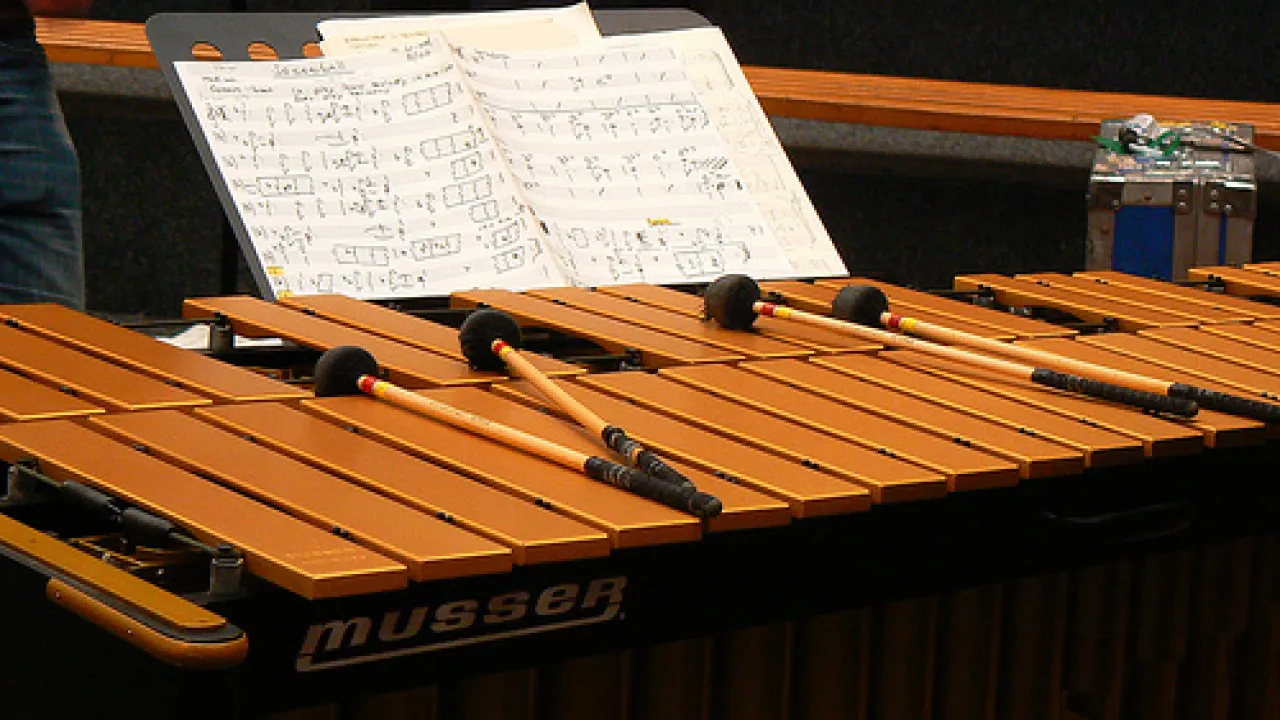
Unlike a xylophone or marimba where sharp-note bars sit slightly raised, all the bars on a vibraphone lie completely flat on one single level!
✨ Word Sparks (Grade 2 Glossary)
Tap 🔊 to hear
aluminum
A lightweight, silvery metal that rings clearly
sustain
Letting a musical note keep ringing smoothly
motor
A small machine that spins parts using electricity
🪝
Why does a vibraphone have both a plug-in motor and a piano-style foot pedal?
1
Liquid Silver Music
Ping-woooo-woooo! Close your eyes at a cozy jazz concert and listen to chords that seem to float in midair like glowing bubbles. Those velvety, shimmering notes come from the vibraphone!
2
Metal Bars That Ring and Hush
Unlike wooden xylophones, a vibraphone has bars made of smooth metal. Metal rings for a long time when struck, which would blur fast songs into a messy cloud! To control that ring, a long strip of soft felt presses beneath the bars until the player steps on a foot pedal.
3
Motorized Shimmer
Flip on its quiet electric , and flat metal discs spin inside the tops of the resonator tubes, making every sustained chord pulse with a dreamy wave.
1. Why does a vibraphone need a felt damper bar controlled by a foot pedal?
2. How are the two rows of bars arranged on top of a vibraphone?
🤯 Mind-Blowing Fact • Grade 3
In 1930, drummer Lionel Hampton spotted a brand-new vibraphone sitting in a recording studio corner, taught himself on the spot, and recorded a hit song with Louis Armstrong less than an hour later!
✨ Word Sparks (Grade 3 Glossary)
Tap 🔊 to hear
pulsator
Spinning disc that opens and closes resonator tubes
damper
A felt pad that stops vibrations on contact
metallophone
Any barred percussion instrument made of tuned metal
🪝
How did an early twentieth-century theatre sound-effects experiment become a superstar of cool jazz?
1
Cool Chords in Motion
Bling-wah-wah-wah! Four cord-wrapped mallets drop together onto gleaming gold-tinted aluminum bars, and a warm, pulsing chord washes across the stage. Part percussion, part keyboard, and part mechanical invention, the vibraphone sounds unlike anything built in ancient times.
2
How Spinning Pulsators Sculpt the Air
Hanging beneath every aluminum bar is a tuned metal resonator tube. Mounted right inside the mouth of each tube sits a thin circular metal disc called a , connected to a long spinning rod driven by a quiet electric motor. Each time the disc turns flat, it blocks the resonator tube; each time it turns sideways, the amplified sound rushes out!
3
Pedaling and Mallet Damping
Because aluminum vibrates with very little internal friction, struck bars ring for many seconds. Pressing the sustain pedal pulls down a spring-loaded felt bar so harmonies bloom. Players also press a silent mallet onto a single ringing bar to hush one note while others keep singing!
4
Born in America for Jazz and Orchestra
Invented in the United States between 1916 and 1921 by Hermann Winterhoff and perfected by Henry Schluter, the vibraphone soared to fame when jazz legend Lionel Hampton recorded sparkling solos alongside Louis Armstrong in 1930.
1. How do the spinning pulsator discs inside a vibraphone create a wavering sound?
2. Which jazz pioneer famously discovered a studio vibraphone in 1930 and made it a jazz icon?
🤯 Mind-Blowing Fact • Grade 4
Rubbing a rosined double-bass bow slowly down the edge of a vibraphone bar with the sustain pedal pressed produces a pure, floating sound that resembles glass harmonicas or singing whales!
✨ Word Sparks (Grade 4 Glossary)
Tap 🔊 to hear
tremolo
A rapid, pulsing rise and fall in volume
anodized
Coated electrochemically with a protective, colored metal layer
dampening
Touching a vibrating bar intentionally to silence it
🪝
Wait—does a vibraphone actually produce pitch vibrato, or is its famous spinning motor playing a clever acoustic trick on our ears?
1
The Youngest Classic in the Percussion Section
Shimmering like starlight through mist, the vibraphone is barely a century old, yet it anchors modern jazz quartets, film scores, and twentieth-century symphonies alike. Standard three-octave models span from F3 below middle C up to F6, built from precision-machined aluminum alloy bars in silver or gold.
2
Tremolo Disguised as Vibrato
Here is an acoustic surprise: despite its name, the vibraphone's spinning fans mostly create amplitude —pulsing changes in loudness—rather than true pitch vibrato! When the motorized shaft rotates the flat metal pulsators inside the tops of the quarter-wave resonator tubes, each quarter turn alternates between sealing the air column and opening it to sympathetic resonance. Because blocking the mouth of a tube also nudges its resonant frequency slightly downward, our ears blend those rapid volume swells with tiny frequency shifts into a lush, vocal-like shimmer.
3
Mallet Dampening and Bowed Singing
Because both rows of aluminum bars sit flush on one flat plane, players using four cord-wrapped mallets can glide a mallet tip onto an old note to silence it while striking a fresh harmony elsewhere—a technique called mallet . Even more hauntingly, drawing a rosined contrabass bow vertically down the edge of a bar makes the metal sing an eerie, floating whistle!
4
From Vaudeville Novelty to Concert Art
First built in Indianapolis in 1916 for vaudeville stages and refined with aluminum bars and a foot damper by Henry Schluter at Deagan in 1927, the instrument evolved through jazz innovators Milt Jackson and Gary Burton, as well as orchestral works by Alban Berg, Olivier Messiaen, and Leonard Bernstein.
1. What acoustic effect do a vibraphone's spinning discs primarily create despite the instrument's name?
2. How can a percussionist draw a long, eerie, flute-like singing tone from a vibraphone without striking it?
🤯 Mind-Blowing Fact • Grade 5
Turning on a vibraphone's spinning fans actually shortens how long a note rings, because each open phase of the resonator pulls acoustic energy out of the vibrating aluminum bar faster into the room air!
✨ Word Sparks (Grade 5 Glossary)
Tap 🔊 to hear
antinode
Point along a bar where vibration swings widest
occlude
Close off or block an opening completely
transients
Brief bursts of sound right at initial impact
🪝
How do aluminum metallurgy, low internal damping, and motorized acoustic modulation unite to make the vibraphone the most pianistic mallet instrument ever engineered?
1
Metallurgy Engineered for Suspended Harmony
Strike a rosewood xylophone bar and internal wood-fiber friction extinguishes the note within half a second; strike a tempered aluminum vibraphone bar with the damper pedal depressed and its crystalline tone hangs suspended in air for eight to twelve seconds! That extraordinary sustain transformed mallet percussion from brisk rhythmic decoration into a lush harmonic voice.
2
Arch Tuning and Planar Keyboard Geometry
Classified organologically as a pitched struck metallophone (111.222), the standard concert vibraphone spans three octaves from F3 (174.6 hertz) to F6 (1,396.9 hertz), while extended solo instruments reach four octaves (C3–C7). Builders mill bars from heat-treated aluminum alloy—lighter and warmer in timbre than steel—and carve a deep underside arch that tunes the prominent second partial two octaves above the fundamental (a 4:1 ratio). Crucially, both natural and accidental rows occupy a single horizontal plane, allowing four-mallet virtuosi to execute pedaling, fingered legato, and selective hand or mallet dampening to voice intricate jazz chords cleanly.
3
Aero-Acoustic Physics of the Rotating Pulsators
Beneath each bar hangs a cylindrical quarter-wavelength stopped tube tuned slightly sharp or matched to the bar's fundamental. Driven by variable-speed belts or direct-drive brushless motors (typically adjustable from 1 to 12 hertz), two gang shafts rotate thin circular vanes—pulsators—inside the upper mouths of the resonators. When vanes align vertically, full Helmholtz-like pipe coupling amplifies the fundamental; rotated horizontally to ninety degrees, they the aperture, dropping radiated amplitude while momentarily detuning the coupled air column and accelerating energy decay when spinning.
4
Extended Articulations: Dead Strokes and Bowing
Tightly wound cord mallets prevent harsh metallic slap while preserving articulate warmth. Pressing a mallet head firmly into the center produces a dry percussive 'dead stroke,' whereas drawing a rosined contrabass bow along a bar's free antinodal end excites sustained stick-slip oscillations devoid of impact .
5
Twentieth-Century Innovation to Modern Classic
Following Hermann Winterhoff's 1916 motorized steel 'vibra-harp' at Leedy Manufacturing, J.C. Deagan chief tuner Henry Schluter introduced aluminum bars, double-octave arch tuning, and the spring-loaded foot damper bar between 1921 and 1927. Jazz titans Lionel Hampton, Red Norvo, Milt Jackson, Bobby Hutcherson, and four-mallet pioneer Gary Burton—alongside composers Alban Berg (Lulu), Messiaen, Boulez, and Steve Reich—cemented its global stature.