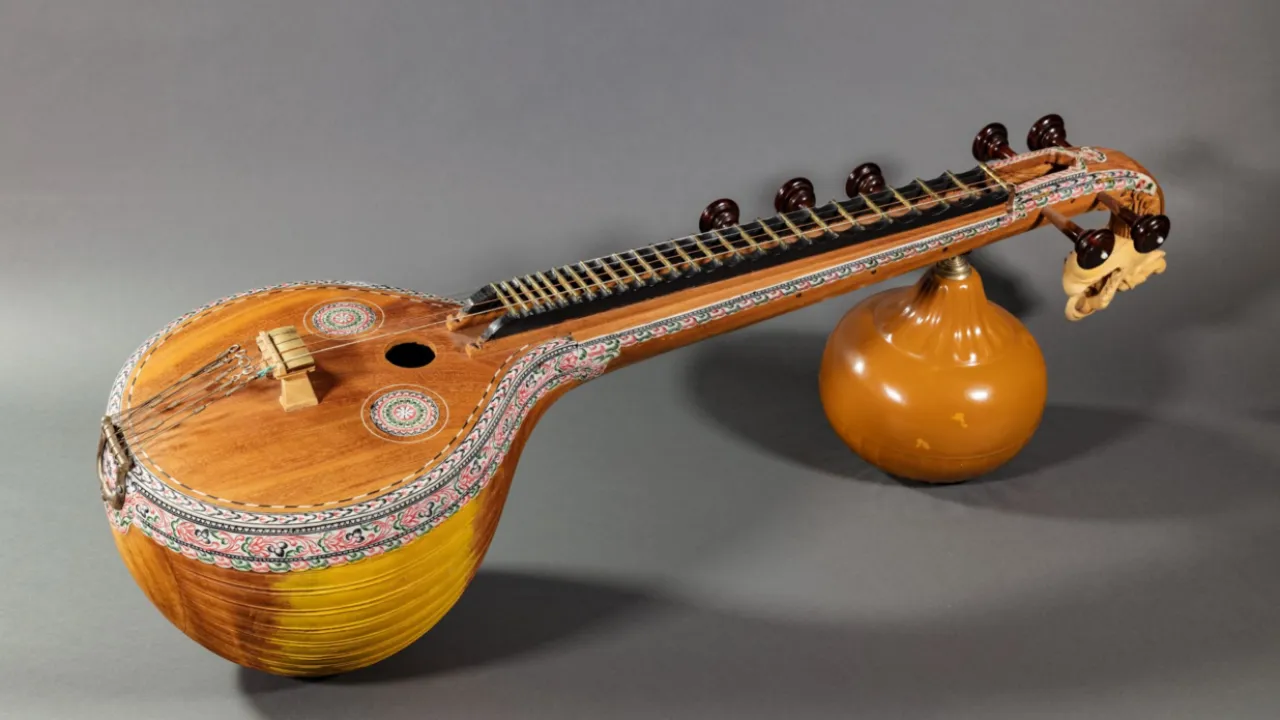
1. Which special tropical tree wood is prized for carving a traditional South Indian veena?
2. What holds the twenty-four shiny brass bars in place along the neck?
🤯 Mind-Blowing Fact • Grade 2
In Indian art and stories, Saraswati—the Hindu goddess of wisdom, learning, and music—is always pictured cradling a graceful veena!
✨ Word Sparks (Grade 2 Glossary)
Tap 🔊 to hear
yali
Mythical dragon-lion creature carved on veena scrolls
melody
Singing tune made of musical notes
seasoned
Wood dried slowly so it stays strong
🪝
How can one musician play a singing melody and keep the beat at the exact same time on a veena?
1
One of History's Oldest Voices
Pluck one long metal string and pull it gently across a brass bar, and hear a warm, bell-like note curl through the air like singing! Poems from India more than three thousand years ago praised ancestors of the veena.
2
Two Gourds, Balanced on a Lap
Seated cross-legged on the floor, a musician rests the large carved wooden bowl on the ground and balances a smaller round gourd under the neck on their left thigh. At the tip of the neck curls a carved mythical creature called a !
3
Four Melody Wires, Three Rhythm Wires
Pointer and middle fingers pluck four main strings on top to shape beautiful melodies across twenty-four brass frets. Meanwhile, the player's right pinky finger brushes upward against three side strings to mark the steady musical beat!
1. What job do the three extra strings running along the side of the veena's neck perform?
2. Why is there a second round resonator attached underneath the upper end of the veena's neck?
🤯 Mind-Blowing Fact • Grade 3
Craftspeople in the South Indian town of Thanjavur have passed down secret family skills for carving jackfruit-wood veenas for more than four hundred years—earning official heritage protection!
✨ Word Sparks (Grade 3 Glossary)
Tap 🔊 to hear
Carnatic
Classical musical tradition of southern India
gamaka
Graceful shaking or sliding musical note ornament
scalloped
Shaped with smooth scooped curves between edges
🪝
Why are a veena's twenty-four brass frets set into scalloped walls of black beeswax instead of wooden slots?
1
Queen of South Indian Strings
What would happen if every tiny quiver, slide, and grace note of a classical singer's voice lived inside four feet of carved jackfruit wood? Meet the Saraswati veena, the revered string treasure of South Indian music!
2
Beeswax Walls and Twenty-Four Frets
Unlike the sitar's movable frets, the Saraswati veena features twenty-four fixed brass frets—one for every half step across two full octaves! Luthiers mold twin ledges of beeswax mixed with fine charcoal along the hollow neck, warming the wax slightly whenever a fret's pitch needs delicate tuning.
3
Deep Scallops for Expressive Pulls
Because the wax curves downward in deep scallops between frets, players can press or pull a string sideways to bend pitches smoothly without touching wood. That fluid motion brings ornaments called vividly to life.
4
A Brass-Topped Bridge
Down on the flat wooden soundboard, strings cross a wide wooden bridge topped with a curved brass plate, adding a warm, golden shimmer to every note.
1. How many fixed brass frets line the neck of a classic Saraswati veena?
2. Why is the black beeswax scooped into deep curved scallops between each brass fret?
🤯 Mind-Blowing Fact • Grade 4
Fixing twenty-four chromatic frets onto the Thanjavur veena in the 1600s inspired music theorist Venkatamakhin—Govinda Dikshitar's own son—to map out Carnatic music's famous mathematical chart of 72 complete parent scales!
✨ Word Sparks (Grade 4 Glossary)
Tap 🔊 to hear
ekanda
Veena sculpted from one unbroken wood log
melakarta
Complete seven-note parent scale in Carnatic music
zither
String instrument stretched along a straight body
🪝
How did seventeenth-century scholars in Thanjavur redesign an ancient Vedic instrument to unlock every scale in South Indian classical music?
1
Three Millennia of Sacred Sound
Touch a finger to a brass fret in a quiet South Indian temple courtyard and pluck: a rich, amber-colored note swells from seasoned jackfruit wood, shimmering against a gentle brass bridge plate. In ancient Sanskrit texts such as the Rigveda and Sama Veda, 'veena' originally named the entire family of Indian stringed instruments.
2
The Seventeenth-Century Thanjavur Breakthrough
Earlier South Indian veenas had movable frets that forced musicians to pause and retune between scales. Around the early 1600s in the royal court of Thanjavur in Tamil Nadu, King Raghunatha Nayak and music scholar Govinda Dikshitar engineered a revolutionary upgrade: cementing twenty-four fixed brass frets into twin beeswax-and-charcoal tracks, allowing seamless performance across all seventy-two parent ragas!
3
Ekanda Single-Log Craftsmanship
Standard veenas join three separate jackfruit-wood pieces—bowl (kudam), hollow neck (dandi), and yali scroll. Yet master Thanjavur artisans reserve their highest reverence for the veena, painstakingly chiseling bowl, hollow neck, and dragon scroll from one unbroken tree trunk so acoustic vibrations flow uninterrupted from bridge to pegbox!
4
Two Cousins: Saraswati and Rudra Veena
While South India cherishes the lute-shaped Saraswati veena, North India preserves a majestic cousin called the Rudra veena—a deep-voiced bamboo-or-teak tube suspended atop two giant calabash gourds for meditative dhrupad concerts.
1. What major upgrade did King Raghunatha Nayak and Govinda Dikshitar introduce in seventeenth-century Thanjavur?
2. What makes an 'ekanda veena' extra prized by Carnatic soloists and builders?
🤯 Mind-Blowing Fact • Grade 5
Unlike almost every other fretted instrument in the world, the Saraswati veena holds ZERO sympathetic strings—relying entirely on one-log jackfruit resonance, viscoelastic beeswax, and its brass-topped bridge for lush sustain!
✨ Word Sparks (Grade 5 Glossary)
Tap 🔊 to hear
viscoelastic
Both springy and softly shock-absorbing at once
tanam
Rhythmic pulsing improvisation unique to Carnatic music
kudam
Large hemispherical jackfruit-wood bowl of veena
🪝
How did embedding twenty-four brass frets in viscoelastic beeswax and coupling a brass-crowned bridge with a rosin-damped resin joint perfect Carnatic vocal ornamentation?
1
Vocal Microtones in Carved Jackfruit Wood
Pluck the lowest bronze sarani string tuned near C2 (65.4 hertz) or F2 (87.3 hertz) while deflecting a steel melody wire across two semitones on an upper fret past B5 (987.8 hertz), and every subtle inflection of Carnatic singing materializes in wood and metal. Revered as the Saraswati veena (Hornbostel-Sachs 321.321), this four-and-a-half-foot fretted lute embodies over three millennia of South Asian organological evolution.
2
Thanjavur Standardization and the 72 Melakartas
Referenced from Vedic hymns and Sangam Tamil epics to temple sculptures across South India, the instrument reached its definitive concert form in early seventeenth-century Thanjavur under Nayak ruler Raghunatha Nayak and minister-musicologist Govinda Dikshitar. Replacing older movable frets with twenty-four fixed, half-round brass rods spanning two chromatic octaves enabled Govinda Dikshitar's son, Venkatamakhin, to formulate the symmetrical seventy-two-melakarta raga classification system in his treatise Chaturdandi Prakasika.
3
Panasa Wood Acoustics and Dual-Bridge Geometry
Luthiers prize seasoned Artocarpus heterophyllus (jackfruit, or panasa) wood because its low density and uniform cellular grain warm midrange frequencies without harshness—culminating in the seamless single-log ekanda veena. On the slightly domed soundtable stands a broad wooden kudurai bridge capped with a gently cambered brass plate affixed via a precise pine-rosin compound, generating rich grazing harmonics, while an adjacent arched side-bridge carries three high-pitched tala drone strings.
4
Viscoelastic Beeswax Ledges and Gamaka Mechanics
Two parallel ridges compounded from beeswax, charcoal powder, and vegetable oil cradle the twenty-four frets above a hollow wooden dandi neck balanced by an auxiliary upper gourd resonator (surakkai). That wax bed damps unwanted metallic buzz while scalloped troughs between frets permit two-finger lateral string deflections spanning up to a perfect fourth—essential for executing the ten classical classes of Carnatic gamaka ornaments.
5
Living Lineage Alongside the Rudra Veena
Whether unfolding structured rhythmic pulses where right-hand index, middle, and little fingers interlock melody with cyclic tala accents, or conversing across traditions with its North Indian stick-zither relative—the twin-gourd dhrupad Rudra veena—the veena remains the foundational acoustic blueprint of Indian music theory.