1. How many bright stars make up the famous Big Dipper shape?
2. What does the Latin name 'Ursa Major' mean in English?
🤯 Mind-Blowing Fact • Grade 2
From much of Canada, Europe, and the northern United States, the Big Dipper circles the North Pole all night without ever dipping below the horizon!
✨ Word Sparks (Grade 2 Glossary)
Tap 🔊 to hear
pointer stars
bowl stars aiming straight at Polaris
circumpolar
circling the pole without ever setting
navigator
person steering ships or journeys using stars
🪝
How did seven bright stars help sailors cross dark oceans and freedom seekers find their way north?
1
Asterism Inside a Constellation
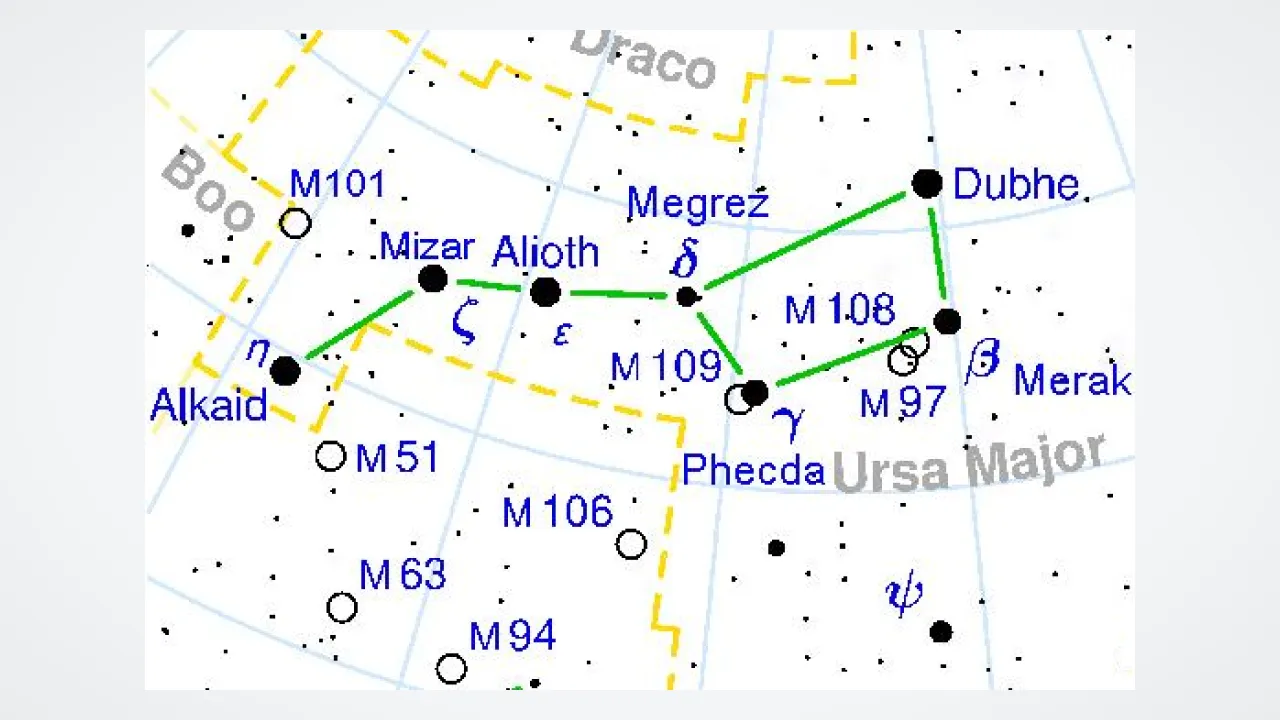
People often call the Big Dipper a constellation, yet astronomers have a special surprise! The Big Dipper is actually an asterism—an easy-to-spot star shape tucked inside a much larger constellation named Ursa Major, the Great Bear.
2
The Famous Pointer Stars
Two stars on the front edge of the Dipper's bowl, named Merak and Dubhe, act like a glowing sky arrow. Draw an imaginary line five times their spacing across the sky and you hit Polaris, the steady North Star!
3
A Sky Map Across Cultures
People in Britain called the Dipper the Plough, Vikings saw Odin's Wagon, and enslaved Americans escaping to freedom followed 'the Drinking Gourd' northward by night.
1. Which two stars of the Big Dipper point straight toward Polaris, the North Star?
2. Is the Big Dipper a full official constellation or an asterism inside Ursa Major?
🤯 Mind-Blowing Fact • Grade 3
Mizar in the Big Dipper's handle made astronomy history twice—as the first telescopic double star discovered in 1617 and the first double star ever photographed in 1857!
✨ Word Sparks (Grade 3 Glossary)
Tap 🔊 to hear
moving group
sibling stars traveling together through space
double star
two stars appearing close or orbiting together
spiral galaxy
pinwheel-shaped city of billions of stars
🪝
Why will the Big Dipper slowly stretch into a completely different shape 100,000 years from now?
1
Five Sibling Stars on the Move
Watch the Big Dipper wheel around Polaris from spring (“spring up, fall down”) through autumn, and its spoon shape looks frozen forever. Yet space telescopes measured a remarkable secret: five of its seven stars—Alioth, Mizar, Merak, Phecda, and Megrez—were born together 300 million years ago! Sitting just 80 light-years from Earth, they cruise together as the Ursa Major .
2
Two Rebels Heading the Other Way
Meanwhile, the two stars at the very ends of the Dipper—orange giant Dubhe at the lip and hot blue Alkaid at the handle tip—aren't family members at all! Because they race in the opposite direction at tens of miles per second, the Dipper will slowly bend into a stretched duckbill shape over the next 100,000 years.
3
The Eye Test: Mizar and Alcor
Look closely at Mizar, the middle star of the handle, to spot fainter Alcor right beside it. Telescopes reveal Mizar is four stars orbiting together and Alcor is two—six stars in one spot!
4
Galaxies Beyond the Bear
Peering past Ursa Major's stars, astronomers photographed the grand spiral Bode's Galaxy (M81) and pointed Hubble at an 'empty' speck to capture the historic Hubble Deep Field!
1. Why will the Big Dipper's shape slowly warp over the next 100,000 years?
2. How many stars actually orbit inside the famous Mizar-and-Alcor system in the Dipper's handle?
🤯 Mind-Blowing Fact • Grade 4
Just off Ursa Major's nose, Bode's Galaxy (M81) and the Cigar Galaxy (M82) brushed past each other 12 million light-years away, sparking a furious 'starburst' fountain of newborn stars in M82!
✨ Word Sparks (Grade 4 Glossary)
Tap 🔊 to hear
proper motion
a star's gradual drift across our sky
starburst galaxy
galaxy birthing new stars at furious rates
deep field
long telescope exposure revealing ultra-distant galaxies
🪝
Why did tribes in Ice Age Siberia and Indigenous nations in North America independently name these exact same stars a Great Bear?
1
Ancient Stories Across Continents
Spanning 1,280 square degrees—third largest of all 88 official constellations—Ursa Major holds an astonishing anthropological mystery. Both ancient Mediterranean cultures and Indigenous Algonquian and Haudenosaunee storytellers in North America saw a Great Bear pursued by three hunters (the three handle stars)! Historians suggest Paleolithic Ice Age travelers may have carried this ancient bear story across the Bering land bridge more than 13,000 years ago.
2
A Sky Clock and Compass
Above 41 degrees north latitude, the Big Dipper is circumpolar—never sinking below the horizon as Earth spins every 23 hours and 56 minutes. Not only do Merak and Dubhe point five bowl-widths straight to Polaris (and curving along the handle 'arcs to Arcturus' in Boötes), the Dipper's revolving position around Polaris acts like an hour hand on a giant 24-hour sky clock.
3
The Closest Open Cluster Core
Measured precisely by ESA's Gaia spacecraft, the five middle Dipper stars form the core of the Ursa Major Moving Group—at roughly 80 light-years away, the closest cluster-born stellar stream to our Solar System. In fact, our own Sun passes right through the outer halo of this stream as an unrelated passerby!
4
Window into the Deepest Cosmos
Because Ursa Major points well away from the dusty plane of our Milky Way, astronomers aimed Hubble at a tiny grain-of-sand patch near the Dipper for ten days in 1995—unveiling 3,000 Primordial galaxies in the landmark Hubble .
1. Why was a dark patch inside Ursa Major chosen for the famous 1995 Hubble Deep Field?
2. If you follow the curve of the Big Dipper's handle outward ('arc to...'), which bright orange star do you find?
🤯 Mind-Blowing Fact • Grade 5
Alioth, the brightest star in the Big Dipper, is a quirky 'chemically peculiar' Ap star whose powerful angled magnetic field concentrates chromium and europium into giant star-spots along its magnetic equator!
✨ Word Sparks (Grade 5 Glossary)
Tap 🔊 to hear
spectroscopic binary
twin stars detected via shifting rainbow lines
coeval
born at the exact same cosmic time
galactic latitude
angle above or below Milky Way's disk
🪝
How did precise stellar kinematics inside the Big Dipper prove that stars scatter across the galaxy in coeval sibling streams?
1
Bayer's Geographic Ordering and Celestial Span
Covering 3.1 percent of the entire celestial sphere across 1,280 square degrees, Ursa Major ranks third in area behind Hydra and Virgo. When German uranographer Johann Bayer assigned Greek letters to its stars in 1603, he bypassed brightness rank and instead lettered the Big Dipper sequentially from bowl lip to handle tip: Dubhe (Alpha), Merak (Beta), Phecda (Gamma), Megrez (Delta), Alioth (Epsilon—actually the brightest at magnitude 1.77), Mizar (Zeta), and Alkaid (Eta). Surrounding this famous heptad, fainter stars trace the Bear's extended snout (Muscida) and three distinctive pairs of 'leaps of the gazelle' paws recognized by medieval Arab astronomers.
2
Discovery of Stellar Moving Groups
In 1869, British astronomer Richard A. Proctor plotted stellar proper motions and noticed something extraordinary: five of the seven Dipper stars shared virtually identical space velocity vectors! Known today as Collinder 285 or the Ursa Major Moving Group, these A-type main-sequence stars—born from a single molecular cloud roughly 300 to 500 million years ago—lie just 78 to 84 light-years away, whereas K-giant Dubhe (123 light-years) and B-type Alkaid (104 light-years) plunge along unrelated galactic orbits.
3
Spectroscopic Firsts in Mizar and Alcor
Zeta Ursae Majoris (Mizar) and 80 Ursae Majoris (Alcor), separated by 11.8 arcminutes, hold unmatched historical significance. Galileo's protégé Benedetto Castelli resolved Mizar A and Mizar B telescopically in 1617; then in 1889 at Harvard, Edward C. Pickering noticed dark spectral lines in Mizar A periodically splitting and merging via Doppler shifts—discovering humanity's very first ! Modern interferometers confirm Mizar A and B are both close binaries gravitationally bound to binary Alcor 75,000 astronomical units away.
4
Extragalactic Treasures Through the Galactic Halo
Positioned at high (around +50 degrees) with minimal interstellar extinction, Ursa Major hosts textbook spiral Pinwheel Galaxy M101, interacting pair M81 and starburst M82, planetary Owl Nebula M97, and December 1995's ten-day Hubble Deep Field exposure.
5
Compass Across Human History
From Polynesian and Viking latitude reckoning to Harriet Tubman guiding Underground Railroad travelers by Merak and Dubhe's unerring pointer line toward Polaris, Ursa Major bridges human courage with galactic astrophysics.