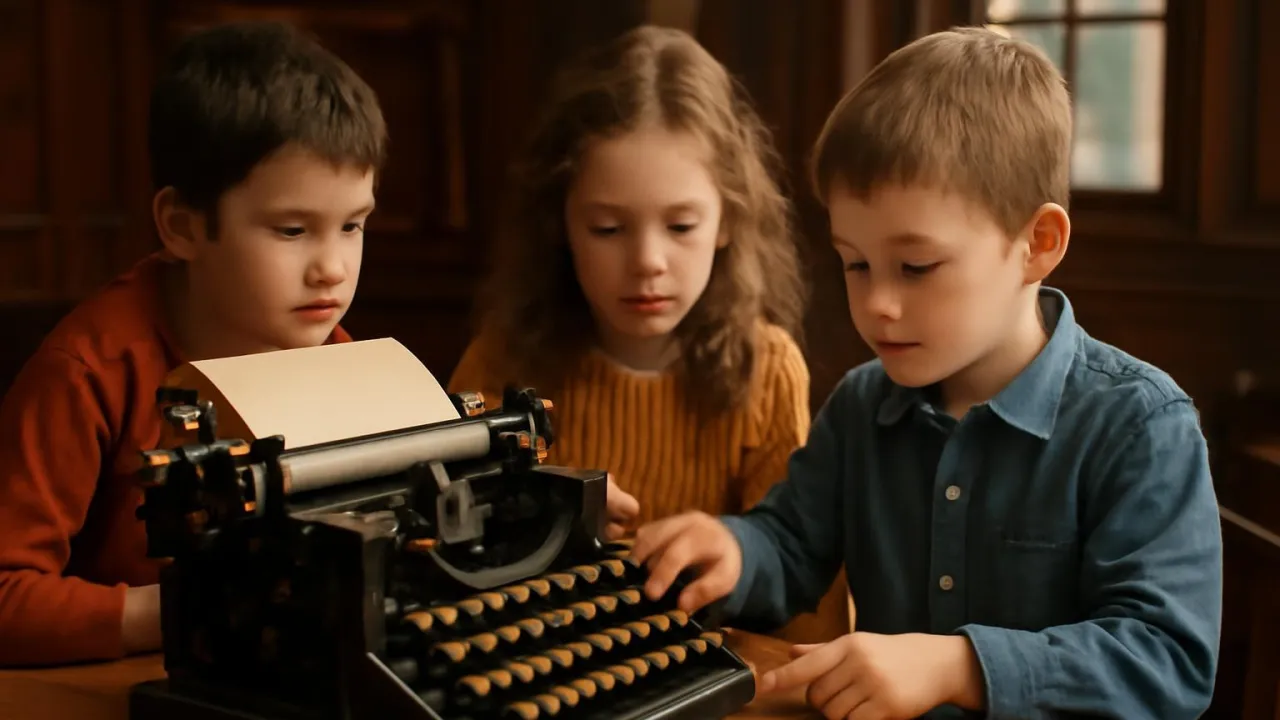
Typewriter keys are arranged in the QWERTY order, not alphabetically!
✨ Word Sparks (Grade 2 Glossary)
Tap 🔊 to hear
ribbon
A strip with ink for printing
stamp
To press a shape onto something
office
A place where people work
🪝
Have you ever heard a room full of clicking keys?
1
Tapping Out Words
When you press a typewriter key, a metal arm jumps up and a letter. Each letter appears on the paper with a click, and the sound is quick and sharp. People loved how fast they could write with it.
2
A New Way to Write
Typewriters helped people write letters and stories much faster than with a pen. and schools used them every day, and even children could learn to type. The neat letters made reading easy for everyone.
3
How It Works
The typewriter uses ink to print letters onto paper. Each key is linked to a special letter arm, so pressing a key always makes the right shape. It was a clever invention that changed writing forever.
Mark Twain was the first author to submit a typed book manuscript to his publisher!
✨ Word Sparks (Grade 3 Glossary)
Tap 🔊 to hear
typebar
A metal arm that prints letters
QWERTY
The top row of keyboard letters
vibration
Fast shaking movement that makes sound
🪝
Imagine hearing hundreds of metal keys tapping out stories at once!
1
Mechanical Magic
When you press a typewriter key, a metal arm called a swings up and strikes an inked ribbon. The ribbon presses against the paper, leaving a clear letter behind. This creates the famous click-clack sound that filled offices for decades. Each key is carefully linked to its own letter, so every tap is precise.
2
A Revolution in Writing
Before typewriters, people wrote everything by hand, which was slow and tiring. The invention of the typewriter made writing much faster and easier to read. Offices, newspapers, and schools quickly adopted these machines for their work. Even famous authors used typewriters to write their books and stories.
3
Inventing the QWERTY Keyboard
Christopher Latham Sholes invented the first practical typewriter in 1868. He also designed the keyboard, which arranged the keys to prevent jams. This clever layout is still used on most computer keyboards today, showing the typewriter’s lasting impact.
4
How Typewriters Changed the World
Typewriters helped more people learn to read and write by making communication faster. They allowed offices to work more efficiently and helped spread news quickly. The typewriter’s acoustic click even inspired early computer sounds. Today, some people still enjoy the feel and sound of typing on these classic machines.
The fastest recorded typing speed on a manual typewriter is 216 words per minute!
✨ Word Sparks (Grade 4 Glossary)
Tap 🔊 to hear
typebar
A lever that stamps a letter
prototype
The first working model of something
jam
When parts get stuck together
🪝
What if every important letter or story you read began with a chorus of mechanical clicks?
1
The Birth of Mechanical Writing
The typewriter emerged in the late 1800s, forever changing how people communicated and worked. Christopher Latham Sholes, along with his partners, invented the first successful model in Milwaukee, Wisconsin. Their invention used a clever system of levers and to transfer inked letters onto paper. The rhythmic click-clack of these machines soon echoed in offices, schools, and newsrooms across the world.
2
Engineering the Typewriter
Each key on a typewriter is connected to a , which swings up to strike an ink ribbon and press a letter onto paper. The QWERTY keyboard layout, invented by Sholes, spaced out commonly used letters to prevent typebars from jamming together. This mechanical design allowed for rapid, accurate typing and made typewriters reliable tools for busy workplaces.
3
A Tool for Progress
Typewriters allowed people to produce clear, identical copies of documents much faster than handwriting. This innovation made it easier for businesses to keep records, for journalists to report news, and for authors to write books. The typewriter also opened new job opportunities, especially for women, who became skilled typists in offices around the world.
4
A Lasting Legacy
Although computers have replaced typewriters, their influence remains strong in modern technology. The QWERTY layout is still used on most keyboards, and the satisfying sound of typing is echoed in digital devices. The typewriter’s invention marked a turning point in global communication, making information more accessible to people everywhere.
The IBM Selectric typewriter, launched in 1961, used a revolutionary spinning typeball instead of typebars!
✨ Word Sparks (Grade 5 Glossary)
Tap 🔊 to hear
carriage
The moving part that holds the paper
standardization
Making things the same everywhere
legacy
Something important left for the future
🪝
Can you picture a world where every business deal, news headline, or story began with the sharp snap of metal keys?
1
The Mechanical Revolution Begins
In 1868, Christopher Latham Sholes, alongside Carlos Glidden and Samuel Soulé, patented the first practical typewriter in Milwaukee, Wisconsin, launching a revolution in written communication. Early prototypes featured a piano-like keyboard and a that moved paper with each keystroke, allowing for continuous lines of text. The mechanical design used levers and typebars to transfer ink from a fabric ribbon onto paper, creating crisp, uniform letters. This innovation enabled people to produce documents much faster and more legibly than by hand. The typewriter’s distinctive click-clack became the soundtrack of offices, newsrooms, and homes for generations.
2
Engineering Principles and the QWERTY Solution
The typewriter’s operation was based on mechanical leverage, where pressing a key caused a typebar to pivot and strike an inked ribbon against paper. Sholes invented the QWERTY keyboard layout to solve the problem of typebar jams by spacing out frequently used letter pairs, increasing typing speed and efficiency. The ink ribbon, usually made of fabric soaked in dye, was advanced automatically with each keystroke, ensuring consistent print quality. The return lever allowed typists to move to a new line, while the bell signaled the end of each row. These engineering solutions made the typewriter a reliable and enduring tool.
3
Cultural and Economic Impact
The typewriter transformed offices, journalism, and literature by making written communication faster, more standardized, and easier to duplicate. Businesses could now produce contracts, letters, and reports with unprecedented speed, while newspapers could quickly prepare articles for publication. The typewriter also played a crucial role in expanding job opportunities for women, who became the primary workforce in clerical roles. Its influence extended globally, with typewriters appearing in government offices, schools, and homes across continents. This invention significantly boosted literacy rates and helped spread information more widely than ever before.
4
From Manual to Electric and Beyond
Over time, typewriters evolved from heavy manual machines to lighter, portable models and eventually to electric versions in the mid-20th century. Electric typewriters used motors to power the keys, making typing even faster and less tiring. Innovations like the IBM Selectric introduced a rotating typeball, replacing individual typebars and further improving speed and reliability. Despite being replaced by computers, the typewriter’s endures in the design of modern keyboards and the language of digital writing. Many writers and collectors still cherish the tactile feedback and sound of typing on classic machines.
5
A Lasting Legacy in Modern Technology
The typewriter’s influence is evident in today’s digital world, from the continued use of the QWERTY layout to the familiar sounds of keyboard clicks on computers and tablets. The principles of mechanical engineering, , and efficient communication pioneered by the typewriter paved the way for modern word processing and office technology. Its global spread helped unify business practices and fostered a culture of literacy and documentation. The typewriter remains a symbol of ingenuity, bridging the gap between handwritten manuscripts and the digital age.