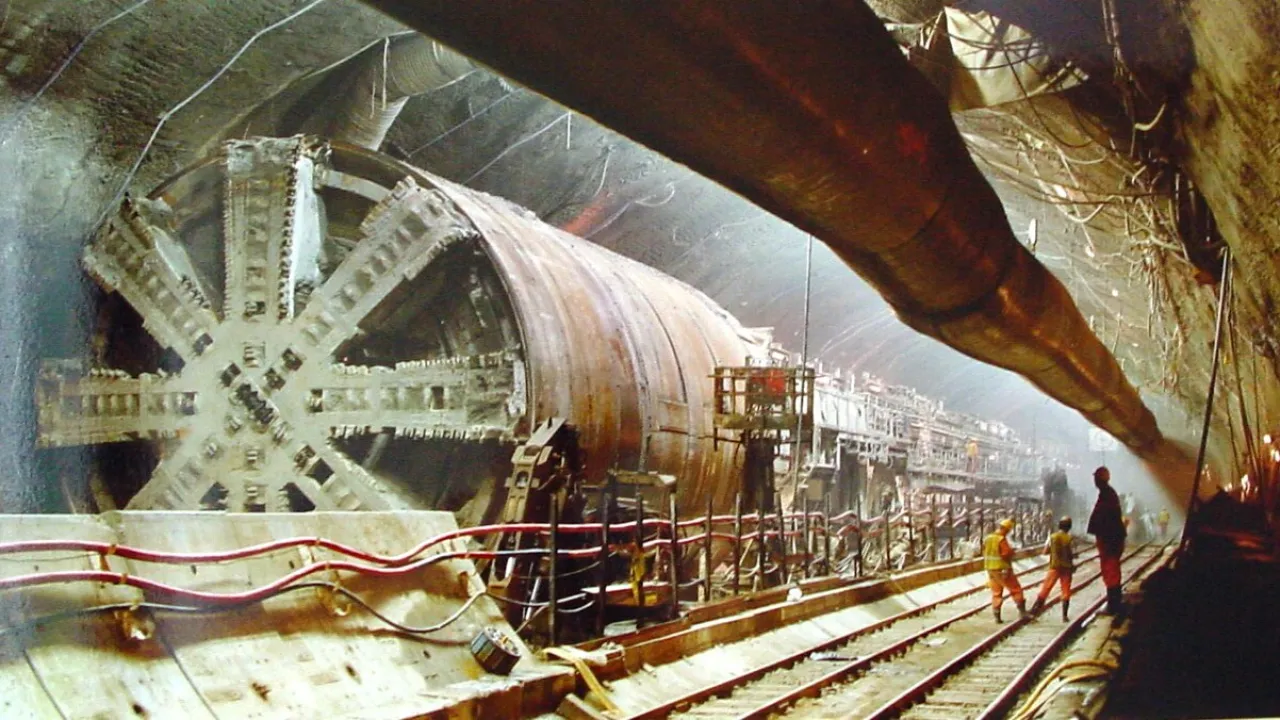
Some tunnel boring machines are taller than a house!
✨ Word Sparks (Grade 2 Glossary)
Tap 🔊 to hear
boring
Making a hole or tunnel
conveyor
A moving belt for carrying things
teeth
Sharp parts that help cut
🪝
Have you ever heard a giant machine roar under your feet?
1
Meet the Tunnel Digger
A tunnel machine is as long as many buses and digs deep underground. Its spinning round head is covered with sharp metal that cut through rock. The machine moves forward as it chews up dirt and stone. People use these tunnels for trains, cars, and pipes.
2
How Does It Work?
The tunnel machine’s head spins quickly, breaking up hard earth and rock. inside the machine carry the broken pieces away as it moves. Workers control the machine from a safe cabin inside. The tunnel gets longer every day as the machine digs forward.
3
Why Tunnels Matter
Tunnels help people travel under rivers, mountains, or busy cities. They keep cars and trains moving even when it rains or snows outside. Water and electricity pipes also use tunnels to reach homes and buildings safely.
The world’s longest railway tunnel, the Gotthard Base Tunnel in Switzerland, was made with TBMs!
✨ Word Sparks (Grade 3 Glossary)
Tap 🔊 to hear
vibration
A fast shaking movement
prototype
A first model of something new
patent
A special right for inventors
🪝
What if you could ride a machine that eats mountains?
1
The Giant Earth Eater
Tunnel boring machines, or TBMs, are enormous mechanical moles that dig long tunnels underground. Their front end has a rotating cutting head with sharp steel teeth that grind through rock and soil. As the head spins, it creates that break apart tough ground. The TBM moves forward slowly, leaving a smooth tunnel behind.
2
How TBMs Work
Inside the TBM, conveyors carry away the broken rock and dirt, called muck. The machine’s body supports the tunnel walls, preventing collapse as it digs. Engineers monitor the TBM from a control room, adjusting speed and pressure for different soil types. TBMs can dig through clay, sand, or even solid stone by changing their cutting tools.
3
A Tunnel for Every Need
Tunnels made by TBMs help trains, cars, and even water pipes travel safely underground. These tunnels can go beneath rivers, mountains, or busy cities where building above ground is impossible. Some tunnels stay dry for vehicles, while others carry water or electricity for homes. TBMs make it possible to connect places that once seemed far apart.
4
From Idea to Invention
The first tunnel boring ideas came from inventors in the 1800s, but modern TBMs appeared in the 1950s. Engineers built and earned for safer, faster machines. Today, TBMs are used worldwide, making travel and city life easier for millions of people.
TBMs can dig tunnels more than 50 feet wide—big enough for two subway trains side by side!
✨ Word Sparks (Grade 4 Glossary)
Tap 🔊 to hear
tunnel lining
Curved walls that make tunnels strong
segment
A piece or section of something
revolutionized
Changed something in a big way
🪝
Can you imagine a machine that carves a path through solid rock?
1
A Marvel of Modern Engineering
Tunnel boring machines (TBMs) are massive, cylindrical inventions designed to dig tunnels through earth and rock. Their rotating cutting heads are covered with tough discs and teeth that grind and crush material as the machine advances. The TBM’s enormous body supports the tunnel roof, preventing collapse and keeping workers safe. As the cutting head spins, it produces powerful vibrations that help break apart even the hardest stone.
2
Inside the Machine
Conveyor belts inside the TBM transport the crushed rock, called muck, to the rear for removal. The machine also installs curved concrete , known as , to reinforce the tunnel walls as it moves forward. Engineers in a control cabin monitor pressure, speed, and the condition of the ground, adjusting settings to match clay, sand, or solid rock. TBMs can be over 300 feet long and weigh thousands of tons, making them some of the largest moving machines on Earth.
3
Changing the World Below Us
TBMs have how people build tunnels for subways, highways, and underground pipes. They make it possible to dig safely beneath rivers, mountains, and crowded cities, where traditional digging would be too dangerous or disruptive. The tunnels created by TBMs help reduce traffic, provide clean water, and deliver electricity to millions of people. Without TBMs, many modern cities could not grow or connect as easily as they do today.
4
From Dream to Reality
The idea of a mechanical tunneling machine began in the early 1800s, but it took over a century for technology to catch up. Early prototypes often failed, but inventors kept improving the design until successful TBMs appeared in the 1950s. Today, TBMs are used worldwide, including in record-breaking projects like Switzerland’s Gotthard Base Tunnel, which stretches over 35 miles beneath the Alps.
The Channel Tunnel TBMs bored through 23 miles of rock beneath the English Channel, connecting two countries by rail.
✨ Word Sparks (Grade 5 Glossary)
Tap 🔊 to hear
torque
A twisting force that makes things spin
slurry
A watery mix of dirt and rock
navigation
Finding and following the right path
🪝
What would it feel like to stand beside a machine that bores a tunnel the size of a subway station?
1
Engineering Giants Beneath Our Feet
Tunnel boring machines (TBMs) are among the most advanced and powerful civil engineering inventions of the modern era. These cylindrical giants can measure over 300 feet in length and weigh more than 4,000 tons, with cutting heads up to 58 feet in diameter. Their rotating heads are equipped with disc cutters and carbide teeth, designed to grind, crush, and chip away at rock and soil as the machine advances. TBMs create minimal disturbance to the surface above, making them essential for constructing tunnels beneath busy cities, rivers, and mountains.
2
The Science of Tunneling
TBMs operate using principles of mechanical engineering, geology, and fluid dynamics. As the cutting head rotates, it generates immense and pressure, fracturing rock through a combination of shear and compressive forces. The resulting debris, known as muck, is transported away by conveyor belts or pipelines. Simultaneously, the TBM installs precast concrete segments to form a continuous tunnel lining, which prevents collapse and resists groundwater pressure. Engineers must constantly monitor variables like ground composition, tunnel alignment, and machine temperature to ensure safe and efficient progress.
3
From Concept to Global Impact
Although the first patented tunneling shield was invented by Marc Isambard Brunel in 1818, it was not until the 1950s that fully mechanized TBMs became practical for large-scale projects. Modern TBMs have enabled the construction of some of the world’s most ambitious infrastructure, including the Channel Tunnel (Chunnel) between England and France and the Gotthard Base Tunnel in Switzerland. These machines have revolutionized urban transportation, water supply systems, and even underground power lines, connecting cities and countries in ways previously thought impossible.
4
Challenges and Innovations
TBMs face numerous engineering challenges, such as varying geological conditions, high water pressure, and the risk of ground settlement. To overcome these, engineers design TBMs with adaptable cutting systems, pressurized face chambers, and sophisticated technology. Some TBMs use Earth Pressure Balance (EPB) or Shield technology to stabilize loose ground and control groundwater. Innovations in robotics, automation, and real-time monitoring have made TBMs safer and more efficient, allowing them to tackle projects in environments once considered too risky.
5
The Future of Underground Exploration
As cities grow and transportation needs increase, TBMs will continue to shape the world beneath our feet. Engineers are developing even larger and more versatile machines, capable of boring tunnels through harder rock, at greater depths, and over longer distances. Future TBMs may use artificial intelligence to optimize digging and reduce energy use, while new materials could make tunnel linings stronger and lighter. The evolution of TBMs demonstrates how human ingenuity and engineering can solve enormous challenges, opening new pathways for generations to come.