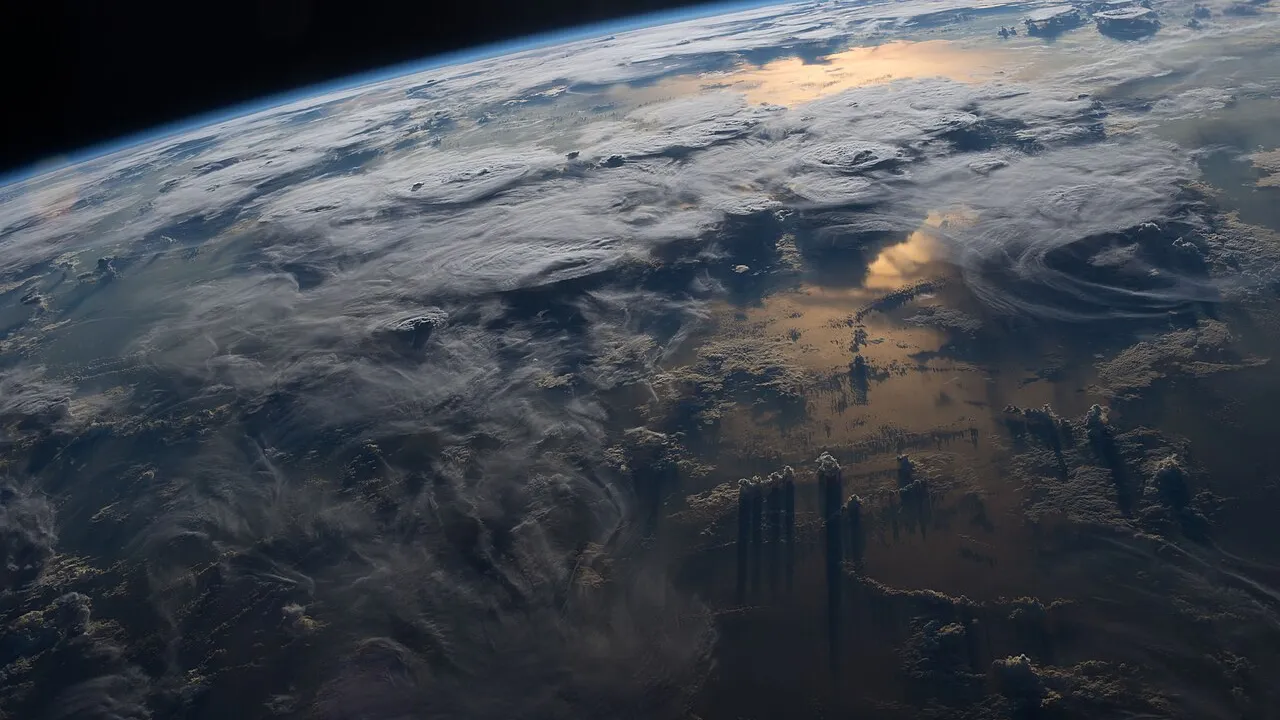
1. What happens inside the troposphere where we live?
2. How does the air feel as you climb higher up a tall mountain in the troposphere?
🤯 Mind-Blowing Fact • Grade 2
Ninety-nine percent of all the sky's water vapor floats inside the troposphere, leaving upper sky layers bone-dry!
✨ Word Sparks (Grade 2 Glossary)
Tap 🔊 to hear
Water Vapor
Invisible gas form of water in air
Molecules
Tiny invisible building blocks making up gases
Altitude
Height measured upward above sea level
🪝
Why do tall mountain peaks wear white snow caps even while valleys below feel warm?
1
Warmed From the Ground Up
Feel warm sidewalk stones under your sneakers on a sunny afternoon! Sunlight passes through clear sky air and heats Earth's land and oceans first. Then the warm ground heats the air right above it—just like a stove burner warming a pot from the bottom!
2
Swirling Air Makes Weather
Warm air near the ground rises upward, cools off, and turns invisible into puffy clouds! In fact, 'tropos' means 'turning' or 'mixing' in Greek because air inside the troposphere never stops churning.
3
Most of Earth's Air
Even though four other sky layers stack far above it, gravity hugs about four-fifths of all Earth's air snugly down inside the troposphere!
1. Why is the bottom of the troposphere warmer than the top?
2. What does the Greek root 'tropos' in troposphere mean?
🤯 Mind-Blowing Fact • Grade 3
Commercial airliners often cruise right near the top of the troposphere so tailwinds from fast jet streams can push planes eastward ahead of schedule!
✨ Word Sparks (Grade 3 Glossary)
Tap 🔊 to hear
Tropopause
Invisible upper ceiling boundary of the troposphere
Jet Stream
Fast high-altitude ribbon of wind steering storms
Air Pressure
Weight of air molecules pressing down overhead
🪝
Why do giant thunderclouds flatten out at the top like a blacksmith's anvil?
1
Thin Skin Around a Giant Apple
If Planet Earth shrunk down to the size of a shiny red apple, the troposphere would be thinner than the apple's peel! Stretching about five miles (eight kilometers) high over the freezing poles and up to eleven miles (eighteen kilometers) over the warm Equator, this thin blanket holds seventy-eight percent nitrogen, twenty-one percent life-giving oxygen, and trace gases.
2
Dropping Temperatures With Height
As hikers climb higher or weather balloons rise, drops and air expands and cools—falling roughly 6.5 degrees Celsius for every kilometer upward (about 3.5°F per thousand feet). Outside a passenger jet cruising near the top of the troposphere, temperatures plunge near minus fifty-five degrees Celsius!
3
Hitting the Tropopause Ceiling
Right at the top of the troposphere sits an invisible lid called the , where air stops cooling and starts warming in the stratosphere above. Rising thunderstorm updrafts smack against that lid and spread sideways into flat anvil clouds!
4
Rivers of Wind Aloft
Near the , narrow ribbons of super-fast wind called race west-to-east at over 100 miles per hour, steering weather fronts across continents.
1. Why do tall thunderstorm clouds spread out flat like an anvil at the top?
2. Where is the troposphere thickest and tallest?
🤯 Mind-Blowing Fact • Grade 4
At the summit of Mount Everest (29,032 feet high inside the upper troposphere), air pressure is only one-third of sea-level pressure—meaning every breath holds just one-third as much oxygen!
✨ Word Sparks (Grade 4 Glossary)
Tap 🔊 to hear
Convection
Heat transfer by warm rising, cool sinking air
Dew Point
Temperature where cooling vapor condenses into droplets
Air Mass
Huge body of air sharing temperature and moisture
🪝
Why do your ears pop driving up Virginia's Shenandoah Mountain—and how does convection brew afternoon storms?
1
Gravity Packs Air Near Sea Level
Ride up Skyline Drive in Shenandoah National Park, and pop go your eardrums! Even though air looks weightless, gravity pulls trillions of gas molecules downward, stacking seventy-five to eighty percent of the entire atmosphere's mass into the bottom troposphere. At sea level in Virginia Beach, air presses inward at 14.7 pounds per square inch; climb higher, and fewer molecules sit overhead, so outside air pressure drops and air inside your ears pops outward to balance!
2
Convection Currents Power the Water Cycle
Every stage of the atmospheric water cycle unfolds inside the troposphere. Solar radiation warms land and water, causing warm, moist air parcels to become less dense and rise in currents. Rising air expands under lower pressure, cools to its , and condenses onto microscopic dust or sea-salt specks to build cumulus, stratus, and cirrus clouds!
3
Highs, Lows, and Weather Fronts
Uneven solar heating between warm tropics and icy poles creates giant —warm humid maritime air from the Gulf and cool dry continental air from Canada. Where air masses collide along cold fronts and warm fronts inside the troposphere, swirling low-pressure systems unleash rain, snow, and thunderstorms.
4
Earth's Natural Greenhouse Blanket
Tiny amounts of tropospheric water vapor and carbon dioxide trap outgoing warmth like a cozy greenhouse blanket—keeping Earth's average surface near a comfortable 15°C (59°F) instead of frozen solid, though burning excess fossil fuels thickens that heat-trapping blanket.
1. Why do your ears pop when you ride rapidly up a mountain or take off in an airplane?
2. What tiny helpers inside the troposphere give cooling water vapor a surface to condense onto when forming cloud droplets?
🤯 Mind-Blowing Fact • Grade 5
Every single day at exactly 00:00 and 12:00 Coordinated Universal Time, meteorologists at over eight hundred stations worldwide launch helium radiosonde balloons simultaneously to map the troposphere in 3D!
✨ Word Sparks (Grade 5 Glossary)
Tap 🔊 to hear
Lapse Rate
Rate temperature drops with rising tropospheric altitude
Adiabatic Cooling
Cooling of rising air caused by expansion
Inversion
Reversed layer where warm air caps cold air
🪝
How did a French scientist launching unmanned balloons in 1902 discover that the sky suddenly stops cooling above eleven kilometers?
1
Teisserenc de Bort and the Environmental Lapse Rate
For centuries, scientists assumed Earth's sky grew steadily colder all the way to outer space. After launching more than two hundred instrument-carrying weather balloons near Paris, French meteorologist Léon Teisserenc de Bort announced a shock in 1902: temperature falls steadily up to roughly eleven kilometers, then abruptly levels off! He named the turbulent lower layer the troposphere and the calm upper layer the stratosphere. Within the troposphere, temperature drops at an average environmental of 6.5°C per kilometer because solar shortwave light passes through transparent air to heat Earth's surface, which warms the bottom air via conduction, latent heat, and longwave infrared radiation.
2
Adiabatic Cooling and Atmospheric Convection
Because barometric pressure decreases exponentially with altitude—dropping from ~1,013 hectopascals (millibars) at sea level to ~500 hPa at 5.5 kilometers and ~250 hPa near 10.5 kilometers—any buoyant air parcel rising upward expands against weaker surrounding pressure. Doing work to expand consumes internal thermal energy, cooling the parcel adiabatically without losing heat to neighbors! Once cooled to saturation, condensing water vapor releases enormous latent heat, fueling towering cumulonimbus convection up to the tropopause .
3
Hadley, Ferrel, and Polar Cells
Differential heating between the sun-drenched Equator (tropopause ~17–18 km) and frigid poles (tropopause ~7–8 km), twisted by Earth's Coriolis force, organizes global tropospheric circulation into three latitude belts per hemisphere: tropical Hadley cells, mid-latitude Ferrel cells, and polar cells. Along steep temperature boundaries between these cells, polar and subtropical jet streams roar at 160 to 400 kilometers per hour!
4
Planetary Boundary Layer and Temperature Inversions
The lowest one to two kilometers—the planetary boundary layer—experiences direct friction against forests, oceans, and skyscrapers. Occasionally on calm, clear winter nights, cold dense air pools in valleys beneath a lid of warmer air aloft; this temperature traps urban smog near the ground until sunshine or wind restores mixing.
5
Radiative Balance in a Changing Troposphere
Containing ~80 percent of atmospheric mass (78.08% N₂, 20.95% O₂, 0.93% Ar, plus trace greenhouse gases like H₂O, CO₂, and CH₄) and 99 percent of aerosols and water vapor, the troposphere governs human habitability—where rising CO₂ concentrations warm the troposphere and expand tropopause height measurable by global radiosonde balloons.