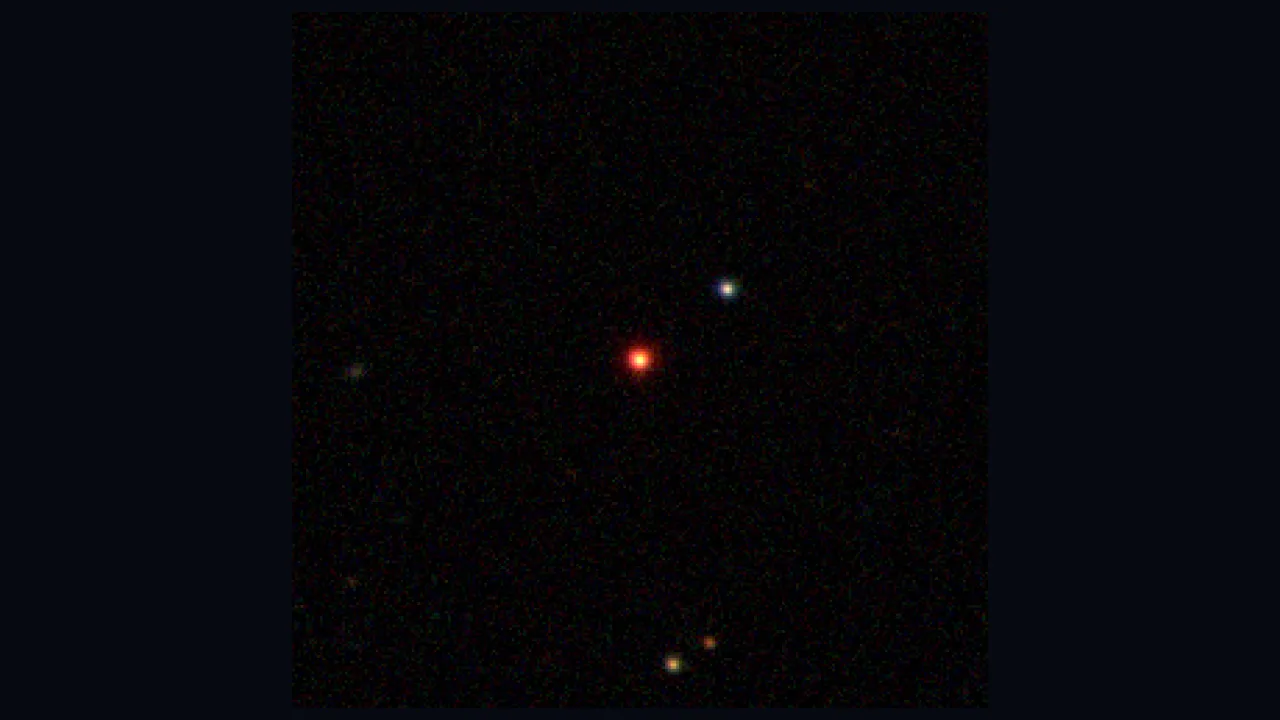
1. How many rocky Earth-sized planets orbit the star TRAPPIST-1?
2. About how big is the star TRAPPIST-1 itself?
🤯 Mind-Blowing Fact • Grade 2
The star TRAPPIST-1 burns its fuel so slowly that it can keep shining for trillions of years—hundreds of times longer than our Sun!
✨ Word Sparks (Grade 2 Glossary)
Tap 🔊 to hear
exoplanet
A planet orbiting a star beyond ours
habitable zone
Orbit zone warm enough for liquid water
tidally locked
Keeping the same face toward a star
🪝
How can seven Earth-sized planets fit inside a space smaller than Mercury's orbit?
1
Huddled Around a Campfire
Imagine seven campers sitting close around a small, glowing campfire to stay warm. Forty-one light-years away in Aquarius, seven rocky planets huddle around a dim red star called TRAPPIST-1. Every single planet orbits closer to that star than Mercury orbits our Sun!
2
Day Side and Night Side
Gravity locks these planets so the same side always faces their star. One half has endless salmon-pink daylight, while the back half stays in starry night!
3
Three Goldilocks Worlds
Because TRAPPIST-1 is cool and dim, its close planets do not all burn up. Three middle worlds sit in the Goldilocks zone, where temperatures could allow liquid oceans!
1. How do all seven TRAPPIST-1 orbits compare in size to Mercury's orbit around our Sun?
2. What happens on a planet that is tidally locked to its star?
🤯 Mind-Blowing Fact • Grade 3
Scientists converted the orbital rhythm of the seven TRAPPIST-1 planets into musical notes, and they play a soothing, harmonious chord!
✨ Word Sparks (Grade 3 Glossary)
Tap 🔊 to hear
transit
When a planet crosses across its star
atmosphere
Blanket of gas surrounding a planet
resonance
Repeating orbital pattern shared by planets
🪝
How did telescopes spot seven shadowy planets crossing a star barely bigger than Jupiter?
1
Tiny Dips in Starlight
In 2016 and 2017, astronomers using a telescope in Chile named TRAPPIST and NASA's Spitzer Space Telescope made front-page news. Watching a dim red star 40.7 light-years away, they noticed tiny dips in brightness whenever planets crossed in front of it—revealing seven Earth-sized worlds!
2
Named Letters b Through h
Astronomers named the planets TRAPPIST-1b, c, d, e, f, g, and h in order from innermost to outermost. Innermost planet b whips around the star in just 1.5 Earth days, while outermost planet h finishes a full year in under 19 days.
3
A Cosmic Musical Rhythm
Packed so tightly together, the seven planets tug gently on one another without ever crashing. For every eight orbits completed by planet b, planet c completes five, planet d completes three, and planet e completes two!
4
Prime Target for Webb
With planets e, f, and g orbiting inside the liquid-water habitable zone, NASA's James Webb Space Telescope is studying this system to check which worlds kept thick .
1. How did astronomers discover the seven planets of TRAPPIST-1?
2. Which three TRAPPIST-1 planets orbit inside the temperate habitable zone?
🤯 Mind-Blowing Fact • Grade 4
If you scaled our Solar System down to match TRAPPIST-1, the star would be the size of a basketball and all seven planets would orbit closer than a classroom wall!
✨ Word Sparks (Grade 4 Glossary)
Tap 🔊 to hear
terrestrial
Earth-like planet built of rock and metal
density
How tightly matter is packed inside something
flare
Sudden burst of radiation from a star
🪝
Why does a star containing just nine percent of our Sun's mass hold the most famous exoplanet family in the galaxy?
1
A Miniature Solar System in Aquarius
Journey 40.7 light-years toward the constellation Aquarius and you will encounter an ultra-cool M8V red dwarf barely larger than Jupiter. Despite having only nine percent of our Sun's mass and glowing at a gentle 2,566 kelvins, TRAPPIST-1 anchors seven exoplanets—the largest batch of Earth-sized rocky worlds ever discovered around a single star.
2
Weighing Worlds Through Gravitational Tugs
Because the seven worlds orbit between just 1 million and 5.5 million miles from their star, their mutual gravity slightly speeds up or delays each planet's transit by minutes. By timing these transit-timing variations with Spitzer and Kepler, scientists calculated every planet's exact mass and , revealing rocky interiors slightly richer in water or lighter minerals than Earth!
3
Locked in an Unbroken Resonance Chain
Normally seven Earth-sized planets crammed inside a six-million-mile circle would tug one another into chaotic collisions within millions of years. TRAPPIST-1 stays stable across billions of years because its worlds formed farther out in an icy disk and migrated inward gently together, locking into the longest unbroken Laplace orbital resonance chain ever observed in space.
4
Testing Atmospheres with JWST
Active red dwarfs unleash frequent X-ray and ultraviolet that can strip air off close-in worlds. Using NASA's James Webb Space Telescope, scientists measured dayside temperatures on innermost rocky worlds 1b and 1c—finding little or no thick atmosphere—while focusing next on temperate habitable-zone neighbors 1e, 1f, and 1g.
1. How did astronomers figure out the masses and densities of the seven TRAPPIST-1 planets?
2. What did James Webb Space Telescope heat measurements reveal about innermost planets TRAPPIST-1b and 1c?
🤯 Mind-Blowing Fact • Grade 5
TRAPPIST-1 fuses hydrogen so frugally that it will shine steadily on the main sequence for roughly ten trillion years—nearly a thousand times the current age of our universe!
✨ Word Sparks (Grade 5 Glossary)
Tap 🔊 to hear
spectroscopy
Splitting starlight to identify chemical gases
secondary eclipse
When an exoplanet passes behind its star
brown dwarf
Substellar object too small to fuse hydrogen
🪝
Why is an ultra-cool dwarf star barely above the fusion limit our best natural laboratory for terrestrial exoplanet atmospheres?
1
From Chilean Desert to Cosmic Fame
Named after the robotic Transiting Planets and Planetesimals Small Telescope (TRAPPIST) operated by Belgian astronomers at La Silla Observatory in Chile, the star 2MASS J23062928-0502285 sits 12.5 parsecs (40.7 light-years) away in Aquarius. Containing just 0.09 solar masses—barely above the eight-percent stellar mass threshold where core hydrogen fusion ignites—its 121,000-kilometer globe radiates mostly infrared light at 2,566 kelvins. A 20-day continuous stare by NASA's Spitzer Space Telescope in 2016–2017 expanded three initial candidates into an unprecedented seven-planet terrestrial family.
2
Why Small Stars Amplify Signals
Around a big yellow G-type star like our Sun, an Earth-sized planet blocks less than 0.01 percent of starlight during transit, burying atmospheric clues beneath instrumental noise. Because ultra-cool dwarf TRAPPIST-1 is scarcely wider than Jupiter, each rocky planet blocks nearly 1 percent of the star's disk—delivering a hundredfold deeper transit signal ideal for transmission .
3
Precision Densities and Volatile Clues
Orbiting between 0.0115 and 0.0619 astronomical units with periods from 1.51 to 18.77 days, the seven worlds form a coupled three-body Laplace resonance chain. Multi-year transit-timing variation (TTV) analyses pinpointed planetary radii (0.76 to 1.13 Earth radii) and masses (0.33 to 1.37 Earth masses) to better than three-percent precision, revealing rocky iron-silicate compositions roughly eight percent less dense than Earth—consistent with either smaller iron cores or up to five percent water ice by mass.
4
Stellar Activity Versus Habitability
Outer habitable-zone worlds TRAPPIST-1e, 1f, and 1g receive bolometric stellar flux comparable to Earth and Mars, yet M8V stars spend nearly a billion early years blazing brightly while bombarding close-in planets with coronal X-rays and stellar winds.
5
The JWST Era of Characterization
Observing 15-micron thermal emission during , JWST's MIRI instrument measured a scorching ~500-kelvin dayside on TRAPPIST-1b consistent with bare dark basaltic rock and ruled out thick Venus-like carbon-dioxide skies on 380-kelvin TRAPPIST-1c—focusing deep multi-transit campaigns onto prime ocean candidate TRAPPIST-1e.