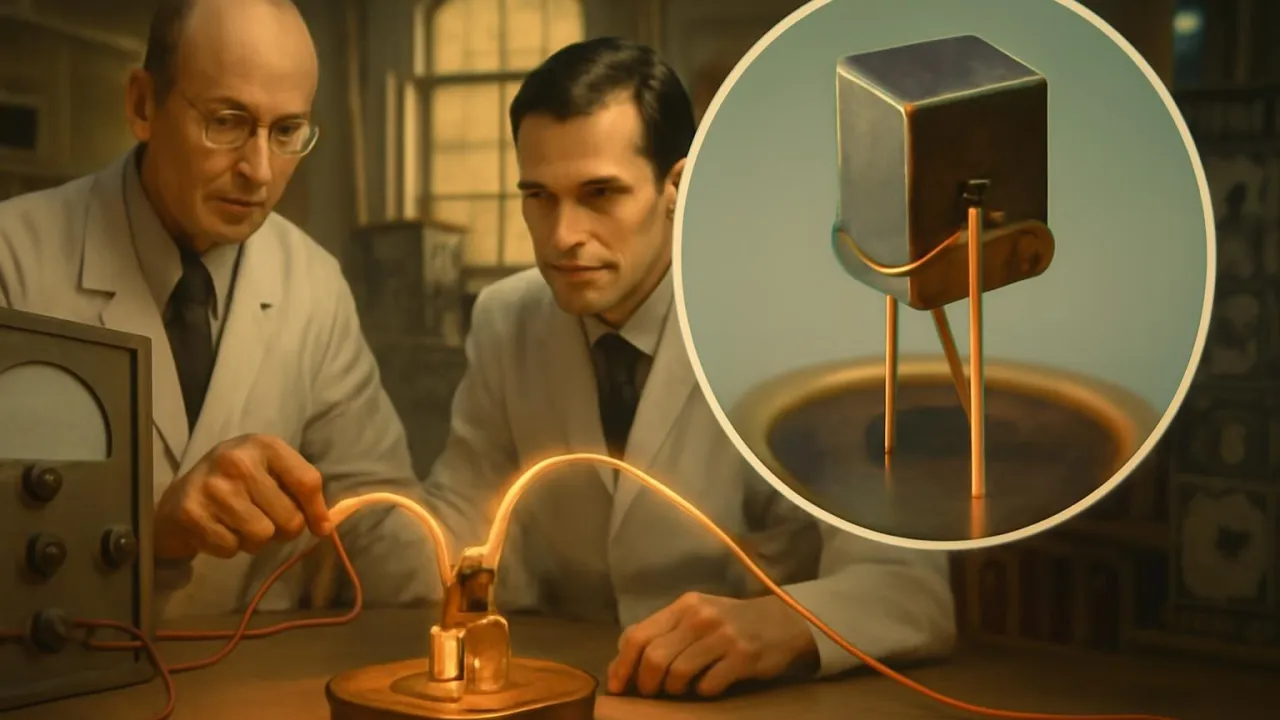
The first transistor was made with gold, plastic, and a tiny crystal!
✨ Word Sparks (Grade 2 Glossary)
Tap 🔊 to hear
microscope
Tool to see tiny things
electricity
Energy that powers devices
gadget
A small, useful machine
🪝
Have you ever wondered how your tablet gets so smart?
1
Tiny Parts, Big Jobs
Transistors are so small, you need a to see them. They work like tiny switches, turning on and off. When many are put together, they help machines think.
2
How Transistors Help Us
Transistors are inside computers, phones, and even cars. They help these things remember, count, and play sounds. Without transistors, our would not be smart.
3
Inventing the Future
Three scientists at Bell Labs made the first transistor in 1947. Their invention made electronics smaller and faster. Today, millions fit on a single chip!
The world's fastest computers use chips with over 50 billion transistors each!
✨ Word Sparks (Grade 3 Glossary)
Tap 🔊 to hear
semiconductor
Material that controls electricity flow
circuit
Path for electricity to travel
prototype
First working model of something new
🪝
Can you imagine a world without smartphones or computers?
1
The Amazing Switch
Transistors are tiny parts that act like electronic switches. They control the flow of electric current in . By turning the current on and off, they help devices store and process information. This switching happens very quickly, making computers fast and powerful.
2
How Does It Work?
A transistor uses a special material called a . When electricity flows through the semiconductor, it can either pass or be blocked. This is called controlling the . The first transistor was a built with gold wires and a germanium crystal.
3
Changing the World
Before transistors, machines used bulky vacuum tubes. Transistors made electronics smaller, lighter, and more reliable. Today, billions of transistors fit on a single microchip, powering everything from watches to rockets.
4
From Labs to Life
In 1947, John Bardeen, Walter Brattain, and William Shockley invented the transistor at Bell Labs. Their invention won a Nobel Prize and started the digital revolution. Now, transistors are found in nearly every electronic device.
1. What did transistors replace in early electronics?
2. What does a transistor control in a circuit?
🤯 Mind-Blowing Fact • Grade 4
A modern smartphone contains over 10 billion microscopic transistors on its main chip!
✨ Word Sparks (Grade 4 Glossary)
Tap 🔊 to hear
amplify
To make something stronger or louder
microchip
Tiny part that holds many circuits
logic
Rules for how computers think
🪝
What if you could shrink a powerful computer to fit in your pocket?
1
A Revolution in Electronics
The invention of the transistor in 1947 marked a turning point in technology and engineering. Unlike earlier vacuum tubes, transistors are made from semiconductor materials that allow them to act as fast, reliable switches. By controlling the flow of electrons, transistors can signals or turn currents on and off in microseconds. This breakthrough allowed engineers to design much smaller, lighter, and more energy-efficient electronic devices.
2
How Transistors Work
Transistors are made using materials like silicon or germanium, which have special electrical properties. When a small voltage is applied to one part of the transistor, it changes how electricity flows through the device. This process, called amplification, lets transistors boost weak signals and perform operations in circuits. Billions of transistors are now packed together on , forming the brains of computers and smartphones.
3
Inventors and Impact
The first working transistor was built by John Bardeen, Walter Brattain, and William Shockley at Bell Labs. Their invention quickly replaced vacuum tubes in radios, televisions, and early computers, making electronics more reliable and affordable for everyone. The transistor's invention sparked the digital age, leading to incredible advances in science, medicine, and communication.
4
Transistors Everywhere
Today, transistors are found in almost every electronic device, from hearing aids to spacecraft. Their small size and efficiency make modern technology possible, enabling the creation of powerful computers, smart devices, and even robots. The world we live in now would be impossible without the humble transistor.
1. What special property lets transistors control electricity?
2. Why did transistors replace vacuum tubes?
🤯 Mind-Blowing Fact • Grade 5
The smallest transistors today are just 2 nanometers wide—about 40,000 times thinner than a human hair!
✨ Word Sparks (Grade 5 Glossary)
Tap 🔊 to hear
semiconductor
Material that controls how electricity flows
amplify
To make signals stronger or bigger
nanotechnology
Science of making things super tiny
🪝
Imagine if every grain of sand on a beach could become a tiny electronic switch—what could you build?
1
The Spark of the Digital Age
In December 1947, at Bell Labs in New Jersey, three scientists—John Bardeen, Walter Brattain, and William Shockley—unveiled a device that would revolutionize the world: the transistor. This tiny invention replaced bulky vacuum tubes and enabled the miniaturization of electronic circuits, making it possible to build powerful computers that fit on your desk or in your pocket. The transistor’s invention is often called the single most important event in modern electronics, igniting the digital revolution.
2
How Transistors Work: Physics in Action
A transistor is made from materials, usually silicon, which can control the flow of electrons with remarkable precision. It typically has three parts: the emitter, base, and collector. By applying a small voltage to the base, the transistor can switch or much larger currents between the emitter and collector. This switching action allows transistors to process digital signals—turning them on and off millions or even billions of times per second.
3
From Prototype to Microchip
The first transistor was a point-contact type, using gold contacts pressed onto a germanium crystal. Soon after, the more robust bipolar junction transistor was developed, followed by the field-effect transistor (FET), which is now the backbone of modern microchips. Today, engineers can fit over 50 billion transistors onto a single silicon chip, each measuring just a few nanometers wide—thousands of times thinner than a human hair.
4
Global Impact and Everyday Life
Transistors have changed nearly every part of our lives, powering everything from smartphones and medical devices to satellites and supercomputers. Their reliability, speed, and tiny size make possible the Internet, video games, streaming music, and even space exploration. The invention of the transistor has also led to new fields like and quantum computing, pushing the boundaries of what humans can achieve.
5
The Future: Smaller, Faster, Smarter
As engineers continue to shrink transistors, new challenges arise, such as heat management and quantum effects at the nanoscale. Researchers are now exploring materials like graphene and carbon nanotubes to create even faster and more energy-efficient transistors. The journey that began with a single, experimental device at Bell Labs continues to shape the future of technology, proving that even the smallest inventions can have the biggest impact.