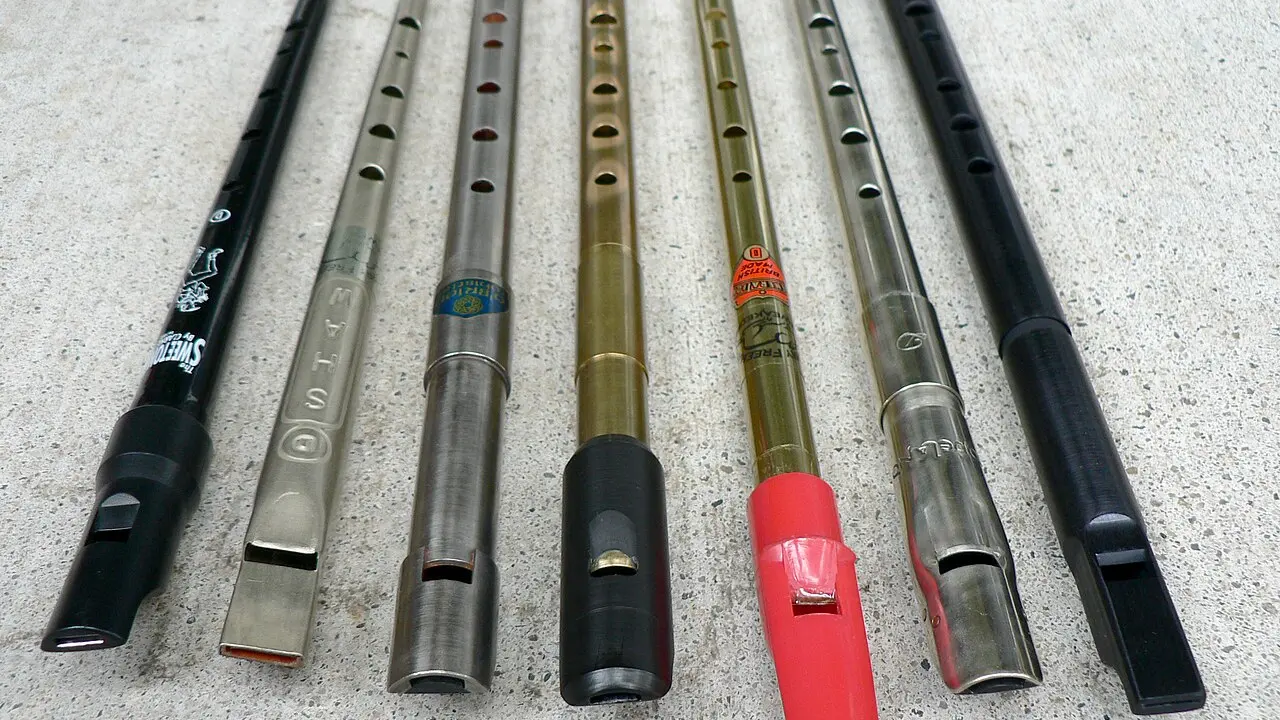
1. How many finger holes sit on a traditional tin whistle?
2. How did the penny whistle get its cheerful nickname?
🤯 Mind-Blowing Fact • Grade 2
Today most 'tin' whistles aren't actually made of tin at all—makers craft them from gleaming brass, nickel-plated brass, or aluminum!
✨ Word Sparks (Grade 2 Glossary)
Tap 🔊 to hear
tinplate
Thin steel sheet coated with shiny tin
overblow
Blowing brisker to jump up an octave
reel
Fast, flowing traditional Celtic dance melody
🪝
How do you reach fourteen bright notes on a metal tube that only has six holes and no thumb hole?
1
Heart of Celtic Music
Step inside a cozy Irish music gathering and listen as fiddles, harps, and drums leap into a joyful ! Dancing right on top of the melody is a slender metal tube barely twelve inches long.
2
Robert Clarke's Tinplate Idea
In 1843 in England, a poor farmworker named Robert Clarke learned that shiny tin-coated sheet metal had just been invented. Using simple hand tools, he rolled into tuned six-hole flutes with wooden whistle plugs and sold thousands for a penny apiece!
3
Overblowing the Second Octave
Cover all six holes and blow gently for low D; blow a little brisker with the exact same fingers, and every note leaps one whole octave higher!
1. How does a musician jump from the lower octave to the higher octave on a six-hole whistle?
2. What metals are most modern 'tin' whistles actually built from today?
🤯 Mind-Blowing Fact • Grade 3
In Irish Gaelic, this beloved instrument is called feadóg stáin (pronounced fah-DOHG STAWN), which literally means tin whistle!
✨ Word Sparks (Grade 3 Glossary)
Tap 🔊 to hear
ornament
Quick decorative finger flick brightening a note
roll
Graceful Irish ornament sparkling with quick flicks
low whistle
Larger cousin pitched one full octave deeper
🪝
Why do Irish whistle masters flick their fingers instead of using their tongues to separate fast notes?
1
From Quiet Hills to Blockbuster Movies
Have you ever heard the peaceful Shire melody in The Lord of the Rings or the haunting opening theme of Titanic? Both iconic movie moments came from one humble six-hole fipple flute: the Irish feadóg stáin!
2
Diatonic Cylindrical Design
Unlike a recorder—which uses eight holes and forked fingerings to play every sharp and flat—a traditional whistle is tuned diatonically to one main home key, most famously High D. Its twenty-nine-centimeter cylindrical brass tube produces a pure, breathy chime across two octaves.
3
Cuts, Strikes, and Rolls
In traditional Irish music, players rarely tongue every note with 'tu-tu-tu.' Instead, they keep one smooth river of breath flowing while flicking fingers up and down in split-second called cuts, taps, and five-note !
4
Meet the Low Whistle
Scottish maker Bernard Overton stretched the design twice as long in 1971, creating the soulful Low D whistle that sings an octave deeper!
1. How do traditional Irish whistle players usually separate two repeated notes smoothly without stopping their breath?
2. Which standard key is the most common traditional whistle pitched in?
🤯 Mind-Blowing Fact • Grade 4
Archaeologists digging in Dublin, Ireland, unearthed a polished twelfth-century bird-bone fipple whistle that still plays clear notes after eight hundred years!
✨ Word Sparks (Grade 4 Glossary)
Tap 🔊 to hear
open-open pipe
Tube open to air at both ends
slow air
Expressive, unhurried Irish melody full of emotion
cross-fingering
Closing holes below an open hole
🪝
How did a farmworker pushing a handcart across England in 1843 spark a global revolution in Celtic folk and cinema music?
1
Six Holes That Conquered the World
Hand a musician a slender brass cylinder with no moving keys, no reed, and no thumb hole, and watch disbelief turn to awe as cascades of jigs, hornpipes, and pour effortlessly from six open holes.
2
Robert Clarke's Industrial Craft
Bone and elderwood fipple flutes echoed across Ireland and Britain since prehistoric times—archaeologists even uncovered a twelfth-century bone whistle in Viking-era Dublin! In 1843, Lancashire farmhand Robert Clarke lost his job, fashioned tinplate-rolling tools with a blacksmith, and walked with a handcart to Manchester selling his 'Meg' penny whistles. Wrapping thin metal into a tapered or cylindrical tube around a cedarwood fipple block democratized music overnight for working families.
3
Open-Pipe Overblowing and Two Home Keys
Acoustically, a standard 29.5-centimeter High D whistle acts as an : both the fipple labium window at the top and the uncovered holes below open directly to outside air, supporting all whole-number harmonics. Increasing jet speed doubles the frequency from D5 (587 Hz) up to D6 and D7! Better still, using one simple for C-natural lets a six-hole D whistle play fluently in both D major and G major.
4
Session Virtuosos and Film Legends
Twentieth-century Irish masters like Mary Bergin, Seán Potts of The Chieftains, and Micho Russell elevated the humble penny whistle to concert artistry, while composer Howard Shore wove its warm simplicity into the heart of Hobbiton.
1. Why can a High D whistle overblow smoothly up a full octave without needing a back thumb hole?
2. Which two major keys can a standard D whistle play most naturally for traditional fiddle tunes?
🤯 Mind-Blowing Fact • Grade 5
High-speed audio analysis shows that a master Irish whistle player's finger 'cut' opens and closes a tone hole in less than thirty milliseconds—faster than the blink of a human eye!
✨ Word Sparks (Grade 5 Glossary)
Tap 🔊 to hear
chiff
Crisp breathy burst heard as notes start
legato
Flowing notes connected smoothly without breath gaps
just intonation
Pure harmonic tuning ringing without wavering beats
🪝
Why does removing chromatic keys and thumb holes make the six-hole diatonic fipple whistle faster and more expressive for Celtic ornamentation?
1
Virtuosity Through Radical Simplicity
At first glance, an orchestral Boehm flute bristling with sixteen silver keys looks vastly more advanced than a keyless six-hole brass tube. Yet challenge both instruments to execute a traditional Irish five-note crann or blistering double-cut reel at 130 beats per minute, and the featherweight fipple whistle reveals why stripping mechanics down to pure acoustics unlocks unmatched finger velocity!
2
Open-Cylinder Edge-Tone Physics and Bore Tradeoffs
Classified organologically as an internal-duct open flute with six finger holes (Hornbostel-Sachs 421.221.12), the standard High D whistle measures roughly 29.5 centimeters with an internal bore around 12 millimeters, spanning D5 (587.33 Hz) to D7 (2,349.32 Hz). Interestingly, two distinct bore geometries coexist: Robert Clarke's original 1843 rolled-tinplate cone—narrowing slightly toward the foot with a cedarwood block, yielding a breathy, -rich folk timbre—and modern drawn-brass cylindrical tubes fitted with injection-molded or Delrin fipples (pioneered in the 1950s by Generation), which deliver brighter harmonic focus and effortless octave leaps.
3
Fluid-Dynamic Articulation: Cuts, Strikes, Rolls, and Cranns
Because traditional Irish, Scottish, and Breton aesthetics prize unbroken phrasing modeled on the uilleann pipes, masters rarely interrupt the air jet with the tongue. Instead, flicking an upper finger open for 20 to 40 milliseconds ('cut') momentarily vents an impedance spike that crisply resets the standing wave, while slapping a lower hole shut ('strike' or 'tap') creates a percussive downward transient! Combining a sustained note, cut, and strike produces the signature Irish 'roll,' while bagpipe-inspired 'cranns' dazzle on bottom D5 where no lower hole exists to strike.
4
Just Intonation and Overton's Low D Expansion
Fine handmade whistles often sweeten the third and seventh scale degrees slightly toward pure so notes lock beatlessly against uilleann-pipe drones. In 1971, luthier Bernard Overton collaborated with Finbar Furey to scale an aluminum tube down an octave to D4 (293.66 Hz), birthing the haunting concert Low Whistle.
5
Living Heritage From Kitchen Sessions to Symphony Stages
Immortalized by Mary Bergin's landmark 1979 Feadóg Stáin recordings, Paddy Moloney and Seán Potts with The Chieftains, and global symphonic film scores by James Horner and Howard Shore, this once-humble penny instrument stands among world music's most expressive voices.