🇺🇸 U.S. HISTORY
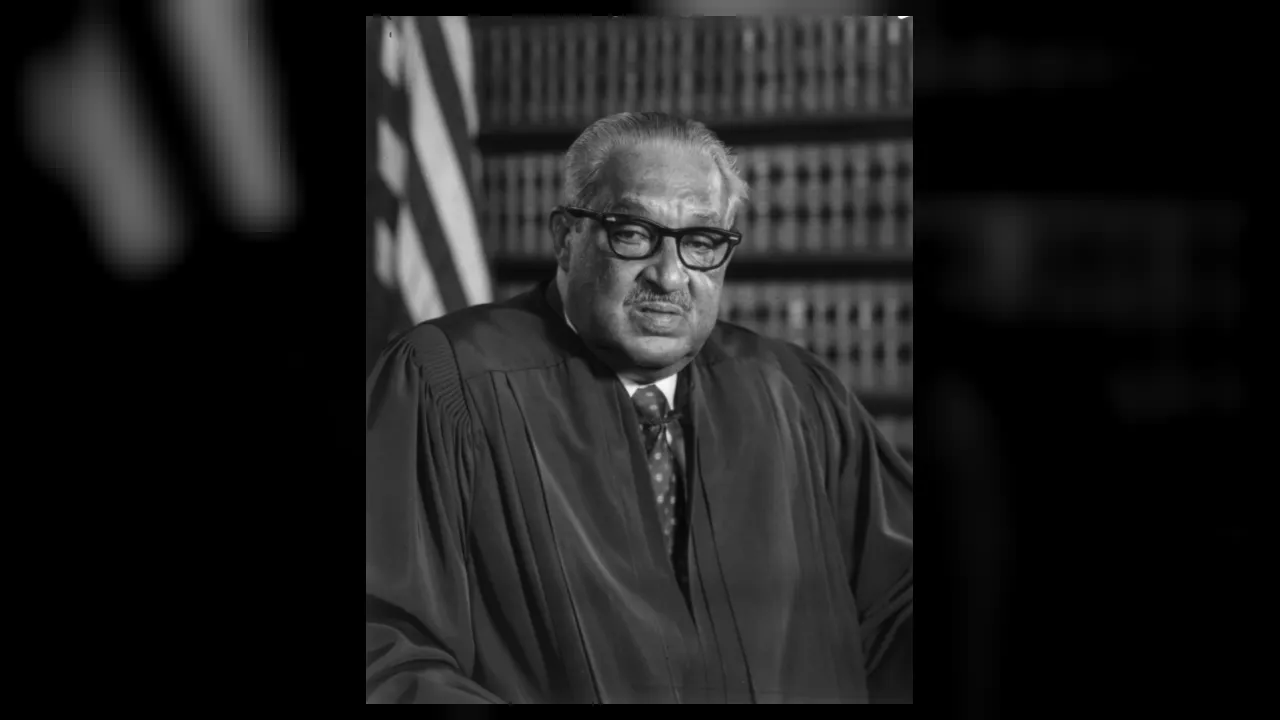
🏛️ First African American U.S. Supreme Court Justice • 1908–1993
VA History & Social Science SOL K.1, 1.2, 2.4, VS.1–VS.10, USI & USII
Thurgood Marshall
Civil Rights Lawyer and Supreme Court Trailblazer
Grade 4 • Expanding • 256 words
⏳ Era / Statehood1908–1993 • Civil Rights Era & Supreme Court (1967–1991)
🗺️ Region / CapitalBaltimore, Maryland & Washington, D.C.
📜 Key MilestoneWon Brown v. Board of Education (1954) & served 24 years on Supreme Court
⚡ Historical SparkUsed the U.S. Constitution in courtrooms to end legal school segregation
🤯 Mind-Blowing Fact • Grade 1
As a boy in Baltimore, Thurgood Marshall memorized the entire United States Constitution, which sparked his dream of becoming a lawyer!
✨ Word Sparks (Grade 1 Glossary)
Tap 🔊 to hear
lawyer
A person trained to explain laws in court
Constitution
The main set of laws for America
justice
A high judge on the Supreme Court
🪝
Can memorizing the rules of America help a kid grow up to change unfair laws?
1
Learning the Constitution
Young Thurgood loved to talk and debate in school. His teacher asked him to read the United States . He learned every part by heart!
2
Fair Schools for All
Long ago, some laws kept Black and white children in separate schools. Thurgood became a smart . He proved in court that all children deserve equal schools.
3
A Historic Judge
Later, Thurgood became the first Black on the Supreme Court. He wore a black robe and protected fair laws for twenty-four years.
1. What important document did young Thurgood Marshall learn by heart in school?
2. What historic first did Thurgood Marshall achieve in 1967?
🤯 Mind-Blowing Fact • Grade 2
As a lawyer arguing cases before the U.S. Supreme Court, Thurgood Marshall won an amazing twenty-nine out of thirty-two cases!
✨ Word Sparks (Grade 2 Glossary)
Tap 🔊 to hear
debate
A respectful discussion giving reasons for ideas
segregation
Unfairly keeping groups of people apart
Supreme Court
The highest court in the United States
🪝
How did dinner-table debates in Baltimore prepare a young boy to win one of America's biggest court cases?
1
Debating Around the Dinner Table
Imagine sitting down to supper where your dad challenges you to prove every opinion with facts! Growing up in Baltimore, Maryland, Thurgood Marshall loved lively and learned the U.S. Constitution inside and out.
2
Winning Brown v. Board of Education
After graduating first in his class at Howard University School of Law, Thurgood traveled across the country defending equal rights. In 1954, he argued Brown v. Board of Education before the U.S. and proved that separating students by race in public schools was unconstitutional.
3
Justice on the Highest Court
In 1967, President Lyndon B. Johnson nominated Thurgood Marshall to the , making him the first African American justice in U.S. history.
1. What famous 1954 case did Thurgood Marshall win to end legal segregation in public schools?
2. Where did Thurgood Marshall graduate first in his law school class?
🤯 Mind-Blowing Fact • Grade 3
Baltimore/Washington International Thurgood Marshall Airport is named in honor of the hometown kid who rode trains out of Baltimore to transform American law!
✨ Word Sparks (Grade 3 Glossary)
Tap 🔊 to hear
unanimous
Agreed upon completely by every single voter
integrate
To bring people of all backgrounds together
mentor
A wise teacher who guides a learner
🪝
What happens when a barred law-school applicant grows up to argue—and win—the case that opens school doors nationwide?
1
Turning Setbacks Into Purpose
Picture a bright college graduate in 1930 who cannot even apply to his hometown law school at the University of Maryland simply because he is African American. Instead of giving up, Thurgood Marshall rode the train daily from Baltimore to Washington, D.C., to study at Howard University School of Law under brilliant Charles Hamilton Houston. He graduated number one in his class in 1933—and just two years later won a lawsuit integrating the very Maryland law school that had excluded him!
2
Mr. Civil Rights on the Road
As chief counsel for the NAACP Legal Defense and Educational Fund, Marshall logged tens of thousands of miles each year. Typing legal briefs on his knees in train cars, he defended equal pay for teachers, fair voting access, and integrated universities.
3
Five Communities Unite in 1954
Marshall combined school lawsuits from Kansas, South Carolina, Delaware, Washington, D.C., and Farmville, Virginia, into one historic landmark case: Brown v. Board of Education. On May 17, 1954, all nine Supreme Court justices ruled unanimously that segregated public schools violated the 14th Amendment.
4
Seat on the Bench
Appointed to the Supreme Court in 1967, Justice Marshall served twenty-four years protecting constitutional rights for every citizen.
1. Who mentored Thurgood Marshall at Howard University School of Law?
2. Which Virginia town was one of the five communities whose school cases merged into Brown v. Board of Education?
🤯 Mind-Blowing Fact • Grade 4
Before becoming a Supreme Court Justice, Thurgood Marshall traveled to London and Nairobi in 1960 to help draft the new democratic constitution for the East African nation of Kenya!
✨ Word Sparks (Grade 4 Glossary)
Tap 🔊 to hear
equal protection
Constitutional guarantee that laws treat people equally
Solicitor General
Top lawyer representing America before Supreme Court
lectern
A tall slanted stand holding speaker notes
🪝
How did Thurgood Marshall dismantle 'separate but equal' step by careful step using the 14th Amendment?
1
Training as a Constitutional Strategist
Listen to the crisp tap of a gavel echoing through the marble courtroom of the United States Supreme Court in December 1952. Standing at the is Thurgood Marshall, grandson of enslaved Americans and son of a Baltimore schoolteacher and railroad steward. Denied admission to the University of Maryland Law School because of segregation, Marshall enrolled at Howard University under Dean Charles Hamilton Houston, who trained students to challenge unequal laws with airtight factual records and constitutional precision.
2
Building Precedent Case by Case
Since the 1896 Plessy v. Ferguson ruling had allowed 'separate but equal' facilities, Marshall and his NAACP Legal Defense Fund colleagues first proved in state and federal courts that segregated graduate schools and teacher salaries were never truly equal. Beginning with Murray v. Pearson (1935) in Maryland and continuing through Sweatt v. Painter (1950) in Texas, each victory chipped away at legal segregation.
3
Brown v. Board and Virginia's Student Walkout
When sixteen-year-old Barbara Johns led fellow students at Moton High School in Farmville, Virginia, in a courageous 1951 strike over leaky tar-paper shacks, NAACP attorneys Spottswood Robinson and Oliver Hill joined their case—Davis v. County School Board of Prince Edward County—with four others under Marshall's leadership in Brown v. Board of Education. On May 17, 1954, Chief Justice Earl Warren read a 9–0 decision declaring that under the 14th Amendment's Clause, 'separate educational facilities are inherently unequal.'
4
Solicitor General to Supreme Court Justice
After serving as a federal appeals judge and the nation's first African American , Marshall was appointed by President Lyndon B. Johnson in 1967 as the 96th—and first African American—Associate Justice of the Supreme Court, serving with distinction until 1991.
1. Which earlier 1896 Supreme Court doctrine did Thurgood Marshall overturn in public education through Brown v. Board of Education?
2. Which Virginia attorneys worked alongside Thurgood Marshall on the Prince Edward County school case?
🤯 Mind-Blowing Fact • Grade 5
During Thurgood Marshall's four years as a judge on the U.S. Court of Appeals for the Second Circuit, he wrote more than 100 majority opinions—and the Supreme Court never overturned a single one!
✨ Word Sparks (Grade 5 Glossary)
Tap 🔊 to hear
valedictorian
Student graduating with the highest class grades
litigation
The process of resolving disputes in court
empirical
Based on real observation and measured evidence
🪝
How did Thurgood Marshall's methodical thirty-year litigation campaign fulfill the Reconstruction promise of the Fourteenth Amendment?
1
Baltimore Foundations and the Howard Law Crucible
Step onto the marble plaza of the United States Supreme Court, where the engraved motto 'Equal Justice Under Law' overlooks the Capitol. Few Americans did more to turn those four words into lived constitutional reality than Thurgood Marshall. Born in Baltimore in 1908—where his father, William Marshall, took him to watch courthouse trials and dissected legal arguments over dinner—young Marshall graduated with honors from Lincoln University in 1930. Barred by racial segregation from the University of Maryland School of Law, he commuted to Howard University School of Law, graduating in 1933 under Vice-Dean Charles Hamilton Houston, who famously declared that 'a lawyer's either a social engineer or he's a parasite on society.'
2
Dismantling Plessy Through Incremental Precedent
In 1940, Marshall founded and directed the NAACP Legal Defense and Educational Fund. Rather than launching an immediate frontal assault on Plessy v. Ferguson (1896) without precedent, Houston and Marshall executed a multi-decade strategy targeting graduate schools, voting primaries, and housing covenants. Marshall won Smith v. Allwright (1944), striking down all-white primaries; Shelley v. Kraemer (1948), barring judicial enforcement of racially restrictive housing covenants; and Sweatt v. Painter and McLaurin v. Oklahoma State Regents (1950), proving that intangible academic equality could not exist in segregated graduate institutions.
3
Consolidating Brown v. Board of Education (1954)
Drawing together five grassroots challenges—from Clarendon County, South Carolina; Topeka, Kansas; Wilmington, Delaware; Washington, D.C.; and Prince Edward County, Virginia (sparked by sixteen-year-old Barbara Johns's 1951 student walkout and litigated with Virginia counsel Oliver Hill and Spottswood Robinson)—Marshall argued Brown twice before the Supreme Court in 1952 and 1953. Combining Fourteenth Amendment history with social-science evidence, he secured a unanimous 9–0 opinion on May 17, 1954, declaring segregated public schools unconstitutional.
4
Appellate Judge and U.S. Solicitor General
Appointed by President John F. Kennedy to the U.S. Court of Appeals for the Second Circuit in 1961, Marshall authored over one hundred opinions—not one of which was reversed by the Supreme Court. Named Solicitor General by President Lyndon B. Johnson in 1965, he successfully defended the Voting Rights Act of 1965 before the high court. Overall, as an advocate, Marshall won 29 of 32 cases argued before the Supreme Court.
5
Twenty-Four Years on the High Bench
Confirmed by the Senate on August 30, 1967, as the first African American Associate Justice, Marshall served until 1991, consistently reminding colleagues how abstract legal doctrines affected ordinary working citizens, students, and defendants.