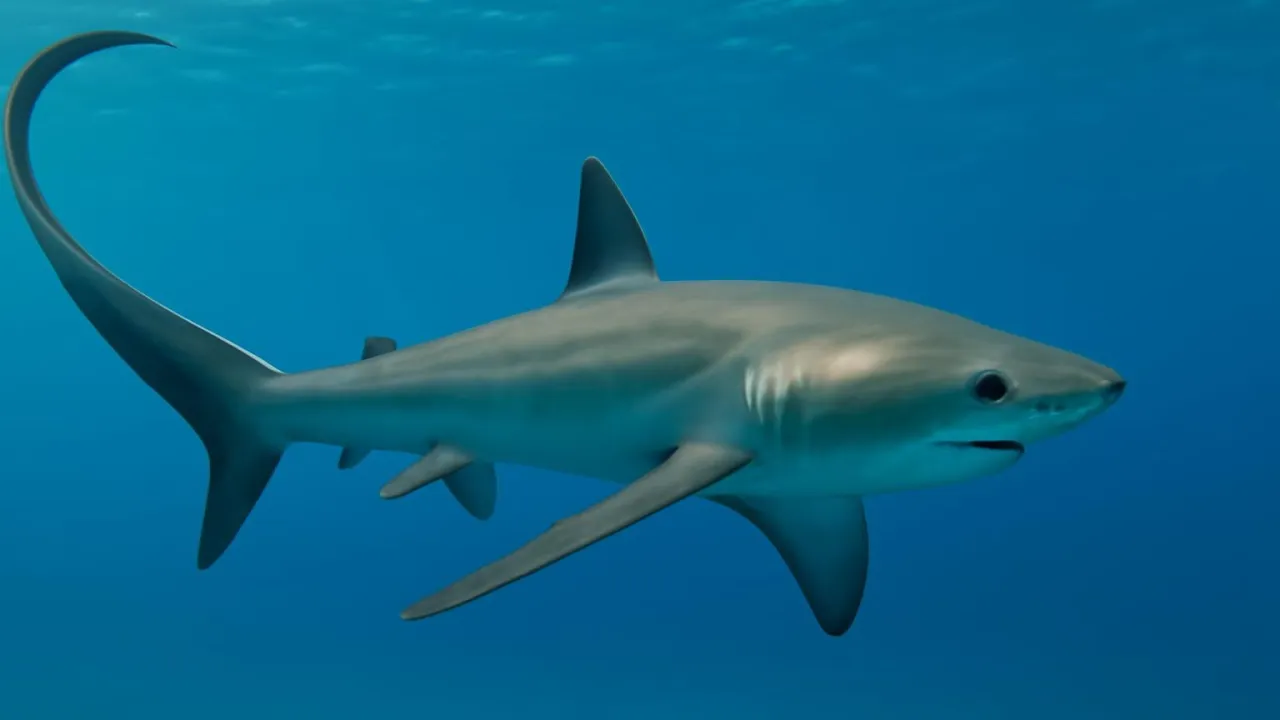
Thresher sharks can whip their tails so fast they stun fish in one hit!
✨ Word Sparks (Grade 2 Glossary)
Tap 🔊 to hear
stun
To hit hard and make someone dizzy
diet
The food that an animal eats
ocean
A large area of salty water
🪝
Have you ever seen a shark with a tail longer than its body?
1
Amazing Tail Power
The thresher shark has a tail that is longer than its body. It uses this long tail to hit and fish. This helps the shark catch its food easily. The tail moves quickly through the water like a whip.
2
Ocean Home
Thresher sharks live in warm and cool all over the world. They swim deep in the water to find food. These sharks can swim very fast to catch fish and squid. They like to stay near the surface or deep down.
3
What They Eat
Their includes fish and squid, which they catch by stunning them. The thresher shark uses its tail to hit groups of fish and make them dizzy. Then it swims through the stunned fish to eat them. This hunting method is very clever.
The thresher shark’s tail can be as long as its body and is used like a whip to stun prey.
✨ Word Sparks (Grade 3 Glossary)
Tap 🔊 to hear
adaptation
A body change that helps survival
prey
Animals hunted for food
camouflage
Colors that help hide from others
🪝
Did you know the thresher shark uses its tail to stun prey and catch dinner?
1
Tail as a Hunting Tool
The thresher shark’s tail is very long and strong, helping it catch . It swings its tail like a whip to stun fish and squid nearby. This allows it to catch food more easily in the ocean. The tail’s power is a key survival tool.
2
Where It Lives and Hunts
Thresher sharks live in temperate and tropical oceans worldwide, often swimming near the surface or at moderate depths. They use their excellent swimming skills to chase . Their habitat provides plenty of fish and squid for food. helps them hide from predators and sneak up on prey.
3
Diet and Feeding Behavior
These sharks eat mainly fish and squid, stunning them with their tail before eating. Their hunting method is efficient because it reduces the chance of escaping. They often hunt in groups or alone, using their tail to herd fish. This behavior shows smart to their environment.
4
Body Adaptations
The thresher shark’s streamlined body and sharp teeth help it swim fast and catch slippery . Its large eyes improve vision in low light underwater. The long tail is a unique that solves the problem of catching fast fish. These features make it a skilled predator.
2. What helps the thresher shark hide from predators?
🤯 Mind-Blowing Fact • Grade 4
Thresher sharks help keep ocean food webs balanced by hunting with their powerful tails.
✨ Word Sparks (Grade 4 Glossary)
Tap 🔊 to hear
ecosystem
A community of plants and animals living together
predator
An animal that hunts other animals
migration
Moving to new places for food or safety
🪝
How does the thresher shark’s whip-like tail affect ocean food webs?
1
Tail’s Role in Hunting
The thresher shark uses its extraordinarily long tail to stun prey, which makes catching fish and squid easier and faster. This cause-and-effect relationship shows how the tail improves the shark’s hunting success. By stunning prey, the shark reduces energy spent chasing food. This hunting technique is an important adaptation for survival in diverse ocean habitats.
2
Ecosystem Impact
As a , the thresher shark plays a vital role in ocean food webs by controlling fish and squid populations. This balance helps maintain healthy and prevents overpopulation of smaller species. The shark’s hunting behavior also affects prey behavior and distribution. Human fishing activities sometimes threaten thresher sharks, impacting their role in the ecosystem.
3
Habitat and Distribution
Thresher sharks inhabit temperate and tropical oceans worldwide, often near continental shelves and deep waters. They migrate seasonally to find food and suitable breeding grounds. Their wide geographic range shows adaptability to different ocean conditions. Ocean temperature and prey availability strongly influence their distribution patterns.
4
Physical Adaptations
The shark’s streamlined body, large eyes, and whip-like tail are physical adaptations that enhance swimming speed, vision, and hunting efficiency. These features allow it to capture fast-moving prey and avoid . The tail’s length and strength provide a mechanical advantage in stunning prey. Such adaptations highlight the shark’s evolutionary success.
1. Why does the thresher shark use its tail to stun prey?
2. How do thresher sharks affect ocean ecosystems?
🤯 Mind-Blowing Fact • Grade 5
Thresher sharks use their tails moving over 50 miles per hour to stun prey in a single strike.
✨ Word Sparks (Grade 5 Glossary)
Tap 🔊 to hear
caudal fin
The tail fin that helps a fish swim fast
apex predator
Top hunter with no natural enemies
bycatch
Animals caught accidentally in fishing nets
🪝
What unique physiological features make the thresher shark a top ocean predator?
1
Scientific Classification and Range
The thresher shark, scientifically named Alopias vulpinus, belongs to the family Alopiidae within the order Lamniformes. It is widely distributed in temperate and tropical oceans worldwide, favoring continental shelves and offshore deep waters. Seasonal migrations occur to optimize feeding and reproductive success. Its broad geographic range demonstrates remarkable ecological adaptability.
2
Physiological Mechanics of Hunting
This shark possesses an exceptionally elongated upper lobe, approximately equal in length to its entire body, which it uses to deliver powerful whip-like strikes. These strikes stun schooling fish and squid, reducing prey escape responses and increasing hunting efficiency. The thresher shark’s streamlined body and large eyes enhance its speed and low-light vision, enabling effective predation in diverse oceanic environments.
3
Conservation Status and Human Impact
Currently, thresher sharks face threats from overfishing and , leading to population declines in some regions. Conservation efforts focus on regulating fishing practices and protecting critical habitats to ensure sustainable populations. Their role as is crucial for maintaining marine ecosystem balance, making their protection vital for ocean health.
4
Ecological Role and Food Web Dynamics
As mesopredators, thresher sharks regulate populations of mid-sized fish and squid, influencing trophic cascades within marine food webs. Their predation affects prey behavior and distribution, thereby shaping community structure. This ecological role highlights their importance in sustaining biodiversity and ecosystem resilience in ocean habitats.
5
Quantitative Comparisons and Adaptations
Adult thresher sharks can reach lengths of up to 20 feet (6 meters) and weigh approximately 500 pounds (227 kilograms). Their tail whip can move at speeds exceeding 50 miles per hour (80 kilometers per hour), delivering stunning blows to prey. These physical adaptations exemplify evolutionary specialization for high-speed hunting and survival in pelagic ocean zones.