🇺🇸 U.S. HISTORY
🏛️ 3rd President of the United States (1801–1809) • Founding Father
VA History & Social Science SOL K.1, 1.2, 2.4, VS.1–VS.10, USI & USII
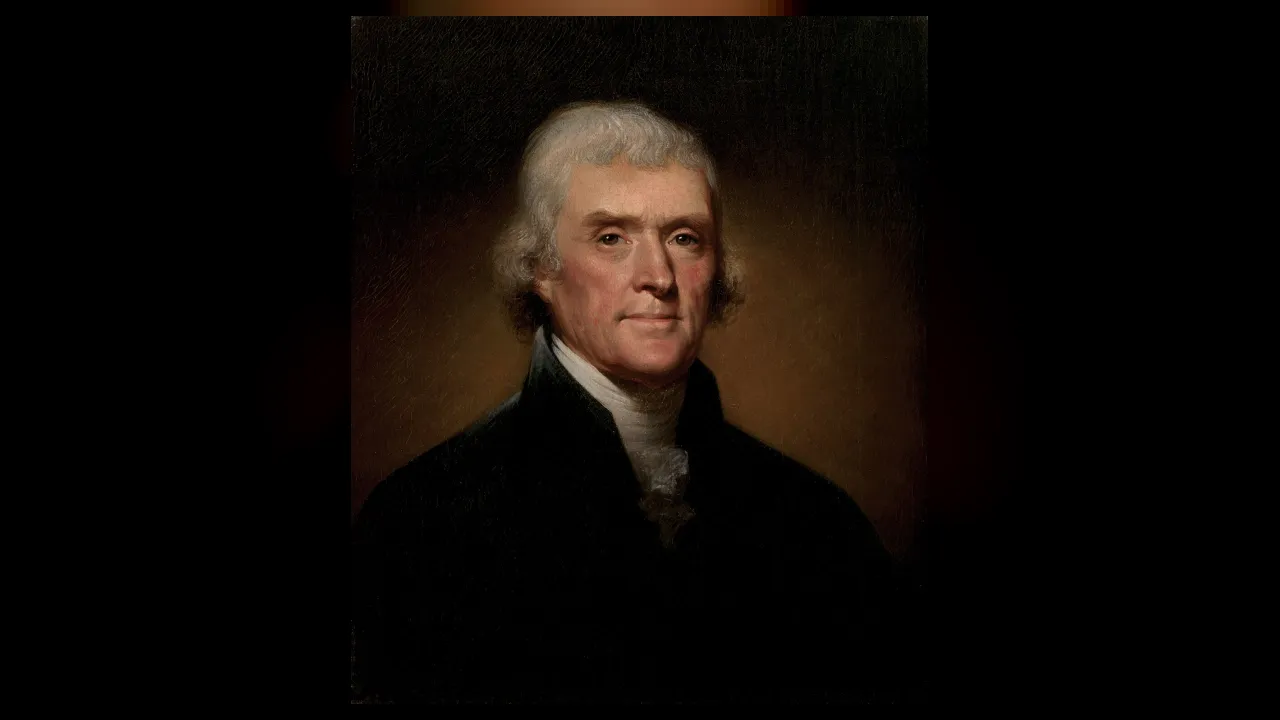
Thomas Jefferson
Declaration Author, Architect, and Third President
Grade 5 • Advanced • 389 words
⏳ Era / StatehoodPresidency: March 4, 1801 – March 4, 1809 (1743–1826)
🗺️ Region / CapitalMonticello • Albemarle County, Commonwealth of Virginia
📜 Key MilestoneAuthor of the Declaration of Independence, Louisiana Purchase (1803), and University of Virginia founder
⚡ Historical SparkPenned the immortal words 'all men are created equal' and doubled the nation's map peacefully
🤯 Mind-Blowing Fact • Grade 1
Thomas Jefferson loved books so much that he collected over six thousand volumes—and they helped rebuild the Library of Congress!
✨ Word Sparks (Grade 1 Glossary)
Tap 🔊 to hear
declaration
bold public statement shared with everyone
equal
having the same value and fair rights
nickel
silver-colored U.S. coin worth five cents
🪝
Whose shiny nickel coin shows a house with a round dome on the back?
1
Words About Freedom
Dip goes the feather pen into black ink! Young Thomas Jefferson wrote the of Independence in 1776 to tell the world America was free.
2
Doubling the Map
Later he served as our third president. He bought huge western land that made America twice as big!
3
A Hilltop Home
Flip over a five-cent coin to see Jefferson and his Virginia home, Monticello!
1. Which famous 1776 founding document did Thomas Jefferson write?
2. Which American coin features Thomas Jefferson on one side and Monticello on the other?
🤯 Mind-Blowing Fact • Grade 2
Inside Monticello's front hall hangs a giant seven-day clock invented by Thomas Jefferson that uses heavy cannonball weights sliding down the wall to tell both the hour and the day of the week!
✨ Word Sparks (Grade 2 Glossary)
Tap 🔊 to hear
liberty
freedom to live and choose fairly
architect
designer who plans buildings and structures
expedition
organized journey to explore unfamiliar lands
🪝
How did a shy thirty-three-year-old Virginian write the most famous birthday message in American history?
1
Writing on a Portable Desk
Sunlight streamed into a quiet second-floor room in Philadelphia during June 1776. Opening a small folding wooden desk he had designed himself, Virginian Thomas Jefferson wrote bold words that still inspire the world: all people are created equal with rights to 'Life, and the pursuit of Happiness.' Congress approved his Declaration of Independence on July 4, 1776!
2
Louisiana Purchase and Lewis and Clark
As our third president in 1803, Jefferson bought the vast Louisiana Territory from France, doubling the size of the United States! Then he sent explorers Meriwether Lewis and William Clark west to map rivers, plants, and mountains.
3
Gadgets at Monticello
Back home at Monticello in Virginia, curious Jefferson grew hundreds of garden plants, played the violin, and invented clever clocks!
1. How did President Thomas Jefferson's 1803 Louisiana Purchase change the map of the United States?
2. Which two explorers did President Jefferson send west in 1804 to map the new lands to the Pacific Ocean?
🤯 Mind-Blowing Fact • Grade 3
Thomas Jefferson invented a clever 'polygraph' copying machine with two linked pens on brass arms—so whenever he wrote a letter with one pen, the second pen wrote an exact twin copy beside it automatically!
✨ Word Sparks (Grade 3 Glossary)
Tap 🔊 to hear
statute
official written law passed by lawmakers
inaugurate
swear a new leader officially into office
obelisk
tall four-sided stone pillar with pointed top
🪝
What three achievements did Thomas Jefferson pick for his own gravestone—leaving out being President of the United States?
1
Three Gifts to Future Generations
Walk up the wooded hillside at Monticello near Charlottesville, Virginia, and read Thomas Jefferson's stone ! Surprisingly, it never mentions that he served as governor, Vice President, or third President of the United States. Instead, Jefferson asked to be remembered for three gifts of ideas: writing the Declaration of Independence, authoring the Virginia for Religious Freedom, and founding the University of Virginia.
2
Protecting Freedom of Belief
Passed in Richmond in 1786 with James Madison's help, Jefferson's Virginia for Religious Freedom guaranteed that no citizen could be forced to attend or pay taxes for a government church—becoming a direct model for the First Amendment.
3
First Secretary of State and Third President
After serving as minister to France and George Washington's first Secretary of State, Jefferson won the presidency in 1800, became the first president inaugurated in Washington, D.C., and approved the 1803 Louisiana Purchase.
4
Rebuilding America's Library
When fire destroyed Congress's books in 1814, Jefferson offered his personal library of 6,487 books—saying 'I cannot live without books'—restarting the Library of Congress!
1. Which three accomplishments did Thomas Jefferson choose to have carved onto his gravestone?
2. How did Thomas Jefferson help rescue the Library of Congress after it burned in 1814?
🤯 Mind-Blowing Fact • Grade 4
On March 4, 1801, Thomas Jefferson became the very first U.S. president inaugurated in Washington, D.C.—and instead of riding in a fancy carriage with guards, he simply walked down the street from his boardinghouse!
✨ Word Sparks (Grade 4 Glossary)
Tap 🔊 to hear
consent
willing agreement given freely by citizens
unalienable
natural rights that cannot rightfully be taken
botany
scientific study of plants, seeds, and trees
🪝
How did Jefferson's words in 1776 become a promise that later generations of Americans used to expand freedom for all?
1
Renaissance Mind on a Virginia Mountain
Gazing west toward the Blue Ridge Mountains from Albemarle County, Virginia, Thomas Jefferson (1743–1826) filled notebooks on , meteorology, paleontology, classical architecture, and six languages. Elected to the Second Continental Congress at thirty-two, he was chosen by the Committee of Five—alongside John Adams, Benjamin Franklin, Roger Sherman, and Robert Livingston—to draft the Declaration of Independence. Drawing on Enlightenment philosophy and George Mason's Virginia Declaration of Rights, Jefferson proclaimed that governments derive 'their just powers from the of the governed.'
2
The Enduring Paradox of Liberty
Historians highlight a profound contradiction in Jefferson's life: the statesman who wrote 'all men are created equal' and pushed to ban the international slave trade as president also held hundreds of enslaved men, women, and children in bondage on his Monticello plantation. Yet because Jefferson anchored America's founding creed in universal human rights rather than royal bloodlines, reformers from Abraham Lincoln to Frederick Douglass, Elizabeth Cady Stanton, and Dr. Martin Luther King Jr. invoked Jefferson's own words to demand full equality for every American.
3
First D.C. Inauguration and Continental Reach
On March 4, 1801, Jefferson walked on foot to the unfinished U.S. Capitol for the very first presidential inauguration held in Washington, D.C., declaring after a heated election, 'We are all Republicans, we are all Federalists.' Two years later, when Napoleon offered all 828,000 square miles of Louisiana for fifteen million dollars, Jefferson set aside strict constitutional doubts to double the nation's territory and launch the Corps of Discovery under Virginian neighbors Meriwether Lewis and William Clark.
4
Architecture and Lifelong Learning
Designing Virginia's classical State Capitol in Richmond, Monticello's octagonal dome, and the Rotunda and 'Academical Village' at the University of Virginia in Charlottesville (chartered 1819), Jefferson championed public education as the true safeguard of self-government.
1. According to the Declaration of Independence written by Thomas Jefferson, where do governments get their 'just powers'?
2. Which public university in Charlottesville did Thomas Jefferson design and found in 1819 to advance science and self-government?
🤯 Mind-Blowing Fact • Grade 5
Monticello and the University of Virginia in Charlottesville—both designed by Thomas Jefferson—make up the only architectural site in the United States honored on the UNESCO World Heritage List as the creation of an American president!
✨ Word Sparks (Grade 5 Glossary)
Tap 🔊 to hear
polymath
thinker skilled across many branches of learning
Enlightenment
era prizing reason, science, and individual rights
conciliatory
calmly bringing opposing sides together in peace
🪝
How did Enlightenment philosophy, neoclassical architecture, and continental geography unite in the mind of America's third president?
1
Enlightenment Polymath of the Virginia Piedmont
Educated at the College of William & Mary in Williamsburg under legal mentor George Wythe and natural philosopher William Small, Thomas Jefferson (1743–1826) embodied the eighteenth-century American . Serving in Virginia's House of Burgesses and writing 'A Summary View of the Rights of British America' (1774), the Piedmont scholar arrived at Philadelphia's Second Continental Congress famed for what John Adams called a 'peculiar felicity of expression.' Over seventeen June days in 1776, Jefferson synthesized John Locke's social-contract philosophy with colonial grievances into the Declaration of Independence—grounding American nationhood in self-evident human equality, unalienable rights, and government by consent.
2
Virginia Reforms and Religious Liberty
Returning to Virginia's legislature and serving as wartime governor, Jefferson worked to modernize colonial law—abolishing feudal inheritance rules (primogeniture and entail), proposing publicly funded elementary schools, and drafting the Virginia Statute for Religious Freedom in 1777. Enacted in January 1786 through James Madison's legislative leadership while Jefferson served as U.S. minister in Paris, the statute decoupled civil rights from religious belief, laying the intellectual cornerstone for the First Amendment's Establishment and Free Exercise clauses.
3
Cabinet Debates, 1800 Transition, and the Louisiana Purchase
As George Washington's first Secretary of State (1790–1793) and John Adams's Vice President (1797–1801), Jefferson championed an agrarian republic and strict construction of federal powers in spirited constitutional debates with Alexander Hamilton. Following his watershed 1800 election and 1801 inaugural address in Washington, D.C., President Jefferson dispatched naval squadrons against Barbary corsairs in the Mediterranean, reduced national debt, and seized a historic diplomatic opening in 1803: when Robert Livingston and James Monroe negotiated France's sale of all 828,000 square miles of Louisiana for $15 million, Jefferson ratified the treaty and trained Meriwether Lewis to lead the scientific Corps of Discovery to the Pacific.
4
Slavery's Moral Contradiction and the Founding Creed
Though Jefferson signed the 1807 federal law banning the transatlantic importation of enslaved people effective January 1, 1808, and famously warned that slavery was like holding 'a wolf by the ear,' he depended on the labor of more than six hundred enslaved people over his lifetime at Monticello, freeing only a handful. Modern scholarship at Monticello examines both that painful human reality and how abolitionists, suffragists at Seneca Falls (1848), and civil rights leaders transformed Jefferson's universal preamble into an instrument of expanding justice.
5
Neoclassical Legacy and the Jubilee Fourth
Introducing Palladian neoclassical architecture across Virginia's Capitol, Monticello, and the University of Virginia, and seeding the Library of Congress with his 6,487 volumes, Jefferson died at Monticello on July 4, 1826—exactly fifty years after the Declaration's adoption and hours before John Adams.
1. How did Thomas Jefferson's 1786 Virginia Statute for Religious Freedom shape the U.S. Constitution?
2. Why did later reformers like Abraham Lincoln, Elizabeth Cady Stanton, and Dr. Martin Luther King Jr. repeatedly quote Jefferson's Declaration of Independence?