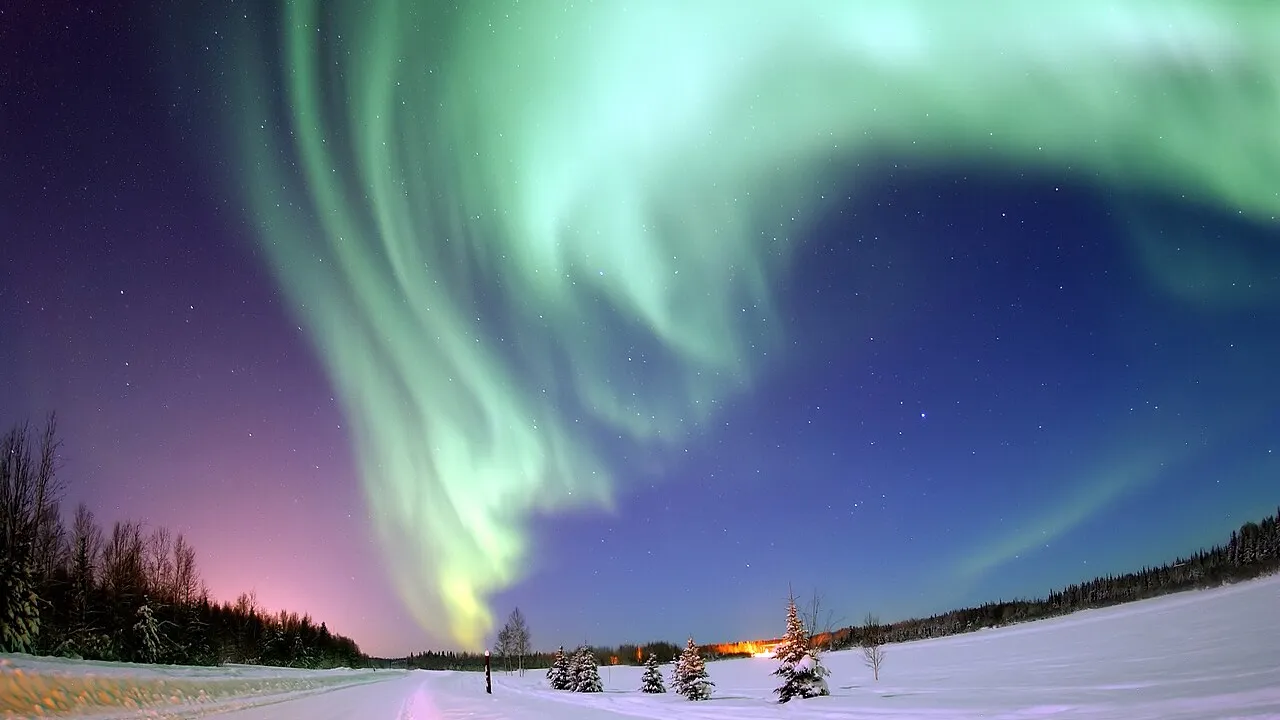
1. What makes auroras light up high in the thermosphere?
2. Who lives and works while orbiting inside the thermosphere?
🤯 Mind-Blowing Fact • Grade 2
Both the North Pole and the South Pole get auroras at the very same time!
✨ Word Sparks (Grade 2 Glossary)
Tap 🔊 to hear
magnetic field
an invisible force shield around planet Earth
oxygen
a common sky gas that glows bright green
particle
a tiny speck much smaller than dust
🪝
How can the hottest layer of Earth's air still feel freezing cold?
1
Curtains of Polar Color
Imagine standing near the North Pole on a crisp winter night while emerald waves ripple silently across the stars. You are watching the Northern Lights! They shine inside the thermosphere, the fourth layer of Earth's atmosphere.
2
Hot Gas, Freezing Feel
Thermo means heat, and sunlight warms single gas bits here past 2,000 degrees Fahrenheit. Yet the air is so thin that gas bits float far apart. Almost none would touch a thermometer, so you would still feel icy cold!
3
How Gases Choose Their Colors
Streams of tiny blow from the Sun and follow Earth's toward the poles. When they strike and nitrogen high in the thermosphere, those gases light up in green, red, and purple curtains.
1. Why wouldn't the super-hot thermosphere feel hot on an astronaut's suit?
2. Where does Earth's magnetic field guide solar particles to make auroras?
🤯 Mind-Blowing Fact • Grade 3
The International Space Station orbits about 400 kilometers high—right in the middle of the thermosphere!
✨ Word Sparks (Grade 3 Glossary)
Tap 🔊 to hear
solar wind
a fast stream of particles from the Sun
ultraviolet
high-energy invisible light from the Sun
nitrogen
a gas that makes purple and blue auroras
🪝
Why do some auroras shimmer bright emerald green while others glow ruby red or violet?
1
High Above the Weather
Shimmering like giant silk curtains in the dark, auroras put on Earth's grandest light show more than 53 miles overhead. Their stage is the thermosphere, an enormous atmospheric layer stretching from 85 kilometers all the way to about 600 kilometers above sea level.
2
Soaking Up Fierce Sunlight
The thermosphere is the first shield to catch the Sun's strongest X-rays and rays. Absorbing all that raw energy speeds up oxygen and atoms until temperatures soar past 1,500 degrees Celsius. However, because the air is millions of times thinner than surface air, heat barely transfers at all.
3
Solar Wind Meets Magnetosphere
The Sun constantly blasts out a stream of charged particles called the . Earth's magnetic shield deflects most of this blast, but funnels some particles down toward the Arctic and Antarctic.
4
A Rainbow Written in Gas
Colliding with oxygen atoms about 100 kilometers up produces classic green auroras, while higher oxygen shines crimson red and sparkles blue or violet!
1. Which gas creates the most common bright green color in an aurora?
2. What kind of solar energy heats the thermosphere to extreme temperatures?
🤯 Mind-Blowing Fact • Grade 4
During powerful solar storms, the thermosphere puffs up like a heated marshmallow, increasing drag on low-orbiting satellites!
✨ Word Sparks (Grade 4 Glossary)
Tap 🔊 to hear
magnetosphere
Earth's protective magnetic bubble in space
aurora borealis
scientific name for the glowing Northern Lights
photon
a tiny packet of pure light energy
🪝
How do storms on the Sun 93 million miles away light up the sky above Earth's poles?
1
Where Sky Meets Orbit
Picture floating beside a window on the International Space Station 400 kilometers above Earth while luminous green pillars dance beneath your spacecraft. Although astronauts consider themselves in outer space, they actually orbit inside the thermosphere! Extending from roughly 85 to 600 kilometers in altitude, this vast layer bridges our planet's denser lower atmosphere and the vacuum of space.
2
Temperature Versus Heat
Physicists love using the thermosphere to explain the difference between temperature and heat. Temperature measures how fast individual atoms jiggle. Because oxygen and nitrogen atoms here absorb intense solar X-ray and extreme ultraviolet radiation, they zip around at blistering speeds corresponding to 500 to 2,000 degrees Celsius. Yet molecules sit kilometers apart, meaning total heat energy per cubic meter is tiny.
3
Space Weather and Geomagnetic Storms
When solar flares or coronal mass ejections erupt on the Sun, gusts of electrified solar wind race across 150 million kilometers toward Earth. Our planet's channels electrons and protons along magnetic field lines into oval rings surrounding both magnetic poles, creating the in the north and aurora australis in the south.
4
Atomic Neon Signs and Radio Reflections
Much like electricity exciting gas inside a neon sign, solar electrons boost thermospheric atoms into higher energy states. As atoms relax, oxygen emits green or high-altitude red , while ionized nitrogen radiates violet-blue light.
1. What is the scientific name for the Southern Lights near Antarctica?
2. What happens to the thermosphere when a strong solar storm blasts extra energy at Earth?
🤯 Mind-Blowing Fact • Grade 5
The Kármán line—the internationally recognized boundary of outer space at 100 kilometers—actually lies near the bottom of the thermosphere!
✨ Word Sparks (Grade 5 Glossary)
Tap 🔊 to hear
ionosphere
electrically charged upper air that reflects radio waves
Kármán line
the 100-kilometer boundary marking outer space
tenuous
extremely thin and spread far apart
🪝
Why does a solar eruption expand Earth's upper atmosphere and paint atomic quantum colors across the sky?
1
Threshold of Orbital Space
Gaze upward during a geomagnetic storm—sometimes visible even as far south as the Blue Ridge Mountains of Virginia—and you may witness crimson and emerald curtains pulsing silently across the stars. Those celestial ribbons ignite inside the thermosphere, a sweeping atmospheric realm spanning roughly 85 to 600 kilometers (53 to 375 miles) above Earth. Crossing the famous at 100 kilometers, this region hosts both dazzling auroras and the International Space Station.
2
Kinetic Temperature in a Near-Vacuum
Above the frigid mesopause, temperature abruptly reverses course and climbs dramatically with altitude. Atomic oxygen, molecular nitrogen, and helium intercept unfiltered extreme ultraviolet (EUV) and X-ray photons from the Sun. Kinetic temperatures surge from 500 degrees Celsius during quiet solar nights to over 2,000 degrees Celsius during peak solar activity. Nevertheless, air density is so —a single molecule may travel over a kilometer before colliding with another—that conductive heat transfer is negligible.
3
The Ionosphere and Radio Propagation
High-energy solar radiation also strips electrons from neutral gas atoms, embedding electrically charged plasma layers known as the inside the thermosphere. Long-distance shortwave radio operators bounce signals off these ionized mirrors to communicate beyond the horizon.
4
Quantum Physics of Auroral Colors
When coronal mass ejections buffet Earth's magnetosphere, magnetic reconnection accelerates electrons down field lines into polar ovals. Collisions excite thermospheric gases: atomic oxygen between 100 and 240 kilometers emits brilliant 557.7-nanometer green light, rarer oxygen collisions above 240 kilometers glow ruby red, and molecular nitrogen below 100 kilometers radiates royal blue and violet fringes.
5
Satellite Drag and Space Weather Forecasting
Solar storms heat and inflate the thermosphere outward, multiplying atmospheric drag on low-Earth-orbit spacecraft and requiring engineers to fire thrusters so satellites stay safely aloft.