1. How many parts of a theremin do your hands actually touch while playing a song?
2. What does moving your right hand closer to the tall straight rod change?
🤯 Mind-Blowing Fact • Grade 2
Hollywood movie composers in the 1940s and 1950s loved the theremin's eerie, gliding voice so much that it became the signature sound of flying saucers and outer space!
✨ Word Sparks (Grade 2 Glossary)
Tap 🔊 to hear
loop
Metal wire bent into a smooth curved ring
gliding
Sliding smoothly from note to note without steps
radio
Invisible electromagnetic waves traveling silently through space
🪝
Why does waving your hands near two metal antennas look like conducting an invisible ghost?
1
Music Pulled Straight From Thin Air
Ooooo-wah-eeeee! Imagine standing onstage like a magician, curling your fingers gently in empty space while a soaring voice—half opera singer, half violin—fills the concert hall! That astonishing instrument is the theremin.
2
One Rod for Pitch, One Loop for Loudness
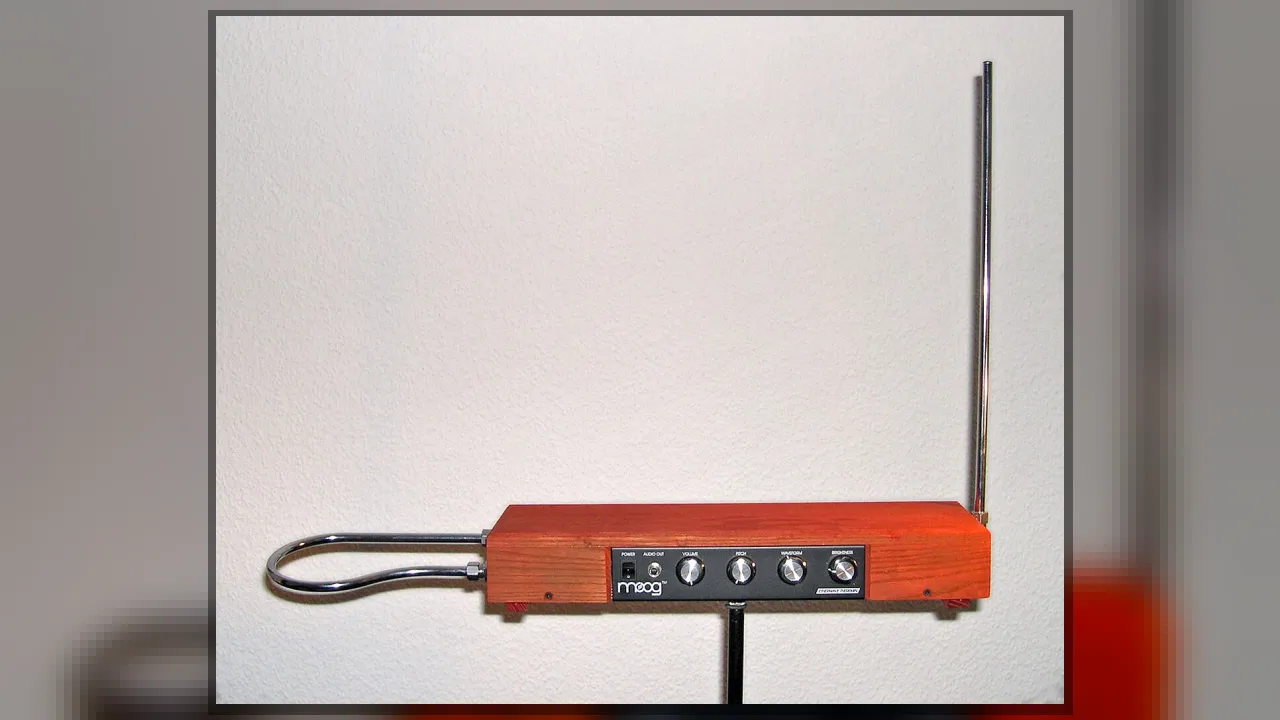
Built inside a small wooden box, the theremin sends gentle, harmless waves around two shiny metal antennas. Moving your right hand closer to the tall upright antenna slides the note higher; lowering your left hand toward the sideways quiets the volume down to complete silence!
3
Tricky Without Frets or Keys
Because there are no keys, frets, or lines to see in empty air, theremin players must rely completely on sharp ears and steady hands!
1. What job does the curved sideways loop antenna on the left side perform?
2. Why is playing a melody in tune on a theremin especially challenging?
🤯 Mind-Blowing Fact • Grade 3
Before being named after its inventor Léon Theremin, the instrument was originally called the Aetherphone—meaning 'sound from the invisible ether of space'!
✨ Word Sparks (Grade 3 Glossary)
Tap 🔊 to hear
electromagnetic
Invisible energy field combining electricity and magnetism
capacitance
Ability of separated objects to store electrical charge
aerial
Happening gracefully up in open air
🪝
How did a twenty-four-year-old Russian scientist accidentally invent a musical instrument while testing gas sensors in a lab?
1
When Physics Became a Concert Violin
Vvvv-ooooo-eeeee! In 1920, a young Russian physicist and trained cellist named Léon Theremin was measuring invisible gases in his Petrograd laboratory when he noticed something thrilling: whenever his hand moved near his electronic test circuit, a high whistling tone slid up and down like a singing cello!
2
Your Own Body Joins the Circuit
How does your hand steer electricity without touching metal? Each antenna creates a weak field around itself. Because the human body conducts a tiny bit of electrical charge, bringing your hand closer changes how much energy the antenna stores—an effect scientists call !
3
Two High Waves Make One Musical Note
Inside the box, two radio oscillators buzz far too high for humans or even dogs to hear. When your hand shifts one oscillator's speed slightly, the difference between the two waves drops right into human hearing as a warm, singing musical pitch!
4
Clara Rockmore's Virtuoso Art
Concert violinist Clara Rockmore teamed up with Léon Theremin in the 1930s and invented ' fingering,' proving the theremin could perform classical masterpieces by Rachmaninoff and Saint-Saëns with breathtaking beauty.
1. What instrument did inventor Léon Theremin play that inspired how he shaped the theremin's singing voice?
2. Who pioneered 'aerial fingering' technique to perform soaring classical repertoire on the theremin?
🤯 Mind-Blowing Fact • Grade 4
Synthesizer legend Robert Moog started his career in 1954 at age nineteen by building and selling mail-order theremin kits out of his parents' basement in Queens, New York!
✨ Word Sparks (Grade 4 Glossary)
Tap 🔊 to hear
heterodyning
Mixing two high frequencies to create difference tones
glissando
Smooth continuous slide from one pitch to another
capacitor
Pair of conductors storing charge across space
🪝
How can two silent 250,000-hertz radio signals collide inside a theremin to create a sweet 440-hertz concert A?
1
A Century-Old Ancestor of Electronic Music
Decades before Robert Moog built his first synthesizer—in fact, it was assembling DIY theremin kits as a teenager that inspired young Bob Moog!—Léon Theremin's 1920 invention astonished audiences from Moscow to Carnegie Hall as one of humanity's earliest electronic instruments.
2
Capacitance and the Magic of Heterodyning
Trying to shift an audible 440-hertz circuit directly with tiny hand capacitance would barely budge the pitch at all! Léon Theremin solved that puzzle using a clever radio principle called . Inside the cabinet, one fixed radio-frequency oscillator hums steadily around 250,000 hertz—more than ten times higher than humans can hear. Beside it sits a second variable oscillator linked to the vertical rod antenna, which acts as one plate of a while your grounded hand acts as the other! Moving your hand a few centimeters closer adds just a couple of picofarads of capacitance, nudging the variable oscillator down to 249,560 hertz. When a mixer combines both waves, their mathematical difference—250,000 minus 249,560—pops out as a crystal-clear 440-hertz musical A!
3
Articulating Notes With the Left-Hand Loop
Because pitch slides continuously like a trombone without valves, every distinct note would smear into a siren unless sculpted by the left hand! Dipping the left hand swiftly toward the horizontal volume loop dips an internal resonant circuit to silence between notes for crisp staccato phrasing.
4
Symphony Halls, Sci-Fi Cinema, and Rock
Championed in classical recitals by Clara Rockmore and scored into eerie film classics like Spellbound and The Day the Earth Stood Still, the theremin continues captivating modern orchestras and experimental stages.
1. If a theremin's fixed oscillator runs at 250,000 Hz and your hand shifts the variable oscillator to 249,000 Hz, what audible pitch comes out?
2. How does a theremin player separate two notes cleanly without a sliding siren sound between them?
🤯 Mind-Blowing Fact • Grade 5
Moving your hand from half a meter away to just inches from a theremin pitch antenna changes capacitance by roughly one picofarad—one trillionth of a farad—which is why players must stand rock-still so even taking a deep breath doesn't bend the note!
✨ Word Sparks (Grade 5 Glossary)
Tap 🔊 to hear
picofarad
Tiny capacitance unit—one trillionth of a farad
inductor
Coiled wire component storing energy magnetically
ultrasonic
Oscillating at frequencies above human hearing limits
🪝
How does picofarad human-body capacitance modulate LC tank oscillators and nonlinear beat-frequency waveforms to give the theremin its uncannily vocal timbre?
1
The Pioneer of Contactless Electrophones
Unveiled in October 1920 in Petrograd by twenty-four-year-old physicist-cellist Lev Sergeyevich Termen (Léon Theremin), the Aetherphone—classified organologically as a proximity-controlled heterodyne electrophone (531.11)—shattered thousands of years of organological tradition by severing physical contact between performer and resonator entirely.
2
Picofarad Capacitance and Beat-Frequency Heterodyning
At the core of a classic vacuum-tube or solid-state theremin lie two LC (-capacitor) radio-frequency oscillators operating near 250 to 285 kilohertz. One oscillator remains crystal- or coil-fixed, while the second connects via series linearized inductance coils to a vertical nickel-plated brass pitch rod roughly 40 to 50 centimeters tall. Together, the antenna and the grounded human body form the two plates of an open-air variable capacitor! Advancing the right hand from arm's length to within two centimeters of the rod increases shunt capacitance by barely 0.5 to 2 (trillionths of a farad)—yet at 260 kilohertz, governed by f = 1 / (2π√LC), that minuscule shift pulls the variable oscillator downward by up to 4,000 hertz. Fed into a nonlinear mixer/detector stage and low-pass filter, the ultrasonic sum frequency (f₁ + f₂) is discarded while the audible difference or 'beat' frequency |f₁ − f₂| emerges across a continuous five-octave span.
3
Waveform Synchronization and Formant-Like Warmth
Why didn't Léon Theremin's original vacuum-tube instruments sound like sterile laboratory test tones? Subtle weak coupling between the two RF oscillators gently pulls their phases as they approach unison, skewing the resulting beat wave from a pure sine into an asymmetrical, harmonic-rich waveform remarkably akin to bowed cello strings or human vocal cords! Meanwhile, a separate ~450-kilohertz oscillator coupled to the left-hand horizontal loop shifts off resonance as the hand approaches, regulating control voltage to a variable-gain amplifier over a 60-decibel dynamic span.
4
Clara Rockmore's Aerial Fingering Kinematics
Standing statuesquely still so breathing or torso sway never detuned the field, virtuoso Clara Rockmore pioneered octaval knuckle-and-thumb micro-extensions ('aerial fingering') paired with rapid vibrato to navigate chromatic leaps cleanly.
5
Concert Repertoire, Cinema, and Synthesis Legacy
Scored into orchestral works by Varèse (Ecuatorial), Shostakovich, Martinů, and Miklós Rózsa (Spellbound, 1945) as well as Bernard Herrmann's The Day the Earth Stood Still (1951) and modern concertos by Kalevi Aho, the theremin directly launched Robert Moog's lifelong journey into analog synthesis.