🇺🇸 U.S. HISTORY
🏛️ 26th President of the United States (1901–1909)
VA History & Social Science SOL K.1, 1.2, 2.4, VS.1–VS.10, USI & USII
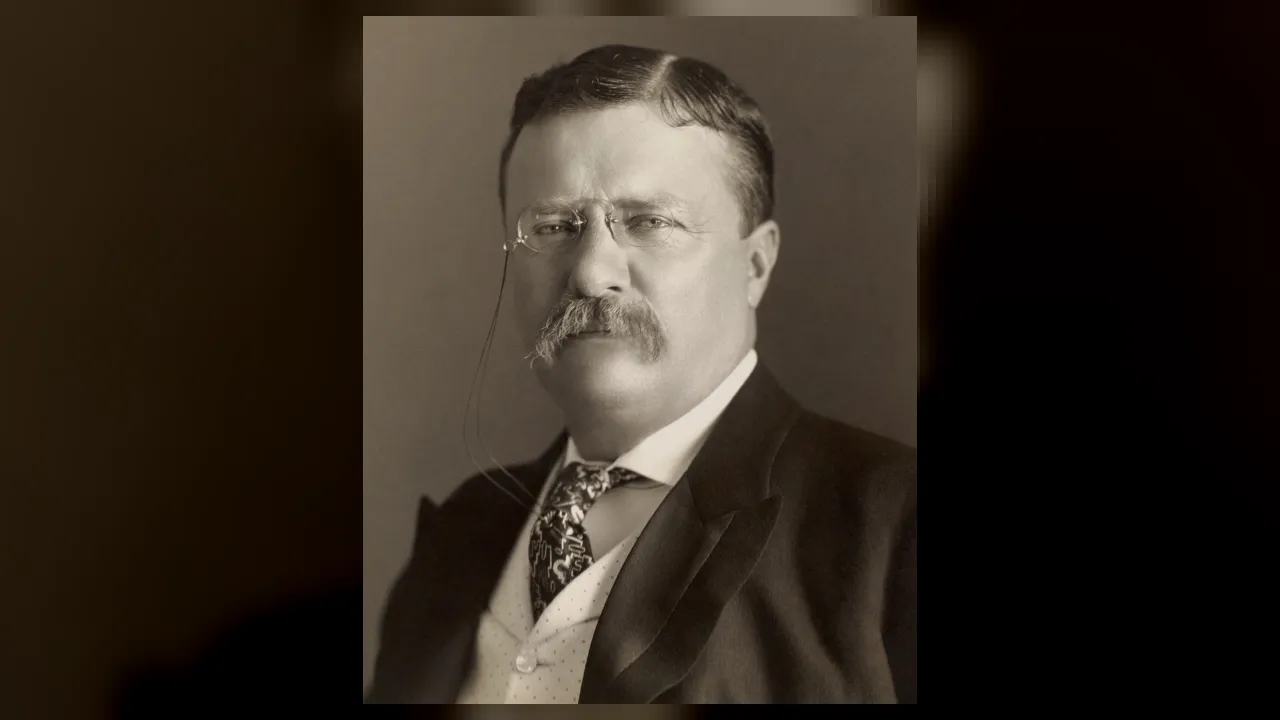
Theodore Roosevelt
The Conservation President Full of Boundless Energy
Grade 3 • Fluent • 181 words
⏳ Era / StatehoodPresidential Term: 1901–1909 (Youngest President at Age 42)
🗺️ Region / CapitalNew York City; Oyster Bay, New York & Badlands, North Dakota
📜 Key MilestoneProtected 230 Million Acres of Public Land & Built Panama Canal
⚡ Historical SparkFirst American awarded the Nobel Peace Prize and namesake of the beloved Teddy Bear
🤯 Mind-Blowing Fact • Grade 1
Theodore Roosevelt's six lively children brought a small pony named Algonquin right inside the White House elevator to cheer up their sick brother!
✨ Word Sparks (Grade 1 Glossary)
Tap 🔊 to hear
asthma
A condition that makes breathing feel tight
canyon
A deep valley with steep rocky sides
acre
A measure of land near football-field size
🪝
Did you know your favorite cuddly teddy bear was named after a real president?
1
Sickly Boy to Strong Explorer
Wheeze, cough! As a small boy in New York, young Teedie had bad and stayed indoors. He lifted weights, hiked mountains, and grew super strong!
2
Why We Have Teddy Bears
When he became our twenty-sixth president, people called him Teddy. One day he refused to harm a helpless black bear cub, so toymakers made soft 'Teddy's bears'!
3
Saving Forests and Parks
Teddy loved birds, trees, and wild . He protected millions of of forests and national parks so kids like you can explore nature forever!
1. How did the stuffed 'Teddy Bear' toy get its famous name?
2. What outdoor places did Theodore Roosevelt work hard to protect?
🤯 Mind-Blowing Fact • Grade 2
Theodore Roosevelt could read one to three entire books almost every single day—even on busy White House workdays—and wrote over thirty-five books himself!
✨ Word Sparks (Grade 2 Glossary)
Tap 🔊 to hear
sanctuary
A safe outdoor place where wild animals live protected
naturalist
A scientist or explorer who studies nature closely
cavalry
Soldiers trained to ride and travel on horseback
🪝
What kind of president reads a whole book before breakfast and camps under giant redwood trees?
1
Curiosity and Cowboy Grit
Chirp, rustle! Young Theodore Roosevelt filled notebooks with drawings of beetles, frogs, and birds. After overcoming childhood asthma through exercise, he worked as a cattle rancher in the rugged Dakota Badlands and led brave riders called the Rough Riders.
2
Youngest President in History
At just forty-two years old, Roosevelt became the youngest person ever to serve as U.S. president in 1901. Shouting his favorite cheerful word—'Bully!'—he promised every American a fair 'Square Deal' and passed laws keeping store food and medicine clean.
3
Guardian of Wild America
Camping under the stars in Yosemite with John Muir inspired him deeply. Before leaving office, Roosevelt protected 230 million acres of public land—including five national parks and fifty-one bird sanctuaries—and launched construction of the Panama Canal.
1. What record did Theodore Roosevelt set when he became president in 1901 at age forty-two?
2. Which huge engineering shortcut between the Atlantic and Pacific oceans did Roosevelt champion?
🤯 Mind-Blowing Fact • Grade 3
On New Year's Day in 1907, President Theodore Roosevelt shook hands with 8,513 White House visitors in a single day—setting a world record that stood for seventy years!
✨ Word Sparks (Grade 3 Glossary)
Tap 🔊 to hear
conservation
Wisely protecting nature, forests, water, and wildlife
monopoly
One giant company controlling an entire industry alone
strenuous
Requiring bold energy, hard effort, and action
🪝
How did one energetic president protect 230 million acres of wilderness, clean up America's food supply, and win the Nobel Peace Prize?
1
Building 'The Strenuous Life'
Imagine turning your childhood bedroom into a miniature natural history museum! Born in New York City in 1858, Theodore Roosevelt battled severe asthma by embracing what he called 'the life'—hiking, rowing, studying biology at Harvard, and ranching cattle on the Dakota frontier.
2
A 'Square Deal' for Citizens
After serving as New York City police commissioner, Rough Rider commander, governor, and vice president, Roosevelt became our twenty-sixth president in September 1901. His 'Square Deal' broke up unfair business monopolies and created the Pure Food and Drug Act of 1906 so families could trust store labels.
3
The Conservation President
Worried that logging and overhunting would erase America's scenic treasures, Roosevelt created the U.S. Forest Service and signed the Antiquities Act of 1906. He safeguarded the Grand Canyon, Crater Lake, Mesa Verde, 150 national forests, and 230 million acres—roughly an area the size of Texas and Virginia combined!
4
Peacemaker and Global Explorer
Roosevelt became the first sitting president to travel outside the United States when he inspected the giant steam shovels digging the Panama Canal. That same year, 1906, he became the very first American awarded the Nobel Peace Prize for helping Russia and Japan end a major war.
1. Why did Theodore Roosevelt become the first American ever awarded the Nobel Peace Prize in 1906?
2. How did the Pure Food and Drug Act of 1906 help everyday American families?
🤯 Mind-Blowing Fact • Grade 4
Theodore Roosevelt protected an average of roughly 84,000 acres of American land every single day he served in the White House—adding up to 230 million acres!
✨ Word Sparks (Grade 4 Glossary)
Tap 🔊 to hear
antitrust
Laws stopping giant companies from crushing fair competition
antiquities
Ancient historic sites, artifacts, or natural landmarks
pulpit
A prominent platform for speaking and inspiring listeners
🪝
How did Theodore Roosevelt modernize the presidency for the twentieth century while rescuing America's natural heritage?
1
Naturalist, Reformer, and Rough Rider
From sketching songbirds as a nearsighted boy in Manhattan to publishing a respected naval history of the War of 1812 while still in his twenties, Theodore Roosevelt approached every challenge at full gallop. Grief after losing his mother and first wife on the same day in 1884 drew him west to ranch in North Dakota's Badlands, where witnessing vanishing bison herds awakened his lifelong passion for wildlife conservation.
2
The White House as a 'Bully Pulpit'
Ascending from the vice presidency in September 1901 after President William McKinley's assassination, forty-two-year-old Roosevelt called the presidency a 'bully '—using 'bully' to mean 'terrific'—a national stage to inspire public action. His domestic 'Square Deal' balanced business, labor, and consumers: enforcing the Sherman Act against railroad monopolies, mediating the 1902 anthracite coal strike fairly, and signing the Meat Inspection Act and Pure Food and Drug Act in 1906.
3
Unmatched Conservation Legacy
Partnering with Chief Forester Gifford Pinchot and naturalist John Muir, Roosevelt placed conservation at the center of national life. Through congressional acts and the Act of 1906, he established five national parks, eighteen national monuments (including the Grand Canyon and Devils Tower), fifty-one federal bird reservations, four big-game preserves, and 150 national forests—protecting roughly 84,000 acres per day of his presidency!
4
Panama Canal and World Diplomacy
Summarizing his foreign approach with the West African proverb 'Speak softly and carry a big stick,' Roosevelt modernized the U.S. Navy, propelled construction of the fifty-mile Panama Canal linking the Atlantic and Pacific oceans, and hosted the 1905 Portsmouth Peace Conference. Winning the 1906 Nobel Peace Prize signaled America's arrival as a respected voice in twentieth-century world affairs.
1. What did the Antiquities Act of 1906 empower U.S. presidents to do quickly?
2. What did Roosevelt mean when he called the presidency a 'bully pulpit'?
🤯 Mind-Blowing Fact • Grade 5
After his presidency, fifty-five-year-old Theodore Roosevelt co-led a scientific expedition that mapped a dangerous, previously uncharted 600-mile tributary of the Amazon River—which Brazil officially renamed the Rio Roosevelt in his honor!
✨ Word Sparks (Grade 5 Glossary)
Tap 🔊 to hear
ornithology
The branch of zoology focused on studying birds
circumnavigation
Sailing or traveling all the way around Earth
tributary
A smaller river flowing into a larger river
🪝
Why is Theodore Roosevelt carved alongside Washington, Jefferson, and Lincoln on Mount Rushmore as the architect of the modern presidency?
1
Self-Reinvention and Scientific Curiosity
Picture a Harvard undergraduate publishing scholarly catalogues while simultaneously boxing lightweight intramurals! Born in Manhattan in 1858, Theodore Roosevelt conquered debilitating childhood asthma through disciplined physical training and lifelong natural science study. Two transformative years ranching along North Dakota's Little Missouri River (1884–1886) exposed him directly to western soil erosion, timber clear-cutting, and the near-extinction of the American bison—experiences that forged his Progressive worldview.
2
Stewardship Theory and the 'Square Deal'
Elevated to the presidency at forty-two in September 1901, Roosevelt articulated the 'stewardship theory' of executive leadership: the president may take any action in the public interest not forbidden by the Constitution or federal law. His Progressive 'Square Deal' targeted three goals—corporate regulation, consumer safety, and resource conservation. He revived the Sherman Antitrust Act in Northern Securities Co. v. United States (1904), strengthened railroad rate oversight via the Hepburn Act (1906), and signed the landmark Pure Food and Drug and Meat Inspection Acts.
3
Institutionalizing American Conservation
Calling natural resources 'the heritage of our children and our children's children,' Roosevelt partnered with U.S. Forest Service chief Gifford Pinchot to pioneer scientific land management. Between 1901 and 1909, he established five new national parks, signed the Antiquities Act of 1906 to designate eighteen national monuments—including 800,000 acres of the Grand Canyon—created Pelican Island as the first federal wildlife refuge, and placed approximately 230 million acres (nearly one-tenth of the United States) under federal protection.
4
Maritime Strategy, Panama, and Portsmouth
Internationally, Roosevelt recognized that industrialization linked American prosperity to global sea-lanes. In 1904, the United States assumed construction of the fifty-mile Panama Canal—conquering yellow fever through Dr. Walter Reed's and Dr. William Gorgas's mosquito-control breakthroughs and engineering giant concrete locks completed in 1914. Simultaneously, Roosevelt mediated the Treaty of Portsmouth (1905) ending the Russo-Japanese War, becoming the first American Nobel laureate in 1906, and dispatched the sixteen-battleship Great White Fleet on a peaceful 43,000-mile .
5
Unstoppable Explorer to the End
Even after leaving office in 1909—running as the Progressive 'Bull Moose' nominee in 1912 and mapping an uncharted 600-mile Amazon (now Brazil's Rio Roosevelt) alongside Brazilian explorer Candido Rondon in 1913–1914—Roosevelt embodied civic vigor. Sculptor Gutzon Borglum later included him on Mount Rushmore to honor his role in uniting ocean commerce and safeguarding America's natural estate.