1. Why did flour companies start printing pretty flowers on their cotton flour sacks in the 1930s?
2. How did neighbors help one another during the Great Depression?
🤯 Mind-Blowing Fact • Grade 2
The board game Monopoly became a runaway hit in 1935 because families loved pretending to buy grand hotels and railroads right at their kitchen tables!
✨ Word Sparks (Grade 2 Glossary)
Tap 🔊 to hear
depression
Long period when businesses and jobs shrink
unemployed
Wanting a job but unable to find work
deposit
Money placed inside a bank for safekeeping
🪝
Why did one out of every four workers suddenly lose their job in the early 1930s?
1
A Sudden Crash in 1929
Imagine busy city streets suddenly growing quiet as factories slow down and shop windows go dark. In October 1929, the stock market crashed, and thousands of banks ran out of cash, wiping out families' hard-earned savings.
2
Making Every Penny Count
Without bank loans or shoppers, businesses closed until one out of four American workers had no job. Families planted backyard vegetable gardens, patched worn shoe soles with cardboard, and traded favors instead of spending coins.
3
Radio Smiles and Fireside Hope
Even in tough times, families gathered around living-room radios for free comedy shows and comforting speeches. Soon, new laws protected bank so families would never lose their savings that way again.
1. About what fraction of American workers were unemployed at the worst point of the Great Depression?
2. Why was listening to the radio so popular for 1930s families?
🤯 Mind-Blowing Fact • Grade 3
Empire State Building crews constructed the 102-story skyscraper in Manhattan in just one year and forty-five days during the Great Depression, finishing in 1931!
✨ Word Sparks (Grade 3 Glossary)
Tap 🔊 to hear
bank run
Panic when everyone demands bank cash together
resourceful
Clever at solving problems with limited supplies
insure
Promise to replace money if loss happens
🪝
How could a crash on Wall Street cause banks, farms, and factories thousands of miles away to close?
1
The Chain Reaction of 1929
Picture anxious crowds gathering on rainy sidewalks outside locked bank doors! After stock prices plunged in October 1929, nervous depositors rushed to withdraw their cash all at once—a panic called a . Because banks had loaned much of that money out, over nine thousand banks failed.
2
Factories and Farms Feel the Squeeze
When families lost savings, they stopped buying cars, clothes, and furniture. Factories laid off millions of workers, and farm crop prices fell so low that wheat and corn barely paid for shipping to market.
3
Everyday Ingenuity at Home
Americans responded with remarkable resourcefulness, living by the motto: 'Use it up, wear it out, make it do, or do without.' Children collected scrap metal and glass, parents canned summer tomatoes in mason jars, and neighbors organized potluck suppers.
4
Building Safer Banks for the Future
Starting in 1933, Congress created the Federal Deposit Insurance Corporation, or FDIC, to bank accounts. Confidence returned as public works programs and safer banking rules helped steady the nation.
2. What new agency did Congress create in 1933 to protect people's bank savings?
🤯 Mind-Blowing Fact • Grade 4
Photographer Dorothea Lange captured unforgettable portraits of resilient farming families in the 1930s, helping Americans across the country understand and support struggling rural neighbors!
✨ Word Sparks (Grade 4 Glossary)
Tap 🔊 to hear
tariff
Tax placed on goods traded between countries
barter
Trade goods or chores directly without money
unregulated
Operating without safety rules or government checks
🪝
Why did several economic weaknesses combine at once to cause the longest downturn in modern history?
1
More Than Just One Crash
Hear the clatter of ticker-tape machines on October 29, 1929—nicknamed Black Tuesday—as sixteen million shares traded in panic on the New York Stock Exchange! Historians note, however, that the stock crash alone did not cause the Great Depression; rather, it exposed deeper cracks including agricultural debt, uneven wages, risky credit, and fragile banks.
2
A Global Domino Effect
Between 1929 and 1933, U.S. industrial output dropped nearly in half, and unemployment climbed to twenty-five percent—nearly thirteen million workers. High trade enacted in 1930 slowed international commerce even further, spreading economic hardship across Europe, Latin America, and Asia.
3
Life in Cities and Virginia Communities
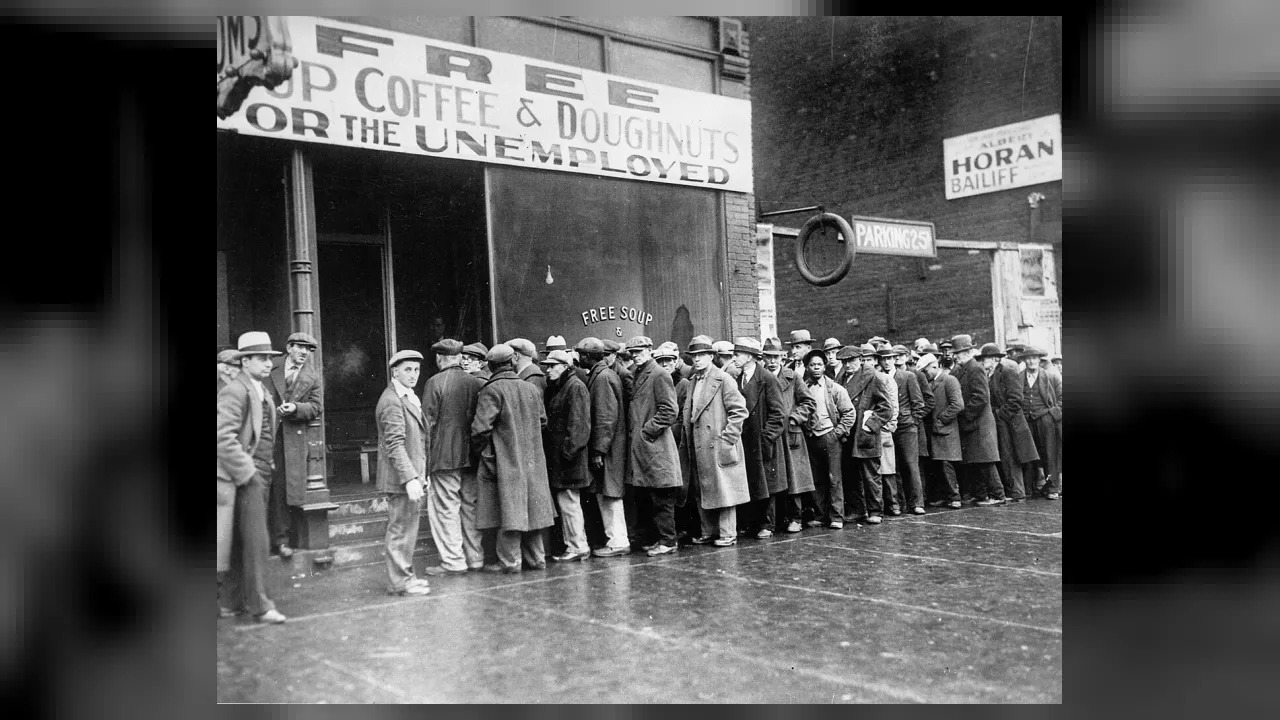
In big cities, homeless workers built makeshift shantytowns while charity breadlines stretched around blocks. In Virginia, tobacco and peanut prices tumbled and Appalachian coal mines cut shifts, yet tight-knit rural neighbors bartered eggs, firewood, and tailoring to sustain one another without cash.
4
Fireside Chats and Lasting Safeguards
Elected in 1932, President Franklin D. Roosevelt spoke calmly to sixty million radio listeners in 'Fireside Chats,' explaining how reopened banks and FDIC deposit insurance worked. Those reforms, combined with relief jobs and eventual World War II manufacturing, lifted America out of the Depression.
1. Besides the 1929 stock market crash, which deeper factors contributed to the Great Depression?
2. How did President Franklin D. Roosevelt use radio 'Fireside Chats' in 1933?
🤯 Mind-Blowing Fact • Grade 5
Before the FDIC began insuring accounts in 1934, more than 9,000 U.S. banks failed in just four years—yet in 1934, the very first year of federal deposit insurance, only nine insured banks failed nationwide!
✨ Word Sparks (Grade 5 Glossary)
Tap 🔊 to hear
contraction
Period when overall economic activity shrinks sharply
retaliate
Respond to another country's tax with taxes
mobilization
Organizing factories and citizens for national effort
🪝
How did the economic crisis of 1929–1939 permanently reshape how governments protect banks, workers, and financial markets?
1
Anatomy of an Economic Contraction
On October 24 and October 29, 1929, waves of panic selling swept Wall Street, erasing tens of billions of dollars in paper wealth. That shock triggered a severe four-year : between 1929 and 1933, U.S. gross domestic product fell by roughly thirty percent, wholesale prices plummeted, and national unemployment soared from 3.2 percent to nearly twenty-five percent.
2
Monetary Shrinkage and Trade Barriers
Why did a sharp downturn deepen into a decade-long crisis? As more than nine thousand commercial banks collapsed, the nation's money supply shrank by nearly one-third, starving surviving farms and factories of credit while the Federal Reserve hesitated to lend aggressively. Compounding the slump, the Smoot-Hawley Tariff Act of 1930 raised U.S. import duties, prompting foreign nations to and slashing world trade by over sixty percent.
3
Human Resilience Across Diverse Communities
Behind economic statistics stood millions of families demonstrating extraordinary perseverance. Urban Mutual Aid societies, church pantries, and neighborhood cooperatives pooled groceries and rent money. Minority workers often faced 'last hired, first fired' layoffs, prompting civic leaders like Mary McLeod Bethune and labor organizers to advocate for equitable access to federal relief.
4
Culture as Comfort and Documentary Witness
Even amid scarcity, cultural life flourished: public libraries recorded record borrowing, symphony radio broadcasts reached millions, and documentary photographers like Dorothea Lange and Gordon Parks chronicled dignified everyday courage across American towns.
5
Institutional Lessons That Endure Today
To prevent future panics, lawmakers enacted enduring structural guardrails during the 1930s—including Federal Deposit Insurance Corporation (FDIC) protection for bank accounts, the Securities and Exchange Commission (SEC) to oversee stock markets, unemployment insurance, and Social Security. When industrial for World War II finally restored full employment after 1940, the American economy emerged with far stronger financial foundations.