🇺🇸 U.S. HISTORY
🏛️ First Ten Constitutional Amendments • Ratified December 15, 1791
VA History & Social Science SOL K.1, 1.2, 2.4, VS.1–VS.10, USI & USII
The Bill of Rights
Ten Shielding Promises That Protect Every Voice
Grade 5 • Advanced • 361 words
⏳ Era / StatehoodRatified: December 15, 1791
🗺️ Region / CapitalDrafted in First U.S. Congress; Decisive Vote in Richmond, Virginia
1. How many amendments make up the Bill of Rights?
2. Which freedom is protected by the Bill of Rights?
🤯 Mind-Blowing Fact • Grade 2
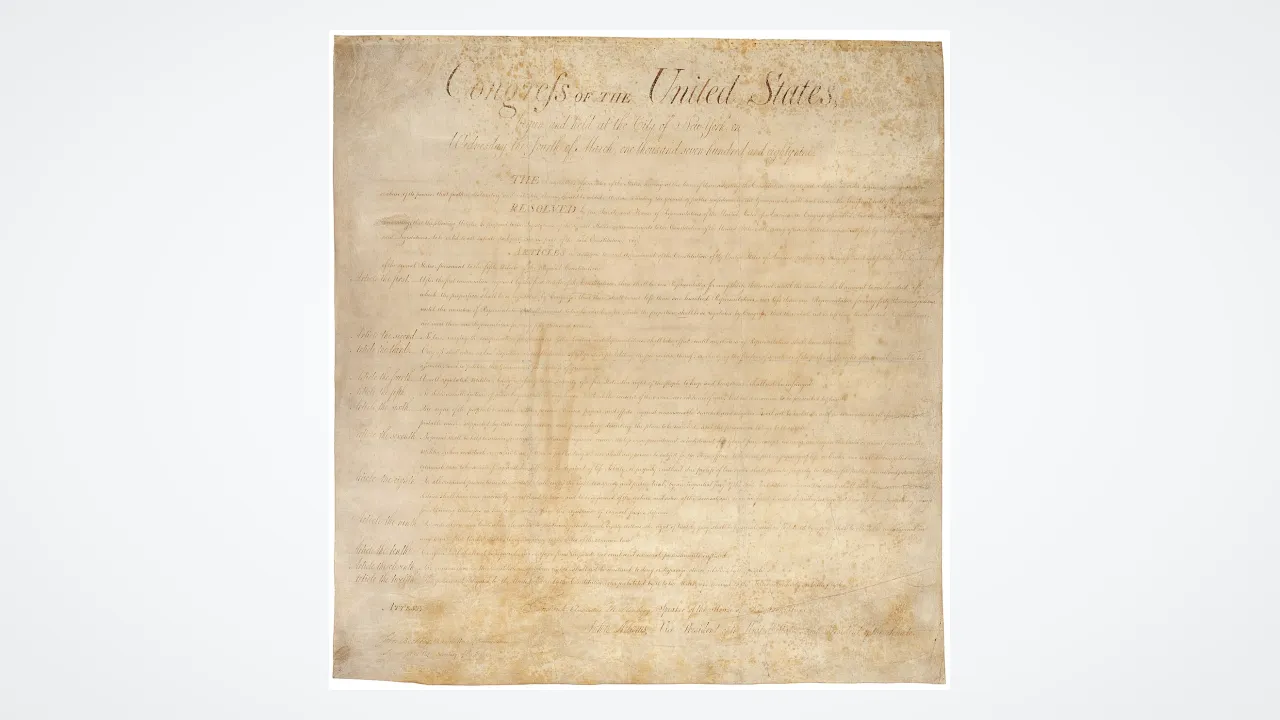
To thank states for ratifying the Constitution, Congress made fourteen original handwritten copies of the Bill of Rights—one for the federal government and one for each of the thirteen states!
✨ Word Sparks (Grade 2 Glossary)
Tap 🔊 to hear
press
Newspapers, books, and journalists sharing public news
assembly
Gathering together peacefully as a group
jury
Group of citizens deciding facts fairly in court
🪝
Why did many Americans insist on adding ten extra promises to the brand-new Constitution?
1
Citizens Ask for Written Guarantees
Imagine reading the brand-new U.S. Constitution in 1788 and noticing something missing! While it explained how Congress, the President, and courts worked, many citizens worried it did not clearly list the personal freedoms government could never take away.
2
Virginia Ideas Guide James Madison
Keeping his promise to voters, Congressman James Madison studied earlier Virginia documents written by George Mason and Thomas Jefferson. In 1789, Madison wrote clear constitutional amendments for Congress and the states to approve.
3
Five Freedoms in Amendment One
Approved on December 15, 1791, the ten amendments of the Bill of Rights safeguard religion, speech, the , peaceful , petitions, and fair trials.
1. Who drafted and introduced the Bill of Rights in the First U.S. Congress?
2. Which amendment protects the five freedoms of religion, speech, press, assembly, and petition?
🤯 Mind-Blowing Fact • Grade 3
Congress actually sent twelve proposed amendments to the states in 1789; ten passed in 1791, and one—about congressional pay changes—finally passed 202 years later in 1992 as the Twenty-Seventh Amendment!
✨ Word Sparks (Grade 3 Glossary)
Tap 🔊 to hear
petition
Asking government leaders formally to solve a problem
warrant
Judge's written permission allowing a legal search
conscience
Inner personal belief about faith, right, and wrong
🪝
How did two landmark Virginia laws from 1776 and 1786 become the blueprint for America's Bill of Rights?
1
A Promise That Saved Ratification
During the 1787–1788 state conventions voting on the U.S. Constitution, leaders like Virginia's George Mason and Patrick Henry warned that a strong national government might someday limit citizens' liberties unless rights were spelled out in ink. Supporters promised to add a Bill of Rights immediately if states ratified the Constitution.
2
George Mason and Thomas Jefferson's Blueprints
When the First Congress met in New York in 1789, Representative James Madison turned directly to two famous Virginia texts. George Mason's 1776 Virginia Declaration of Rights inspired protections for free press and fair trials, while Thomas Jefferson's 1786 Virginia Statute for Religious Freedom shaped freedom of .
3
Fair Courts and Privacy
Beyond the First Amendment's five freedoms, the Bill of Rights protects citizens against unreasonable searches of their homes, guarantees speedy public trials by jury, and forbids cruel and unusual punishments.
4
Virginia Casts the Deciding Vote
On December 15, 1791, Virginia became the crucial state whose approval officially added the first ten amendments to the Constitution.
1. Which two earlier Virginia documents directly inspired James Madison when drafting the Bill of Rights?
2. Which state cast the final ratifying vote on December 15, 1791, making the Bill of Rights law?
🤯 Mind-Blowing Fact • Grade 4
A high school student in Austin, Texas, earned an 'A' in 1982 after proving that the forgotten congressional-pay amendment from 1789 could still be ratified—sparking a nationwide campaign that passed it ten years later!
✨ Word Sparks (Grade 4 Glossary)
Tap 🔊 to hear
due process
Fair legal rules government must follow in court
impartial
Treating all sides fairly without taking favorites
reserved powers
Powers kept by states or citizens under Amendment Ten
🪝
Why did James Madison initially hesitate about listing rights, yet ultimately fight harder than anyone in Congress to pass the Bill of Rights?
1
Federalists, Anti-Federalists, and Trust
Listen to the passionate speeches inside Richmond's ratification convention in June 1788! Anti-Federalists such as George Mason and Patrick Henry argued that without an explicit bill of rights, federal officials could silence newspapers or search homes without warrants. Initially, James Madison worried any written list might accidentally leave out unnamed freedoms, yet letters from Thomas Jefferson in Paris and feedback from Virginia voters convinced him a clear safeguard would unite the young republic.
2
Distilling Hundreds of Proposals
Elected to the First House of Representatives in 1789, Madison sifted through nearly two hundred state recommendations while drawing heavily upon George Mason's June 1776 Virginia Declaration of Rights and Thomas Jefferson's 1786 Virginia Statute for Religious Freedom. When busy lawmakers wanted to focus solely on taxes and trade, Madison persistently urged Congress to honor its pledge to the people.
3
What the Ten Amendments Protect
Amendment I safeguards religious liberty, free speech, a free press, peaceful assembly, and the right to petition government. Amendments II and III address arms and quartering troops, while Amendments IV through VIII establish bedrock courtroom protections: probable-cause warrants, of law, protection against self-incrimination, legal counsel, juries, and bans on cruel and unusual punishment.
4
Answering Madison's Original Worry
Cleverly solving his earlier concern, the Ninth Amendment states that listing certain rights never denies other rights retained by the people, while the Tenth Amendment reserves undelegated powers to the states or the people.
1. How did the Ninth Amendment solve James Madison's worry that listing specific rights might leave others unprotected?
2. Which group of amendments focuses on fair searches, due process, jury trials, and courtroom justice?
🤯 Mind-Blowing Fact • Grade 5
Originally, James Madison wanted to insert the new rights right inside the middle paragraphs of the 1787 Constitution, until Connecticut's Roger Sherman convinced Congress to attach them neatly at the end as numbered amendments!
✨ Word Sparks (Grade 5 Glossary)
Tap 🔊 to hear
unenumerated
Real rights existing even without being listed individually
coercion
Forcing someone to act or believe against their will
incorporation
Applying Bill of Rights protections to state governments
🪝
How did Virginia's revolutionary charters of liberty transform from state-level ideals into the constitutional bedrock of American civil liberties?
1
The Ratification Bargain of 1788
When the Philadelphia Convention adjourned in September 1787 without a declaration of individual liberties, Virginian George Mason penned his influential 'Objections to This Constitution of Government,' opening squarely with the sentence: 'There is no Declaration of Rights.' Across pivotal ratifying conventions in Massachusetts, Virginia, and New York, ratification succeeded by slim margins—89 to 79 in Richmond—only after Federalists pledged to pursue immediate constitutional amendments under Article V.
2
Virginia Lineage: Mason, Jefferson, and Madison
Encouraged from Paris by Thomas Jefferson, who wrote that 'a bill of rights is what the people are entitled to against every government on earth,' Representative James Madison shouldered the task in the First Congress on June 8, 1789. Synthesizing state proposals alongside English common-law traditions, Madison relied above all on two Virginia landmarks: Mason's sixteen-article Virginia Declaration of Rights (June 12, 1776), which affirmed free press, jury trials, and checks against general warrants, and Jefferson's Virginia Statute for Religious Freedom (January 16, 1786), which barred government in matters of religious belief.
3
Architecture of Liberty: Amendments I–VIII
Where Madison proposed weaving amendments directly into the Constitution's text, Representative Roger Sherman persuaded Congress to append them at the end so the 1787 parchment remained intact. Approved by Congress on September 25, 1789, the resulting Bill of Rights opens with the First Amendment's Establishment and Free Exercise Clauses alongside speech, press, assembly, and petition, followed by protections regarding arms and peacetime quartering (II–III) and rigorous criminal-procedure guarantees (IV–VIII)—including Fourth Amendment probable-cause warrants, Fifth Amendment due process and takings clauses, Sixth Amendment speedy jury trials and counsel, and Eighth Amendment bans on excessive bail and cruel and unusual punishments.
4
Amendments IX and X: Unenumerated Rights and Federalism
To prevent future officials from claiming citizens possessed solely the rights explicitly cataloged, Madison crafted the Ninth Amendment protecting rights retained by the people, paired with the Tenth Amendment affirming that powers neither delegated to the United States nor prohibited to the states remain reserved to the states or the people.
5
Ratification in 1791 and Modern Incorporation
With Vermont's admission raising the state count to fourteen, Virginia's General Assembly cast the decisive eleventh ratifying vote on December 15, 1791. Originally restricting only the federal government, most Bill of Rights protections were later applied to state and local governments as well through the Fourteenth Amendment's Due Process Clause, safeguarding every resident across the nation.