🎵 INSTRUMENTS
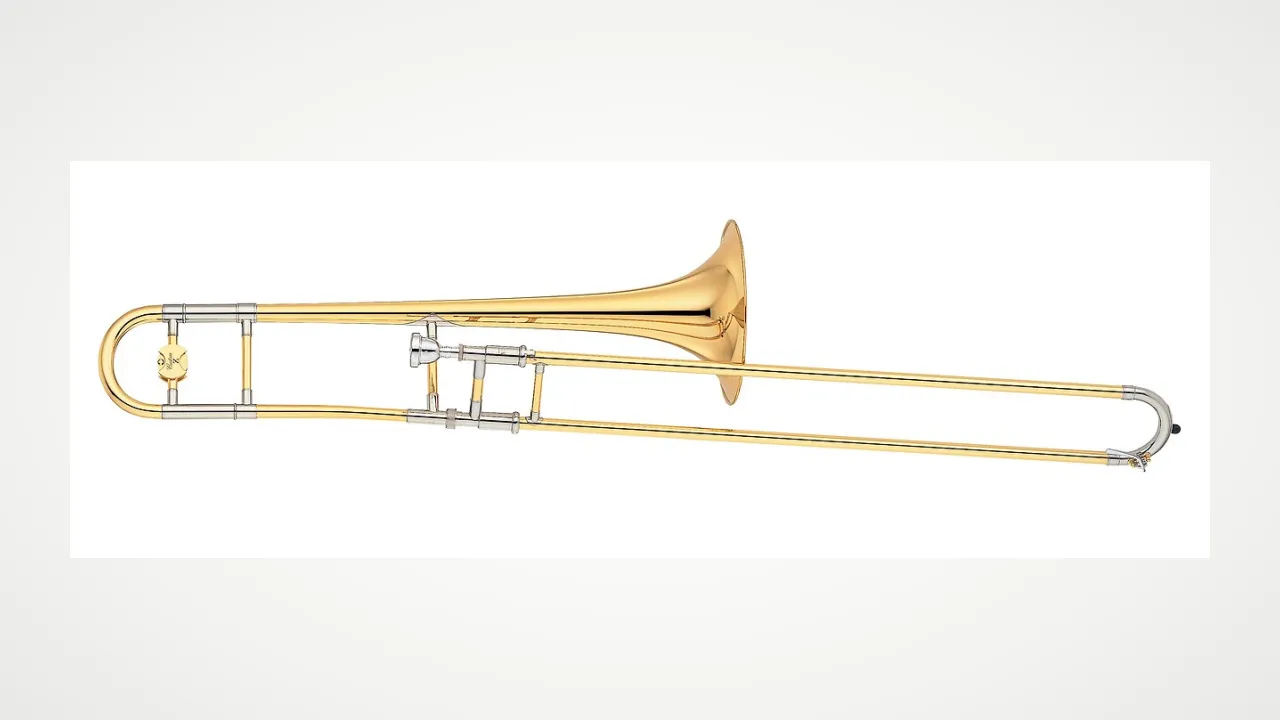
🎶 Slide Cylindrical Brass Aerophone (Hornbostel-Sachs 423.22)
VA Music, Fine Arts & Sound Physics SOL 5.5
Tenor Trombone
The Brass Voice That Glides Smoothly
Grade 5 • Advanced • 275 words
🎶 Instrument Family & OriginBrass family; evolved from the 15th-century Renaissance sackbut in Burgundy, Flanders, and Italy
🪵 Materials & RangeYellow or rose brass with chrome-plated inner slide; ~9 ft (2.7 m) B-flat tubing spanning ~3.5 octaves (E2 to F5, plus F-trigger lows)
🔊 How Sound Is MadeBuzzing lips in a cup mouthpiece vibrate a cylindrical air column lengthened smoothly by a telescoping U-shaped hand slide
⚡ Signature Sound SparkPerforms seamless, vocal pitch glides (glissandos) across seven slide positions with zero buttons required
🤯 Mind-Blowing Fact • Grade 1
The Italian word *trombone* literally translates to 'big trumpet'!
✨ Word Sparks (Grade 1 Glossary)
Tap 🔊 to hear
slide
Moving brass tube that changes note length
cup
Bowl-shaped mouthpiece where lips buzz fast
swoop
To glide smoothly from low to high
🪝
How can a shiny brass horn change notes without any buttons?
1
Zoom Goes the Slide!
Bwah-woooop! A bright brass note up like a laughing voice! No buttons sit on top of this gleaming horn. Instead, a long U-shaped tube out and in.
2
Push Out, Pull In
The player buzzes tight lips into a smooth metal . Pushing the out makes the air path longer. Longer tubes make deeper, lower sounds!
3
Bold and Singing
Pulling the back in makes the notes jump higher. It can march with a big, brassy roar. Or it can sing a soft, sweet tune.
1. What happens to the sound when a trombone player pushes the slide farther out?
2. What does the Italian name *trombone* mean in English?
🤯 Mind-Blowing Fact • Grade 2
Five hundred years ago in England, people called the trombone's ancestor a *sackbut*, from old French words meaning 'pull-push'!
✨ Word Sparks (Grade 2 Glossary)
Tap 🔊 to hear
glissando
Smooth glide through pitches without any breaks
pitch
How high or low a note sounds
sackbut
Early Renaissance ancestor of the modern trombone
🪝
What lets a trombone swoop between notes just like a human voice?
1
Look, Ma, No Buttons!
Waaah-ooop! Hear that playful brass voice swoop smoothly from a low rumble up to a sunny cheer! Most brass horns use finger buttons, yet this shiny golden tube changes notes with a long, gliding hand slide.
2
Seven Stops Along the Arm
When the player buzzes their lips into a bowl-shaped mouthpiece, air vibrates down nine feet of brass tubing. Extending the smooth outer slide along seven invisible arm positions stretches the air column longer, dropping the step by step.
3
Jazz Swings and Orchestra Rings
Because no valves interrupt the slide, the horn can glide seamlessly in a musical smear called a . That expressive trick shines in swinging jazz bands, lively parades, and grand symphony halls alike!
1. How many standard slide positions do trombone players learn along their arm?
2. What do musicians call a smooth, unbroken slide from one note to another?
🤯 Mind-Blowing Fact • Grade 3
The gap between a trombone's inner and outer slide tubes is thinner than two sheets of notebook paper, so even a tiny dent can slow the slide!
✨ Word Sparks (Grade 3 Glossary)
Tap 🔊 to hear
cylindrical
Shaped like a straight pipe of equal width
telescoping
Sliding smoothly one tube inside another tube
F-attachment
Extra tubing loop engaged by thumb trigger
🪝
Why has the tenor trombone barely changed its basic shape in more than five centuries?
1
A Five-Hundred-Year Masterpiece
Picture a royal court in 1450 where brass makers first fitted one straight metal tube neatly over another! That Renaissance invention—called the sackbut—worked so brilliantly that today's tenor trombone still relies on the exact same U-shaped slide.
2
Cylindrical Tubing for Bold Power
When a trombonist buzzes their lips into a deep cup mouthpiece, vibrating air races through nine feet of mostly tubing that stays the same width until flaring near the eight-inch bell. That straight bore gives the instrument a bright, heroic punch.
3
Microscopic Precision on Rails
Two chrome-plated inner tubes glide inside thin brass outer sleeves lubricated with a mist of water and slide cream. Moving from first position all the way out to seventh adds nearly four extra feet of tubing to lower the pitch.
4
The Helpful Thumb Trigger
Many concert tenor trombones also carry an extra loop of coiled brass in the back section. Pressing a left-thumb rotor called an sends air through that loop, saving the player's right arm from long reaches!
1. Why do many modern tenor trombones include a thumb-operated F-attachment loop?
2. How does mostly cylindrical tubing shape the tenor trombone's tone compared to a conical horn?
🤯 Mind-Blowing Fact • Grade 4
Beethoven's Fifth Symphony in 1808 was the very first major symphony to unleash trombones in a concert hall, saving their blazing entrance until the triumphant final movement!
✨ Word Sparks (Grade 4 Glossary)
Tap 🔊 to hear
chromatic
Moving step-by-step through all twelve musical half-steps
intonation
Playing pitches accurately and cleanly in tune
fundamental
Lowest natural resonant pitch of a tube
🪝
Why could a 15th-century trombonist play every chromatic note centuries before trumpets or horns had valves?
1
Chromatic Freedom in the Renaissance
During the 1400s in Burgundy and Flanders, metalworkers perfected thin-walled telescoping brass tubes, transforming the fixed medieval slide trumpet into the double-slide sackbut. While trumpets and hunting horns remained trapped inside a single harmonic series until 19th-century valves arrived, the trombone could already lengthen its air column continuously to play full scales in any musical key.
2
Physics of the Seven Slide Positions
Closed in first position, a standard B-flat tenor trombone holds roughly nine feet (2.7 meters) of predominantly cylindrical tubing. Each outward slide position lowers the resonance by one musical half step; interestingly, positions grow progressively farther apart down the arm because lowering an already-long tube by a fixed frequency ratio requires a proportionally larger increase in length.
3
Pure Intonation and Expressive Glissandi
Because no fixed valve ports lock the pitch into predetermined compromises, skilled trombonists adjust their slide by millimeters in real time to lock chords into crystal-clear pure . That same continuous airway produces the true acoustic glissando—sweeping unbroken across frequencies—provided both notes belong to the same harmonic partial.
4
From Sacred Cathedrals to Jazz Frontlines
For centuries, European composers reserved the trombone's solemn choir-like blend for sacred cathedrals, Mozart operas, and Beethoven's landmark Fifth Symphony. In the 20th century, New Orleans brass bands and big-band icons like Tommy Dorsey and J.J. Johnson revealed its velvety lyricism and dazzling jazz agility.
1. Why are outer slide positions spaced slightly wider apart near the wrist than near the shoulder?
2. What historic milestone did Beethoven's Fifth Symphony mark for the trombone in 1808?
🤯 Mind-Blowing Fact • Grade 5
At fortissimo volume inside a cylindrical trombone bore, high-pressure sound peaks actually travel slightly faster than low-pressure troughs, steepening waves on the fly to create sizzling high harmonics!
✨ Word Sparks (Grade 5 Glossary)
Tap 🔊 to hear
nonlinear
High-energy wave steepening that adds bright harmonics
semitone
Smallest standard half-step interval in Western music
antiphonal
Alternating musical phrases between separated ensembles
🪝
How does a predominantly cylindrical bore with a continuous slide achieve acoustically pure harmonic ratios?
1
Organology of the Telescoping Slide Aerophone
Designated 423.22 in the Hornbostel-Sachs classification, the B-flat tenor trombone is a chromatic cylindrical labrosone aerophone spanning a practical range from E2 (82.4 Hz) to F5 (698.5 Hz), plus resonant pedal tones down to B-flat0 (29.1 Hz). When equipped with an orchestral F-attachment valve, it bridges the chromatic gap between E2 and pedal B-flat1, uniting tenor brilliance with baritone depth.
2
Standing Waves, Bore Geometry, and Brassiness
Approximately two-thirds of a tenor trombone's 2.74-meter closed length consists of strictly cylindrical tubing—typically 12.7 millimeters (0.500 inch) in jazz horns and 13.9 millimeters (0.547 inch) in symphonic models—before expanding through the tuning bow into a 20-to-22-centimeter bell. At loud dynamics, high-pressure wavefronts steepen as they travel down this narrow cylinder, generating shock-like enrichment of upper harmonics known acoustically as cuivré or brassy edge.
3
Logarithmic Geometry of Slide Extension
Unlike fixed-length valve slides that suffer minor tuning discrepancies when combined, a telescoping hand slide obeys exact acoustic physics. Lowering pitch by one equal-tempered requires multiplying total effective air-column length by the twelfth root of two (approximately 1.0595). Because the U-slide doubles every outward motion across two parallel tubes, moving from first to second position requires roughly 8 centimeters of slide travel, whereas moving from sixth to seventh demands over 10.5 centimeters.
4
Axial-Flow Valves and Open-Wrap Engineering
Symphonic tenors frequently incorporate rotary or axial-flow thumb valves developed in the late 20th century, routing air through ~0.9 meters of auxiliary tubing with minimal sharp bends. Lowering the fundamental from B-flat to F reduces resistance and unlocks low C2 (65.4 Hz) without sacrificing centered projection.
5
Vocal Expressiveness Across Five Centuries
From Giovanni Gabrieli's brass choirs in Venice's St. Mark's Basilica and Berlioz's ceremonial grandeur to Duke Ellington's muted plunger voicings, the tenor trombone endures because its continuous airway mirrors the pitch flexibility and harmonic richness of the human singing voice.