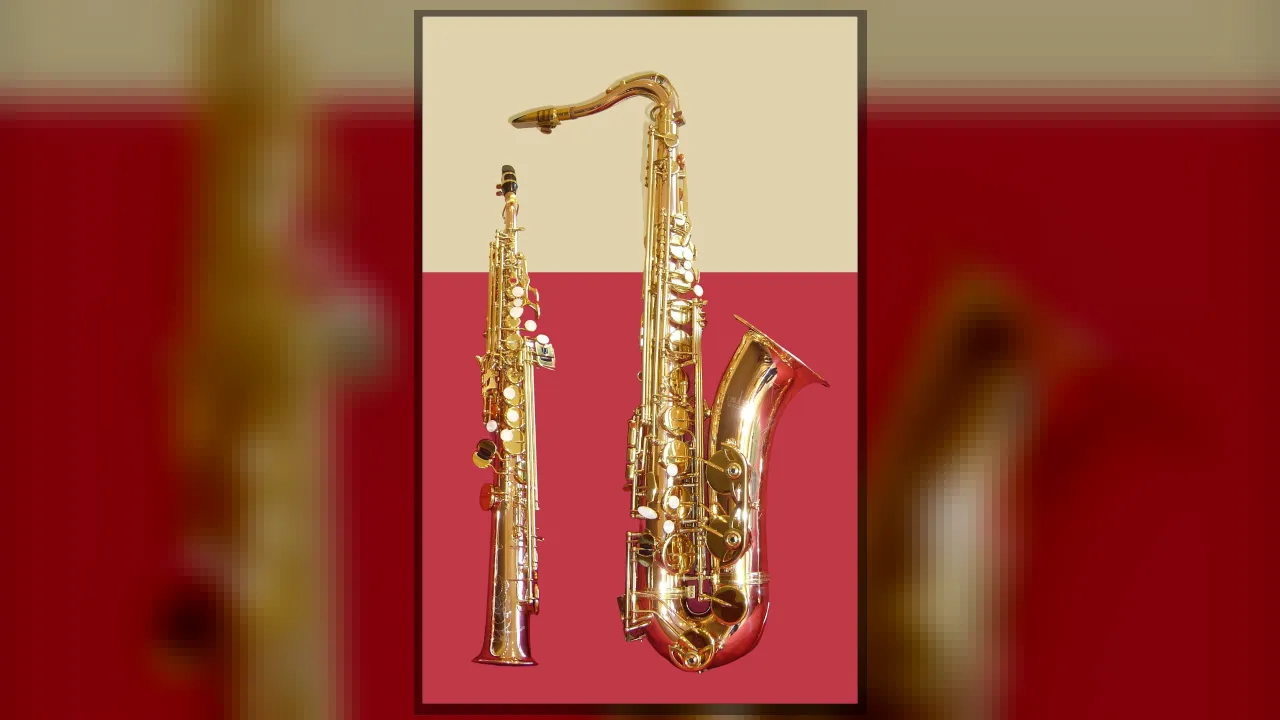
1. What visual clue near the mouthpiece helps you recognize a tenor saxophone?
2. How does a tenor saxophone sound compared to the smaller alto saxophone?
🤯 Mind-Blowing Fact • Grade 2
When a tenor saxophonist loosens the jaw slightly and adds warm breath, low notes puff out with a cozy 'subtone' whisper!
✨ Word Sparks (Grade 2 Glossary)
Tap 🔊 to hear
ballad
Slow, gentle song full of warm feeling
subtone
Soft, breathy whisper on low saxophone notes
crook
Detachable curved neck pipe at the top
🪝
Why does the tenor saxophone sound so much like a real person singing?
1
Singing Without Words
Dim the stage lights and listen as a breathy, soulful melody floats over quiet piano chords. Because its pitch sits right in the middle of the adult human singing voice, the tenor saxophone feels almost like someone talking straight to your heart.
2
Longer Tube, Curved Neck
Invented by Adolphe Sax in Paris, the tenor stretches over four and a half feet if unbent! To keep the keys within easy reach, its brass neck dips in a smooth S-curve while a sturdy strap supports its seven-pound frame.
3
Star of Jazz and Rock
From big-band swing dances to energetic rock-and-roll solos, few wind instruments bring bigger energy to a stage!
How did one B-flat brass woodwind grow from nineteenth-century French marching bands into the undisputed voice of modern jazz?
1
Velvet Breath and Fiery Roars
One moment it breathes a smoky lullaby so softly you can hear air brushing across cane; the next moment it roars above brasses and electric guitars! That dramatic range made the tenor saxophone an icon of twentieth-century music.
2
Fourteen Decimeters of Conical Brass
Patented by Adolphe Sax in 1846, the tenor saxophone is pitched in B-flat—four steps deeper than the E-flat alto and one full octave below the soprano saxophone. Its wide conical tube stretches roughly 1.4 meters from the single-reed mouthpiece through the S-curved swan neck down to the upturned bell.
3
Same Fingerings, Deeper Voice
Because every saxophone shares Adolphe Sax's clever key layout and overblows cleanly at the octave, an alto player can switch to tenor using the exact same fingerings!
4
Symphony Halls and Jazz Giants
Sergei Prokofiev wrote famous orchestral tenor solos in Lieutenant Kijé and Romeo and Juliet, while jazz pioneers Coleman Hawkins, Lester Young, Sonny Rollins, and John Coltrane made its voice legendary.
1. How does the pitch of a B-flat tenor saxophone compare to a B-flat soprano saxophone?
2. Which Russian composer featured the tenor saxophone in both Lieutenant Kijé and Romeo and Juliet?
🤯 Mind-Blowing Fact • Grade 4
Tiny changes of just a couple millimeters in the curve of a tenor saxophone's detachable brass neck can transform its tone from dark and velvety to punchy and bright!
✨ Word Sparks (Grade 4 Glossary)
Tap 🔊 to hear
parabolic
Gently curving flare inside Sax's cone design
treble clef
Musical staff symbol used by all saxophones
resistance
Pushback felt when blowing air into tubing
🪝
Why did Adolphe Sax design every saxophone with identical fingerings, and how did the B-flat tenor claim center stage?
1
Human Emotion Cast in Brass
When Coleman Hawkins recorded 'Body and Soul' in 1939 with a rich, enveloping tone that seemed to wrap around every listener in the room, the tenor saxophone stepped permanently from background band sections into the brightest solo spotlight in popular and jazz music.
2
Conical Bore Physics and the Swan-Neck Crook
Pitched in B-flat and sounding a major ninth below treble-clef notation, the tenor saxophone spans concert A-flat2 (103.8 Hz) to E5 (659.3 Hz) in its standard keyed range. Its 1.4-meter -conical brass bore requires a broader mouthpiece chamber and wider cane reed than the alto. To position that longer air column comfortably without forcing the musician's arms downward, builders shape the detachable upper crook into a gentle S-curve—whose exact bend angle subtly alters airflow and upper-register intonation.
3
Adolphe Sax's Unified Transposing System
When Adolphe Sax patented his family in 1846, he engineered a brilliant pedagogical shortcut: instead of forcing musicians to memorize different fingerings for soprano, alto, tenor, and baritone instruments, he wrote every saxophone part in so identical fingerings worked across the entire family!
4
Orchestral Color and Four Jazz Titans
Maurice Ravel gave the tenor saxophone a sultry solo turn in Boléro, and Ralph Vaughan Williams wove its muscular voice into his Sixth and Ninth Symphonies. Meanwhile, Coleman Hawkins, Lester Young, Sonny Rollins, and John Coltrane revolutionized twentieth-century improvisation through its boundless expressive range.
1. Why is music for every size of saxophone—even low ones—written in treble clef?
2. Which iconic 1928 orchestral piece by Maurice Ravel features a prominent solo for the tenor saxophone?
🤯 Mind-Blowing Fact • Grade 5
Laboratory pressure sensors placed inside players' mouths proved that jazz tenor masters shift their tongue height by millimeters to tune inner throat resonances above 1,000 Hz during high altissimo solos!
✨ Word Sparks (Grade 5 Glossary)
Tap 🔊 to hear
cantabile
Smooth, lyrical style imitating expressive human singing
How do acoustic impedance, reed compliance, and vocal-tract acoustics give the B-flat tenor saxophone its uncanny human cry?
1
The Closest Wind Analog to the Human Voice
Ask acousticians and listeners alike why the B-flat tenor saxophone stirs such immediate emotional recognition, and both point to its spectral overlap with the human tenor and baritone voice. Spanning concert A-flat2 (103.83 Hz) to E5 (659.25 Hz) in standard keywork—and vaulting well past C6 in the altissimo register—it inhabits the exact frequency band where human speech formants carry nuance, grit, and tenderness.
2
Bore Scaling, Crook Curvature, and Subtone
Organologically a single-reed wide-bore conical aerophone patented by Adolphe Sax in 1846, the tenor unfolds to roughly 1.40 meters of yellow, gold, or phosphor-bronze brass. Scaling the conical bore four steps below the E-flat alto increases internal air volume dramatically, requiring a larger mouthpiece window and broader Arundo donax reed (~15.5 mm tip width). At low breath pressures with a relaxed lower lip damping higher reed modes, players produce 'subtone'—an intimate, airy fundamental nearly stripped of upper harmonics. Increase air velocity across a high-baffle metal mouthpiece, however, and wave steepening inside the swan-neck crook ignites a brassy halo of 1,500–3,500 Hz partials that slices through amplified rhythm sections.
3
Vocal-Tract Tuning in the Altissimo
Physics measurements at the University of New South Wales demonstrated that above written D6, bore resonances weaken until the musician's own oral and cavities take command. By positioning the tongue to tune vocal-tract impedance peaks directly onto third-, fourth-, and fifth-harmonic modes of the air column, virtuosos extend the tenor's playable compass beyond three and a half octaves.
4
Orchestral Cameos in Modernist Scores
Though symphony orchestras adopted it selectively, modernist masters seized upon its husky : Ravel paired it with trombones and soprano sax in Boléro (1928), Prokofiev sculpted unforgettable portraits with it in Lieutenant Kijé (1934) and Romeo and Juliet (1935), and Vaughan Williams unleashed its turbulent power in Symphonies Nos. 6 and 9.
5
Architects of Jazz Modernism
From Coleman Hawkins's lush vertical arpeggios and Lester Young's floating horizontal cool to Sonny Rollins's thematic brilliance and John Coltrane's transcendent 'sheets of sound' on A Love Supreme, the tenor saxophone became the supreme vessel of twentieth-century improvisational art.