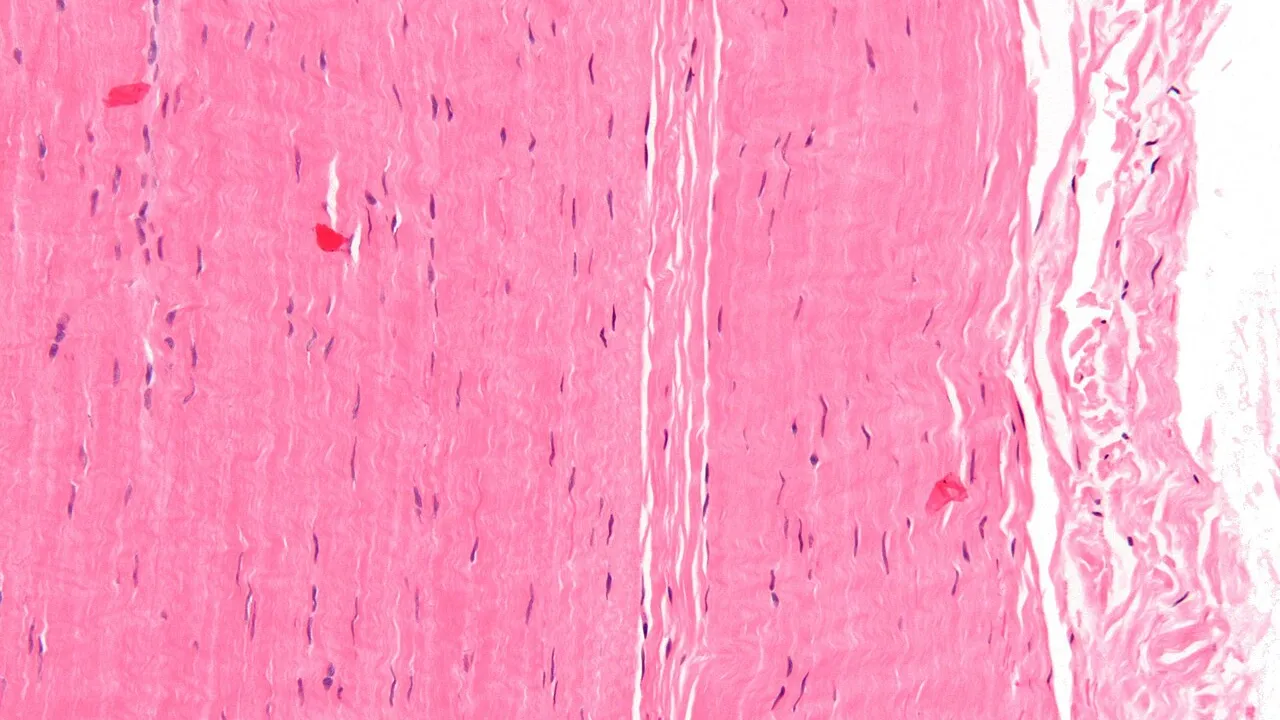
1. What two body parts does a tendon tie together?
2. Where can you easily see tendons sliding right underneath your skin?
🤯 Mind-Blowing Fact • Grade 2
Pound for pound, healthy human tendon fibers can resist pulling forces almost as well as steel wire of the same thickness!
✨ Word Sparks (Grade 2 Glossary)
Tap 🔊 to hear
Forearm
Lower part of your arm above the wrist
Flex
Tighten a muscle to bend a joint
Springy
Able to stretch and bounce energy right back
🪝
How can big forearm muscles move skinny fingers without making your hands puffy and clumsy?
1
Nature's Puppet Strings
Hold your with one hand while opening and closing your other fist. Feel those muscles flexing halfway up your arm? Long, slim cords called tendons travel down from your forearm muscles and attach to your finger bones like puppet strings!
2
Small Space, Huge Strength
If bulky muscles covered every knuckle, your hands would be way too chubby to button a shirt or hold a pencil. Slim tendons solve that puzzle by carrying huge pulling power through narrow wrists and ankles.
3
Built-In Springs
Leg tendons also store energy when your foot lands and spring it right back, making running feel bouncy and light!
1. Why is it helpful that slim tendons reach into your fingers instead of bulky muscles?
2. How do leg tendons help you when you jog down a sidewalk?
🤯 Mind-Blowing Fact • Grade 3
The tiniest tendon in your entire body is barely a millimeter long and sits deep inside your ear to protect your hearing from loud booms!
✨ Word Sparks (Grade 3 Glossary)
Tap 🔊 to hear
Fascicle
Neat bundle of collagen fibers inside a tendon
Tendon Sheath
Slippery fluid tube guiding tendons past bony corners
Hierarchy
Small parts grouped step-by-step into bigger structures
🪝
How are microscopic protein threads bundled inside a tendon so it won't snap during a high jump?
1
Bundles Inside Bundles
Look closely at a thick climbing rope and you will see tiny threads twisted into strands, and strands braided into giant cables. Your body engineers roughly four thousand tendons using that exact ! Microscopic collagen threads group into fibrils, fibrils pack into , and smooth outer wrappers bind the whole glistening white cord from muscle belly to bone.
2
Sliding Inside Slippery Tunnels
Where tendons bend sharply around bony corners—like your wrists and ankles—they could rub and fray. To protect them, your body wraps busy tendons inside double-walled tubes called filled with slick lubricating fluid.
3
Tiny Teammates and Giant Springs
Tendons come in wild sizes! The tiniest tendon in your body attaches to a rice-sized muscle inside your middle ear to muffle booming noises, while the thick Achilles tendon above your heel springs your whole body skyward.
4
Safety Brakes Inside
Special tension sensors built right into tendons warn your brain if a weight is dangerously heavy, relaxing the muscle before anything tears!
1. What keeps wrist and ankle tendons from fraying as they slide back and forth over bony corners?
2. Where is the very smallest tendon in the human body located?
🤯 Mind-Blowing Fact • Grade 4
Elastic leg tendons return over 90 percent of the energy stretched into them on each running step, cutting the fuel your leg muscles burn nearly in half!
✨ Word Sparks (Grade 4 Glossary)
Tap 🔊 to hear
Tensile Strength
Ability to resist snapping when pulled tightly
Myotendinous Junction
Folded seam joining soft muscle fibers to tendon
Golgi Tendon Organ
Built-in nerve sensor measuring muscle pulling force
🪝
How do tendons recycle over half the mechanical energy of a runner's stride for free?
1
Parallel Alignment for Pure Pull
Tap your heel on the floor, then snap your fingers. Every voluntary movement you make relies on tendons transmitting contractile force from soft muscle bellies onto rigid bone levers. Unlike skin—whose collagen fibers crisscross in every direction—a tendon lines up nearly all its Type I collagen bundles strictly parallel to the direction of pull, maximizing along a single axis.
2
Free Elastic Energy Like a Kangaroo
Muscles burn chemical fuel every time they shorten, yet tendons stretch and recoil passively without using extra oxygen! When a sprinter's foot strikes the track, lower-leg tendons stretch up to six percent of their length, storing kinetic energy and snapping over ninety percent of that stored energy back during push-off—much like a kangaroo's famously springy leg tendons.
3
Two Seamless Seam Zones
Engineering a cord that connects squishy muscle on one end to rock-hard bone on the other is tricky. At the muscle end, finger-like microscopic folds called the multiply surface area twentyfold so muscle cells never rip loose. At the bone end, fibrocartilage gradually mineralizes directly into cortical bone.
4
Golgi Tendon Organs: Smart Force Gauges
Braided among collagen strands near the muscle junction sit —nerve sensors that measure exact pulling tension and prevent muscles from overloading their own anchors.
1. Why are collagen fibers inside a tendon lined up strictly parallel instead of woven randomly?
2. How does the myotendinous junction keep soft muscle cells from ripping off a tough tendon?
🤯 Mind-Blowing Fact • Grade 5
Ancient Greek scholars used the exact same word—'neuron'—for both nerves and tendons until physician Galen proved in the 2nd century that nerves carry signals while tendons pull bones!
✨ Word Sparks (Grade 5 Glossary)
Tap 🔊 to hear
Tenocytes
Specialized cells maintaining and repairing tendon collagen fibers
Retinaculum
Fibrous strap holding tendons close against bending joints
Positional Tendon
Stiff tendon engineered for precise finger movement control
🪝
How does hierarchical Type I collagen architecture turn soft biological protein into a living spring with 93 percent energy return?
1
Hierarchical Collagen Cable Design
Bridging compliant contractile muscle tissue to mineralized skeletal levers requires one of biology's premier structural materials: the tendon. Roughly four thousand tendons across the human body exhibit a multi-scale fibrous hierarchy. Triple-helical tropocollagen molecules cross-link into microfibrils, fibrils, fibers, and primary through tertiary fascicles maintained by specialized elongated fibroblasts called , all sheathed inside loose connective endotenon and epitenon layers that permit low-friction internal sliding.
2
Positional Tendons Versus Energy-Storing Springs
Biomechanists distinguish two functional classes of tendons. —such as the digital extensors crossing your wrist—are relatively stiff so sub-millimeter muscle contractions translate directly into crisp fingertip control. Conversely, energy-storing tendons—like the calcaneal (Achilles) and patellar tendons—tolerate strains of six to eight percent, storing elastic strain energy during ground impact and returning roughly 93 percent of it as propulsion, dissipating minimal heat through hysteresis.
3
Pulleys, Retinacula, and Synovial Sheaths
To prevent tendons from bowstringing away from joints when limbs flex, fibrous straps called retinacula and annular finger pulleys hold them flush against bone contours. Inside high-excursion tunnels, double-layered synovial sheaths bathe tendons in hyaluronic-rich fluid while tiny mesotenon bridges carry delicate blood vessels.
4
Neuromuscular Force Regulation
Encapsulated sensory receptors known as Golgi tendon organs sit in series with muscle fibers at the myotendinous junction. Firing action potentials proportional to active tension via fast Ib afferent nerves, they calibrate motor unit recruitment and trigger protective autogenic inhibition under extreme loads.
5
Galen's Distinction and Mechanobiology
Ancient Greeks initially grouped nerves and tendons under one word—neuron—until 2nd-century physician Galen of Pergamon proved nerves carry brain signals while tendons transmit purely mechanical pull. Modern mechanobiology reveals that progressive exercise stimulates to thicken collagen fibrils over months.