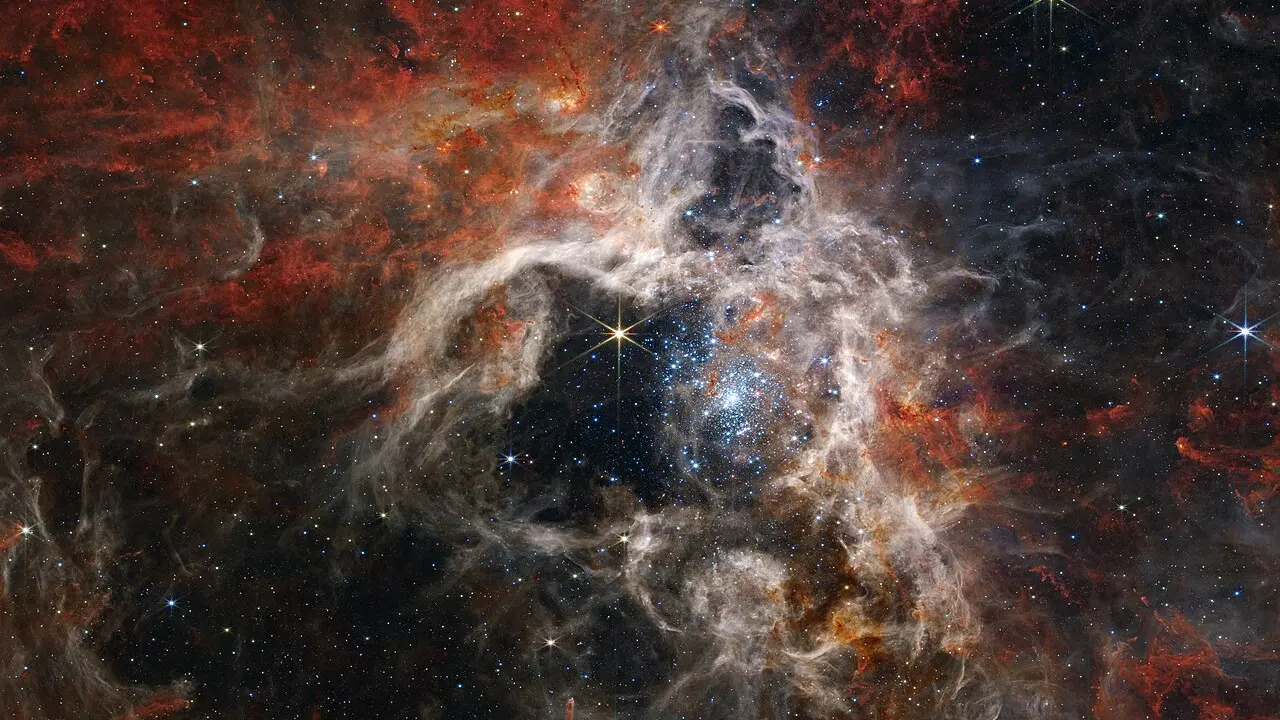
⚡ Cosmic SparkLargest star-making nursery in our entire group of galaxies—bright enough to cast shadows if nearby
🤯 Mind-Blowing Fact • Grade 1
If the Tarantula Nebula sat as close to Earth as the Orion Nebula, it would shine so brightly at night that you would cast a crisp shadow on the sidewalk!
✨ Word Sparks (Grade 1 Glossary)
Tap 🔊 to hear
galaxy
Huge city of billions of stars
web
Crisscrossing threads spun like spider silk
champion
The biggest or strongest record holder
🪝
Can a star cloud in another galaxy be so bright you can spot it with bare eyes?
1
Glowing Space Spider
Zoom right outside our Milky Way to a neighbor ! Tangled, glowing ribbons of gas stretch out like long spider legs. Scientists call it the Tarantula Nebula!
2
Biggest Star Factory Around
No star nursery in our whole comes close to its size! Over eight hundred thousand stars pack inside its bright .
3
Heavyweight Champion Stars
Right in the spider's middle shine the heaviest, brightest stars scientists have ever found anywhere in space!
1. Why did astronomers name this giant cloud the Tarantula Nebula?
2. Where is the Tarantula Nebula located?
🤯 Mind-Blowing Fact • Grade 2
One record-breaking star inside the Tarantula Nebula, called R136a1, shines more than four million times brighter than our Sun!
✨ Word Sparks (Grade 2 Glossary)
Tap 🔊 to hear
dwarf galaxy
Smaller companion galaxy orbiting a big one
30 Doradus
Star-chart name for the Tarantula Nebula
record-breaking
Topping every measurement ever made before
🪝
Why did astronomers mistake a giant cloud 160,000 light-years away for a single star?
1
Mistaken for a Star
Early skywatchers first cataloged this bright spot in the southern sky as a star named . Then in 1751, a telescope proved it was actually a gigantic glowing nebula! Even more amazing, it sits 160,000 light-years away inside a neighbor galaxy called the Large Magellanic Cloud.
2
Casting Nighttime Shadows
Stretching a thousand light-years wide, the Tarantula Nebula is the biggest star-making factory in our entire Local Group of galaxies! Moved to the Orion Nebula's spot, it would fill sixty full Moons across our sky.
3
Stars Weighing 200 Suns
Huddled in its sparkling center is cluster R136, home to monster stars weighing two hundred times more than our Sun!
1. Inside which neighboring galaxy does the Tarantula Nebula live?
2. What would happen in Earth's sky if the Tarantula Nebula sat as close to us as the Orion Nebula?
🤯 Mind-Blowing Fact • Grade 3
Tiny ghostlike particles called neutrinos blasted out by Supernova 1987A next to the Tarantula Nebula raced 160,000 light-years and zipped right through underground detectors on Earth!
✨ Word Sparks (Grade 3 Glossary)
Tap 🔊 to hear
Local Group
Neighborhood of fifty galaxies including ours
starburst
Furious wave of rapid star birth
neutrino
Tiny particle zipping through solid matter
🪝
How can one starry heart pack the most massive stars ever discovered in the universe?
1
King of the Local Group
More than fifty galaxies—including our Milky Way and the giant Andromeda Galaxy—belong to a cosmic neighborhood called the . Out of every single galaxy in that group, the Tarantula Nebula (30 Doradus) is the largest, fiercest star-forming region of all, spanning roughly 1,000 light-years!
2
Powerhouse Cluster R136
Right inside the tarantula's central hollow blazes R136, a young super star cluster less than two million years old. Scientists once thought R136 had to be a single impossible 1,000-Sun monster star until sharp telescopes resolved dozens of heavyweight stars packed tightly together—led by R136a1 at roughly 200 solar masses!
3
Supernova 1987A Next Door
In February 1987, a blue supergiant star on the Tarantula Nebula's outskirts exploded as Supernova 1987A—the closest supernova visible to the unaided eye since telescopes were invented!
4
Webb's Cosmic Tarantula Burrow
In 2022, the James Webb Space Telescope revealed rusty-orange dust threads lining the nebula like a silk-lined tarantula burrow.
1. What sits at the blazing center of the Tarantula Nebula powering most of its glow?
2. What historic cosmic explosion flared up on the outskirts of the Tarantula Nebula in February 1987?
🤯 Mind-Blowing Fact • Grade 4
Star R136a1 inside the Tarantula Nebula radiates more energy in five seconds than our Sun radiates in an entire Earth year!
✨ Word Sparks (Grade 4 Glossary)
Tap 🔊 to hear
Cosmic Noon
Ancient peak era of galaxy starbirth
radiation pressure
Outward push exerted by intense starlight
tidal force
Stretching and squeezing pull between galaxies
🪝
Why does the Tarantula Nebula look just like galaxies from ten billion years ago when the universe was young?
1
Window Into Cosmic Noon
Ten billion years ago, during an era astronomers call ',' young galaxies formed stars tens of times faster than our calm Milky Way does today, fueled by pristine gas containing fewer heavy elements. Remarkably, the Tarantula Nebula—located 160,000 light-years away inside the Large Magellanic Cloud—shares that exact low-heavy-element chemistry and furious starburst pace right in our backyard!
2
Gravitational Tug-of-War Fuel
Why is 30 Doradus churning out over 800,000 stars across a 1,000-light-year span? Gravitational tides between the Large Magellanic Cloud, the Small Magellanic Cloud, and our Milky Way slam giant hydrogen streams together, compressing millions of solar masses of gas into rapid collapse.
3
Shattering the Stellar Mass Limit
For decades, textbook stellar physics suggested outward would blow apart any newborn star heavier than 150 solar masses. High-contrast imaging of central cluster R136 stunned astrophysicists by resolving stars like R136a1, R136a2, and R136a3 weighing between 150 and 230 solar masses and shining millions of times brighter than our Sun!
4
JWST's Silk-Lined Cavity
Using its NIRCam and MIRI infrared instruments in 2022, NASA's James Webb Space Telescope showed how R136's blistering winds hollowed out a massive central tarantula burrow while dense hydrocarbon dust pillars shielded thousands of baby protostars forming along the surrounding walls.
1. Why do astronomers compare the Tarantula Nebula to ancient galaxies from 'Cosmic Noon' ten billion years ago?
2. What textbook rule did stars like R136a1 inside the Tarantula Nebula challenge?
🤯 Mind-Blowing Fact • Grade 5
In 2024, JWST infrared spectroscopy right next to the Tarantula Nebula ended a 37-year scientific treasure hunt by detecting glowing argon gas energized by the newborn neutron star hidden inside Supernova 1987A!
✨ Word Sparks (Grade 5 Glossary)
Tap 🔊 to hear
opacity
How strongly gas traps outgoing light
superbubble
Giant cavity blown by multiple supernovae
Eddington limit
Maximum brightness before light blows gas away
🪝
How can stars grow past 200 solar masses inside 30 Doradus without blowing themselves apart with their own light?
1
Extragalactic Starburst Archetype
First recognized as a glowing nebula rather than a foreground star by French astronomer Nicolas-Louis de Lacaille in 1751, 30 Doradus (NGC 2070)—the Tarantula Nebula—dominates the southeastern corner of our satellite dwarf galaxy, the Large Magellanic Cloud, at an eclipsing-binary-calibrated distance of 49.6 kiloparsecs (162,000 light-years). Spanning roughly 300 parsecs (1,000 light-years) across and energizing millions of solar masses of ionized hydrogen, it outshines every star-forming region in the entire Local Group.
2
Sub-Solar Metallicity and Extreme Masses
Because the Large Magellanic Cloud contains roughly half our Milky Way's heavy-element metallicity, outer stellar atmospheres experience lower iron-line and drive weaker mass-stripping winds during star formation. Combined with dynamical binary mergers inside ultra-dense central cluster R136, this environment allowed hydrogen-burning WN5h titans such as R136a1 (~200–230 solar masses, ~4.7 million solar luminosities, effective temperature above 46,000 kelvins) to assemble well past the classical 150-solar-mass threshold.
3
Superbubbles Carved by Feedback
Multi-wavelength surveys uniting NASA's Chandra X-ray maps, Chile's ALMA millimeter carbon-monoxide filaments, and Hubble ultraviolet photometry reveal overlapping multimillion-kelvin inflated by past core-collapse supernovae alongside R136's ferocious mechanical wind luminosity—showing how massive clusters stir, heat, and compress entire galactic neighborhoods.
4
JWST Penetrates Starburst Dust
In September 2022, JWST's NIRCam, NIRSpec, and MIRI instruments pierced dense hydrocarbon pillars resisting R136's radiation field, catching massive young protostars still cocooned inside icy dust mantles before their own ionizing winds blow those shells clear.
5
Neighbor to Supernova 1987A
Right along the Tarantula's southwestern outskirts lies historic remnant SNR 1987A, where JWST infrared spectroscopy in 2024 finally pinpointed narrow ionized argon and sulfur lines right at the blast center—confirming the cooling newborn neutron star sought by astrophysicists for thirty-seven years!