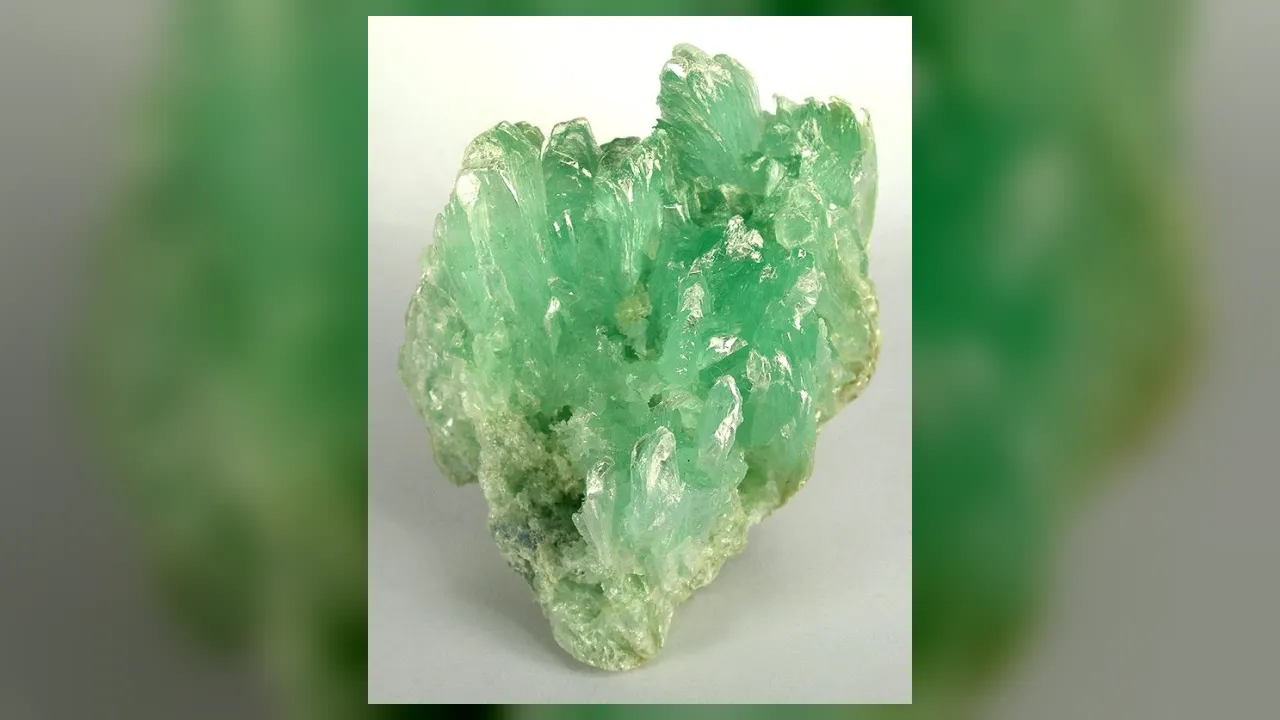
🌋 Where It FormsMetamorphic rock zones where warm water alters magnesium-rich rocks
💎 Key PropertiesMohs hardness 1 (softest standard mineral), soapy feel, pearly luster, white streak
⚡ Planet Earth SparkFeels slippery like dry soap yet withstands blazing heat in science lab countertops
🤯 Mind-Blowing Fact • Grade 1
Gymnasts and rock climbers pat special chalk and mineral powders on their hands, while tailors use solid talc sticks to draw marks on fabric that brush right off!
✨ Word Sparks (Grade 1 Glossary)
Tap 🔊 to hear
Talc
The softest mineral, with a soapy feel
Pearly
Shining softly like the inside of seashells
Soapstone
A smooth rock made mostly of talc
🪝
Can a solid rock feel smooth and slippery like a bar of soap?
1
Slippery Stone
Rub your thumb across a green piece of ! It feels silky and smooth like dry soap. No other common mineral feels quite this soft.
2
Number One Softness
Scientists rank rocks from soft to hard. sits at number one because it is the softest mineral! Even a fingernail scratches it right away.
3
Chalk and Crayons
Crushed makes smooth white powder. Tailors use talc chalk on cloth, and artists carve blocky talc rock into smooth statues!
1. How does a piece of talc feel when you rub it with your fingers?
2. What number is talc on the mineral hardness scale?
🤯 Mind-Blowing Fact • Grade 2
In Schuyler, Virginia, famous soapstone quarries have supplied smooth talc-rich stone for sinks, woodstoves, and science classrooms around the world!
✨ Word Sparks (Grade 2 Glossary)
Tap 🔊 to hear
Metamorphic
Rock changed underground by heat and pressure
Quarry
An open pit where workers cut stone
Streak
The powder color left when rubbing mineral
🪝
Why does the softest mineral on Earth make some of the toughest laboratory countertops?
1
Silky Layers
Close your eyes and touch a piece of pale green talc, and you might think you are holding smooth candle wax! Talc is made of super-thin flat layers that glide over one another whenever you rub it.
2
Born from Heat and Water
Deep underground, hot water and heavy pressure slowly change harder dark rocks into soft, pearly talc. When lots of talc mixes together into a thick solid rock, geologists call it soapstone.
3
Carvings and Heat Shields
Because soapstone is easy to carve, artists have shaped it into bowls, animal figures, and cooking pots for thousands of years. Amazingly, soapstone does not burn or crack in high heat, so science labs use it for sturdy tabletops!
1. What do geologists call a solid rock made mostly of talc?
2. Why is soapstone used for woodstoves and science lab tables?
🤯 Mind-Blowing Fact • Grade 3
Brazil's famous 98-foot Christ the Redeemer statue in Rio de Janeiro is covered in millions of tiny weather-resistant soapstone triangles!
✨ Word Sparks (Grade 3 Glossary)
Tap 🔊 to hear
Silicate
A mineral built from silicon and oxygen
Foliated
Arranged in thin, leaf-like mineral layers
Kiln
A super-hot oven used to bake pottery
🪝
What secret inside talc's microscopic sheets makes it feel slippery even when it is bone dry?
1
Like a Deck of Playing Cards
Picture a fresh deck of glossy playing cards sliding effortlessly across a table. Inside a piece of talc, atoms of magnesium, silicon, oxygen, and hydrogen form flat microscopic sheets. Each sheet is strong by itself, but the bonds between stacked sheets are super weak, letting layers glide under your fingertips.
2
Anchor of the Mohs Scale
In 1812, scientist Friedrich Mohs needed a starting point for his 1-to-10 mineral hardness chart. He chose talc as level 1 because every other standard mineral—even soft gypsum—can scratch it. Whether a sample of talc looks seafoam green, pale gray, or snow white, rubbing it on a test tile always leaves a white streak.
3
Metamorphic Transformation
Talc is a metamorphic mineral. Deep in mountain roots, hot mineral-rich water seeps through cracks in magnesium-rich rocks like olivine or dolomite, transforming hard crystals into pearly, flaky talc.
4
Hidden Helper in Everyday Things
Finely ground talc makes paper ultra-smooth for printing books, strengthens car bumpers, keeps ceramic bathroom tiles from cracking in hot , and helps house paint spread evenly without dripping.
1. Why do talc layers slide past each other like a deck of cards?
2. What color streak does pale green talc leave when rubbed on a streak plate?
🤯 Mind-Blowing Fact • Grade 4
Archaeologists have found 3,500-year-old Indigenous soapstone bowls carved from Piedmont Virginia quarries traded hundreds of miles away across ancient river networks!
✨ Word Sparks (Grade 4 Glossary)
Tap 🔊 to hear
Steatite
Dense, massive soapstone rich in pure talc
Hydrophobic
Repelling water so droplets bead right off
Hydrothermal
Involving super-heated water moving through underground rock
🪝
How did tectonic collisions along the Appalachian Mountains cook ancient ocean rocks into Virginia's famous soapstone?
1
Sandwich Sheets and Van der Waals Forces
Run your fingers over an apple-green flake of pure talc, and you can actually feel atomic physics at work! Talc is a hydrous magnesium sheet silicate with the formula Mg3Si4O10(OH)2. Each microscopic sheet is built like a triple-layer sandwich: a middle layer of magnesium-oxygen-hydroxyl groups tucked neatly between two outer layers of silicon-oxygen tetrahedra. Because each sandwich is electrically neutral, only ultra-weak van der Waals attractions hold adjacent sandwiches together—creating perfect basal cleavage and Mohs hardness 1.
2
Hydrothermal Metamorphism in Mountain Belts
Talc forms through low-to-medium-grade metamorphism along ancient tectonic plate boundaries. Hundreds of millions of years ago, as colliding continents pushed up the Blue Ridge and Piedmont provinces of Virginia and Vermont, hot carbon-dioxide-bearing fluids circulated through magnesium-rich ultramafic rocks and dolomitic marbles. Those fluids hydrated hard minerals like olivine and pyroxene, converting entire rock bodies into massive talc-rich soapstone (also called ).
3
Indigenous Ingenuity to Modern Science Labs
More than 3,000 years before pottery kilns became widespread in eastern North America, Indigenous peoples in Virginia and along the Appalachians quarried soapstone outcrops to carve sturdy cooking bowls that could sit directly in campfire coals without shattering. Today, that exact thermal resilience—paired with natural resistance to strong acids and electricity—makes dense soapstone an ideal material for chemistry countertops, woodstove heat banks, and electrical insulators.
4
Water-Repellent Industrial Powerhouse
Surprisingly, dry talc sheets are naturally , meaning they repel liquid water while absorbing oils and resins. Paper mills coat magazine pages with microscopic talc platelets so ink prints razor-sharp, while engineers blend talc into polypropylene plastics to make lighter, stiffer dashboard and bumper parts that improve vehicle fuel efficiency.
1. Why did ancient Indigenous craftspeople in Virginia prize soapstone for carving cooking bowls?
2. What does it mean that talc surfaces are naturally 'hydrophobic'?
🤯 Mind-Blowing Fact • Grade 5
Deep rock cores drilled from the San Andreas Fault revealed that microscopic coatings of slippery talc allow huge tectonic plates to glide past each other quietly instead of locking into giant earthquakes!
✨ Word Sparks (Grade 5 Glossary)
Tap 🔊 to hear
Phyllosilicate
A mineral made of flat atomic sheets
Aseismic Creep
Slow, steady fault sliding without big earthquakes
Van der Waals
Very weak attractions between neutral atomic layers
🪝
How can soft, slippery talc inside deep earthquake faults quietly prevent catastrophic tremors?
1
Phyllosilicate Architecture at the Atomic Scale
Examine a translucent folia of seafoam-green talc under a petrographic microscope, and you see one of nature's most elegant (sheet silicates). With the chemical formula Mg3Si4O10(OH)2, talc arranges silicon-oxygen tetrahedra into continuous hexagonal meshes bonded above and below an octahedral brucite-like magnesium layer. Unlike mica sheets—which carry electrical charges bridged by potassium ions—talc's trioctahedral T-O-T layers carry virtually zero net surface charge. Held solely by weak forces, neighboring sheets shear effortlessly at minimal stress, establishing Mohs hardness 1 and a pearly-to-greasy luster.
2
Metasomatism Along Plate Boundaries
Geologically, talc crystallizes via two primary metamorphic pathways. In subduction zones and ophiolite belts, carbon-dioxide-rich hydrothermal fluids infiltrate mantle-derived ultramafic peridotites and serpentinites, stripping silica or adding CO2 to produce steatite and magnesite. Alternatively, contact or regional metamorphism of siliceous dolostones (CaMg(CO3)2 + SiO2 + H2O) yields high-purity white talc prized by industrial mineralogists. Because ultramafic deposits can occasionally host fibrous amphibole minerals nearby, modern geologists perform X-ray diffraction and electron microscopy to ensure mined industrial and cosmetic talc deposits are completely pure.
3
Aseismic Creep in Tectonic Fault Zones
In 2007, geophysicists drilling three kilometers deep into California's San Andreas Fault near Parkfield made a startling discovery: rock cores from creeping sections of the fault were coated with slick films of talc! Where serpentinite rock interacts with silica-rich hot fluids deep underground, newly formed talc acts as a high-temperature solid lubricant. Instead of locking tightly for centuries and snapping in one violent earthquake, talc-lined fault segments slide steadily a few centimeters per year in harmless '.'
4
Thermal Mass and Refractory Performance
Despite being scratchable by a fingernail, talc remains chemically stable up to roughly 800°C before losing hydroxyl water and converting into hard enstatite (MgSiO3) and cristobalite silica—ceramic minerals with virtually zero thermal shrinkage. Dense soapstone's high specific heat capacity allows masonry heaters to absorb intense firebox heat quickly and radiate gentle warmth into rooms for twelve hours after the fire goes out.
5
Precision Engineering in Modern Materials
Across global manufacturing, micronized talc platelets serve as platy functional fillers. In catalytic converters inside low-emission vehicles and cordless-tool ceramics, synthetic cordierite ceramics fired from pure talc survive extreme rapid temperature swings without fracturing.