🎵 INSTRUMENTS
🎶 Paired Hand-Struck Tuned Membranophones • Percussion
VA Music, Fine Arts & Sound Physics SOL 5.5
Tabla
Singing Twin Drums With Harmonic Black Spots
Grade 5 • Advanced • 367 words
🎶 Instrument Family & OriginHand percussion family • Indian subcontinent (Hindustani classical music of North India)
🪵 Materials & RangeCarved wood dayan (~14 cm) and copper/brass bayan (~24 cm) with goatskin heads and black syahi
🔊 How Sound Is MadeExpressive finger, palm, and wrist strokes excite harmonic overtones on weighted black tuning spots
⚡ Signature Sound SparkMakes circular drumheads ring clear, bell-pure musical notes and swooping bass pitch bends
🤯 Mind-Blowing Fact • Grade 1
Tabla students learn rhythms by speaking fun drum words out loud—like 'Dha, Dhin, Tirakita'—before their fingers even touch the drums!
✨ Word Sparks (Grade 1 Glossary)
Tap 🔊 to hear
pair
Two matching things that work together
copper
Reddish-orange metal shaped into round bowls
ring
Padded cloth cushion holding drums steady
🪝
Why do these twin drums wear shiny black circles right on top?
1
Dha, Dhin, Tin, Na!
Dha, dhin, tin, na! Quick fingers dance across two round drums sitting side by side. One sings clear high notes! One booms deep and warm. Meet the tabla!
2
Wood and Shiny Metal
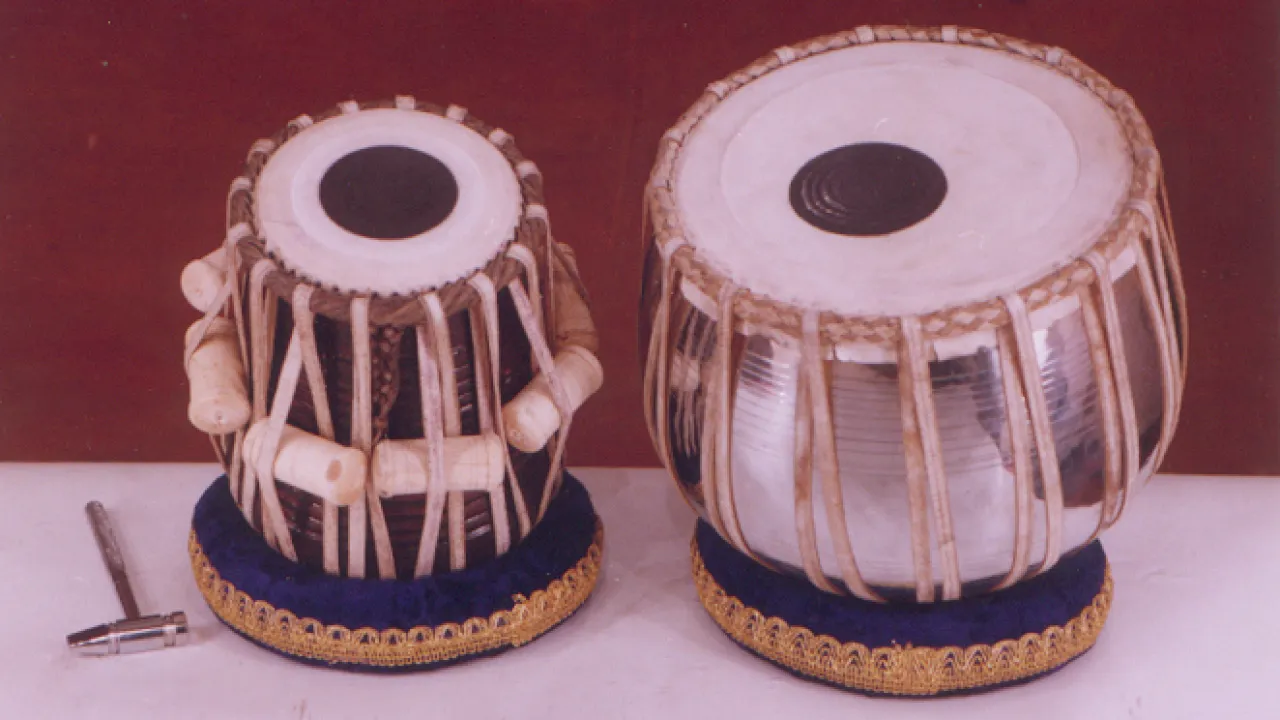
The smaller drum is carved from dark wood. The bigger drum shines in or brass! Soft cloth hold both drums steady on the floor.
3
Magic Black Spot
Each drum skin has a dark black circle on top that helps every tap like a bell!
1. How many drums sit side by side to make a tabla set?
2. What does the dark black circle on top of a tabla head help the drum do?
🤯 Mind-Blowing Fact • Grade 2
To tune the smaller wooden tabla drum up or down, the player taps cylindrical wooden blocks tucked under its leather straps using a special curved metal hammer!
✨ Word Sparks (Grade 2 Glossary)
Tap 🔊 to hear
dayan
Smaller wooden right-hand drum tuned to pitch
bayan
Larger round left-hand drum playing deep bass
bol
Spoken syllable matching a specific tabla stroke
🪝
If you say it, can you play it? How does a spoken drum language teach fingers to fly?
1
Twin Drums That Talk and Sing
Na-tin-tin-na, dha-dhin-dhin-dha! Sit cross-legged on a colorful rug in North India and listen to two hand drums having a lively musical conversation! Together, this famous pair is called the tabla.
2
Meet the Dayan and the Bayan
Played by the right hand, the smaller wooden drum—called the —is tuned with leather straps and wooden blocks to match the exact main note of the song! Played by the left hand, the rounder metal drum—called the —delivers swooping, elastic bass booms when the player presses and slides a wrist across its skin.
3
Speaking Drum Syllables
Every finger tap has its own spoken syllable called a , letting drummers recite dazzling tongue-twisters out loud and mirror them instantly with their hands!
1. How does a tabla player bend deep bass notes up and down on the larger bayan drum?
2. What are the spoken rhythmic syllables like 'Dha,' 'Ge,' and 'Tin' called?
🤯 Mind-Blowing Fact • Grade 3
Tabla players keep a small container of talcum powder onstage to dust their palms and drumheads lightly so their fingers can glide at blur-speed without sticking in humid air!
✨ Word Sparks (Grade 3 Glossary)
Tap 🔊 to hear
syahi
Weighted black paste spot creating clear pitch
tala
Repeating cycle of beats in Indian music
gharana
Artistic school or family lineage of musicians
🪝
Why do ordinary drums go 'thud' while a tabla's black center spot makes goatskin sing a crystal-clear pitch?
1
The Heartbeat of Hindustani Music
Tin-na-tirakita-dha! Across North India, Pakistan, Bangladesh, and concert halls worldwide, few percussion instruments match the lightning speed and singing tone of the tabla! Whether accompanying a sitar or dazzling crowds in a solo, its ten-finger strokes sparkle with melody.
2
The Secret Recipe of the Syahi
Most circular drums produce messy, clashing vibrations that our ears hear as an unpitched thud. Look at the center of the wooden dayan and off-center on the copper bayan, however, and you will see a shiny black circle called the ! Artisans build up dozens of paper-thin layers of paste made from iron filings, soot, and rice or wheat starch, polishing each layer smooth with a stone. That extra weight tames chaotic vibrations so the goatskin rings with bell-pure pitch!
3
Three Concentric Zones of Timbre
Each drumhead features an outer leather rim (kinar), an open middle ring (sur), and the dark center—giving every finger placement its own distinct timbre!
4
Centuries of Classical Gharanas
Flourishing in eighteenth-century North Indian courts, master lineages called —such as Delhi, Lucknow, Benares, and Punjab—developed signature finger styles and rhythmic cycles called .
1. What special ingredients go into crafting the dark syahi spot on a tabla drumhead?
2. What are the repeating rhythmic beat cycles—such as the sixteen-beat Teental—called in Indian classical music?
🤯 Mind-Blowing Fact • Grade 4
Nobel Prize-winning physicist Sir C.V. Raman proved in 1920 that the tabla's hand-applied black syahi spot aligns noisy circular drum vibrations into five pure musical harmonics—something Western drums had never achieved!
✨ Word Sparks (Grade 4 Glossary)
Tap 🔊 to hear
harmonics
Overtones vibrating in exact whole-number pitch multiples
drone
Continuous background reference pitch sounding throughout music
crescent
Curved shape like a sliver of moon
🪝
Why did a Nobel Prize-winning physicist study the black spot on Indian drums inside his laboratory in 1920?
1
Where Ancient Craft Solved a Physics Puzzle
Strike a Western snare drum or timpani and mathematics predicts a stubborn rule: circular membranes held tight around a rim vibrate in weird, uneven decimal ratios (1 : 1.59 : 2.14...) rather than neat musical ! Yet strike the rim of a North Indian tabla dayan with your index finger while resting your ring finger lightly near the black center, and out floats a pure, singing C or G that sustains like a plucked string!
2
C.V. Raman Discovers Harmonic Drum Modes
In 1920, pioneering Indian physicist C.V. Raman sprinkled fine sand onto tabla and mridangam heads to map how their skins vibrate! He proved that Indian drum makers had solved circular-membrane physics centuries early: by applying thickest layers of iron-loaded syahi paste at the center and tapering them thinner outward, artisans slowed down specific vibration patterns until nine separate modes lined up into exact whole-number harmonic overtones (1 : 2 : 3 : 4 : 5)! Even more remarkably, the syahi on the wider copper bayan sits off-center near the wrist rest, leaving a of open goatskin free for dramatic bass pitch glides!
3
Rawhide Tasma and Gatta Fine-Tuning
Sixteen loops of continuous rawhide strap (tasma) pull the multi-layered goatskin head tightly down over eight wooden dowels (gatta). Tapping those dowels downward increases tension for coarse tuning, while light hammer taps around the braided leather crown (gajra) lock microtonal accuracy to the soloist's .
4
Six Classical Gharanas to Global Stages
Codified across six major North Indian gharanas—Delhi, Ajrada, Lucknow, Farrukhabad, Benares, and Punjab—and carried worldwide by maestros Ustads Alla Rakha and Zakir Hussain, the tabla bridges ancient mathematics and modern virtuosity.
1. What did physicist C.V. Raman discover about the layered black syahi spot on a tabla?
2. Why is the black syahi spot placed off-center rather than dead-center on the larger bass bayan drum?
🤯 Mind-Blowing Fact • Grade 5
After applying each wet layer of iron-and-rice syahi paste, a master tabla maker rubs it hard with a polished black volcanic stone to create thousands of microscopic cracks—allowing hardened iron paste to bend like flexible rubber without flaking off!
✨ Word Sparks (Grade 5 Glossary)
Tap 🔊 to hear
eccentric
Positioned off-center rather than in the middle
tihai
Phrase repeated three times landing on beat one
onomatopoeic
Words whose spoken sound imitates real noises
🪝
How does radially graded iron-paste loading transform inharmonic Bessel-function drumhead vibrations into a five-harmonic pitched voice?
1
Defying the Inharmonicity of Circular Membranes
In classical acoustics, an uniform circular membrane clamped at its boundary obeys wave equations governed by Bessel functions, yielding natural modal frequencies at non-integer ratios of 1.00 : 1.593 : 2.136 : 2.295 : 2.653—an inharmonic spectrum heard by the human ear as an indefinite percussive thud. Yet North India's twin hand drums, the tabla—classified organologically as paired single-headed tuned membranophones (211.11 / 211.211.1)—radiate crystalline pitched bell tones capable of matching a vocalist's tonic within a single cent.
2
Bessel-Mode Realignment via Radially Graded Syahi
As Sir C.V. Raman demonstrated in his landmark 1920 Chladni nodal studies, Indian artisans engineered an acoustic transformation through two structural innovations on the right-hand wooden dayan (carved from dense Dalbergia sissoo / sheesham, ~13 to 15 centimeters in head diameter, tuned across C4 to F5). First, a concentric annular leather overlay ring—the chat or kinar—trimmed around the perimeter selectively damps unruly edge modes. Second, thirty to forty hand-burnished concentric applications of syahi (ferric oxide/iron filings, carbon soot, and amylopectin grain paste, incised with microscopic drying cracks by a smooth basalt stone so the patch flexes elastically!) load the central 60 percent of the goatskin with radially decreasing areal density. That precise mass gradient depresses specific nodal-diameter and nodal-circle modes until nine distinct vibrational patterns coalesce into five exact integer harmonics: 1f, 2f, 3f, 4f, and 5f!
3
Nodal Finger Damping and Bayan Pitch Modulation
Executing the signature stroke Na or Tin, the player's ring finger rests lightly at the junction of the syahi and open maidan—imposing a deliberate nodal point that suppresses the fundamental (1f) and unleashes shimmering second and third harmonics! Simultaneously, the hemispherical hammered-copper left-hand bayan (~22 to 25 centimeters wide) places an syahi near the wrist heel, enabling continuous real-time membrane tensioning (meend) across an entire octave of sub-bass.
4
Oral Mnemonics (Bols) and Mathematical Tala Architecture
Tensioned by continuous buffalo-rawhide tasma over eight cylindrical gatta dowels and a sixteen-pleat braided gajra hoop, tabla repertoire encodes timbral strokes as bols organized into cyclical talas—from 7-beat Rupak and 10-beat Jhaptal to 16-beat Teental—crowned by dazzling three-fold cadential permutations called that resolve squarely on beat one (Sam).
5
Six Gharanas and Global Virtuosity
Crystallizing in eighteenth-century Mughal-era North India across six stylistically distinct gharanas—kinar-focused Delhi and Ajrada, dance-linked Lucknow and Farrukhabad, powerful Benares, and pakhawaj-rooted Punjab—the tabla achieved worldwide concert renown through luminaries Ahmed Jan Thirakwa, Samta Prasad, Alla Rakha, and Zakir Hussain.