🌌 COSMOS
🔭 Photospheric Magnetic Flux Tube • Solar Cycle Feature
VA Science SOL 1.6, 4.5, 4.6 (Solar System, Stars & Space Exploration)
Sunspots
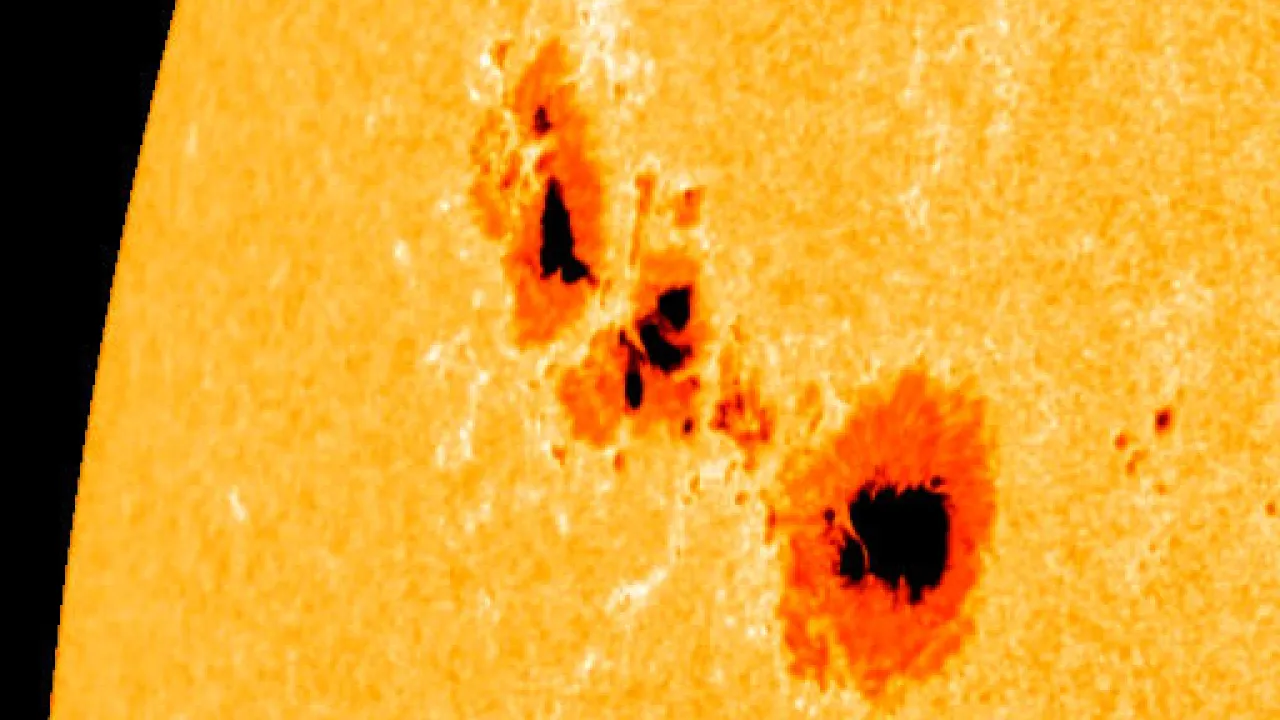
Planet-Sized Magnetic Freckles Dancing Across the Sun
Grade 4 • Expanding • 179 words
🌌 Cosmic Location & DistanceSolar Photosphere • ~93 million miles (150 million km) from Earth
🪐 Scale / Diameter1,000 to 100,000 miles (1,600–160,000 km) wide • Often wider than Earth
☄️ Composition & Orbit~6,500°F (3,600°C) dark umbra • 11-year solar activity cycle
⚡ Cosmic SparkBlocks rising solar heat with super-magnets—yet still glows brighter than a full Moon
🤯 Mind-Blowing Fact • Grade 1
If you lifted one 'dark' sunspot away from the bright Sun and set it in the night sky, it would shine bright orange—brighter than the full Moon!
✨ Word Sparks (Grade 1 Glossary)
Tap 🔊 to hear
solar filter
Special dark lens for viewing the Sun safely
patch
A spot that looks different from around it
cycle
A pattern that repeats again and again
🪝
Why does the super-bright Sun sometimes grow dark freckles bigger than planet Earth?
1
Freckles on the Sun
Never stare straight at the Sun! Using safe , scientists spot dark moving across its bright face. Those dark patches are called sunspots, and many could swallow Earth whole!
2
Cooler, Still Super Hot
Why do they look dark? Strong magnets keep hot gas from bubbling up there. A sunspot is cooler than the bright Sun around it, though it is still super hot!
3
Coming and Going
Sunspots fade away in days or weeks. Every eleven years, tons of new spots pop up!
1. How big can many sunspots grow on the Sun's surface?
2. Why does a sunspot look dark on the Sun?
🤯 Mind-Blowing Fact • Grade 2
Over 2,000 years ago, astronomers in China spotted giant sunspots with their bare eyes when thick morning mist dimmed the rising Sun!
✨ Word Sparks (Grade 2 Glossary)
Tap 🔊 to hear
umbra
The darkest middle part of a sunspot
penumbra
Lighter striped outer ring around a sunspot
contrast
How different two things look side by side
🪝
How can a spot that burns at 6,500 degrees Fahrenheit look pitch black?
1
Dark Only by Contrast
Peek at a safe projection of the Sun and you might see dark spots marching slowly from left to right. The Sun's bright surface blazes near 10,000 degrees Fahrenheit! Inside a sunspot, powerful magnets act like a lid on a boiling pot, cooling the gas to around 6,500 degrees so it looks dark beside brighter neighbors.
2
Bullseye Shapes
Zoom in close and a sunspot looks like a cosmic flower. A very dark center called the sits inside a lighter, striped ring called the .
3
The Eleven-Year Heartbeat
Sunspots often travel in pairs like the north and south ends of a bar magnet. Roughly every eleven years, the Sun reaches 'solar maximum' and sprouts dozens of spot groups!
2. About how often does the Sun's sunspot count peak in its regular cycle?
🤯 Mind-Blowing Fact • Grade 3
From about 1645 to 1715, sunspots almost completely vanished for 70 years during a mystery chill on Earth called the Maunder Minimum!
✨ Word Sparks (Grade 3 Glossary)
Tap 🔊 to hear
photosphere
Visible glowing surface layer of the Sun
convection
Heat rising in warm currents and sinking cool
solar minimum
Quiet period when very few sunspots appear
🪝
What did moving dark spots on the Sun prove to Galileo over four hundred years ago?
1
Proof the Sun Spins
In the early 1600s, astronomers like Galileo Galilei projected telescope images of the Sun onto paper—never looking directly through the lens! Day after day, jagged dark blotches marched across the solar disk in about four weeks. That motion proved two big truths: the Sun wasn't a spotless crystal sphere, and it rotates on its axis!
2
Choking Off Boiling Heat
Normally, boiling cells of plasma carry fierce heat upward to the Sun's visible surface, the . Where magnetic bundles thousands of times stronger than Earth's magnet poke through, they block that upward . The spot cools from 10,000°F down to about 6,500°F.
3
Launchpads for Solar Storms
Sunspots usually appear in pairs—one acting as a magnetic north pole and its partner as a south pole—linked by giant glowing arches. Tangled big sunspot groups serve as launchpads for solar flares and coronal mass ejections!
4
Minimum to Maximum
During , weeks pass without a single spot; five years later at solar maximum, over a hundred spots may freckle the Sun at once.
1. What did Galileo discover by watching sunspots move day after day?
2. How do intense magnetic fields create a cooler sunspot?
🤯 Mind-Blowing Fact • Grade 4
The largest sunspot group ever photographed, seen in April 1947, sprawled across more than six billion square miles—over thirty times Earth's entire surface area!
✨ Word Sparks (Grade 4 Glossary)
Tap 🔊 to hear
granules
Boiling heat cells covering the Sun's surface
Zeeman effect
Splitting of light lines by strong magnetic fields
latitude
Distance north or south of an equator
🪝
Why do sunspots plot a giant butterfly wing pattern whenever astronomers graph their locations over time?
1
George Ellery Hale's Magnetic Breakthrough
For centuries, astronomers debated whether sunspots were solar mountains, clouds, or craters. In 1908, American astrophysicist George Ellery Hale split sunspot light through a spectrograph and noticed spectral lines splitting apart—a physics clue called the . Hale had discovered magnetism outside Earth for the first time, measuring fields up to 4,000 gauss—thousands of times stronger than Earth's surface field!
2
Suppressing Solar Granulation
Surrounding a sunspot, Texas-sized convection cells called bubble up hot 5,800-kelvin plasma like miso soup. Inside a sunspot's dark umbra, vertical magnetic flux tubes stiffen the electrically conductive plasma, suppressing rising heat and dropping temperatures near 3,800 kelvins. Around the umbra, tilted magnetic fields stretch convection into radial filaments forming the lighter penumbra.
3
Butterfly Diagrams and Polar Flips
German amateur astronomer Samuel Heinrich Schwabe tracked the 11-year sunspot cycle in 1843. Early in each cycle, spots emerge near 30 degrees north and south ; as years pass, new spots erupt steadily closer to the solar equator, sketching twin 'butterfly wings' on latitude-time charts.
4
The 22-Year Hale Cycle
At every solar maximum, the Sun's entire global north and south magnetic poles flip upside down, meaning a complete magnetic return takes 22 years!
1. How did George Ellery Hale prove in 1908 that sunspots are intensely magnetic?
2. Why does a sunspot cycle require 22 years to fully reset magnetically?
🤯 Mind-Blowing Fact • Grade 5
Sound waves bouncing inside the Sun speed up through magnetic sunspot roots, letting scientists 'hear' giant sunspots brewing on the far side of the Sun before they rotate into view!
✨ Word Sparks (Grade 5 Glossary)
Tap 🔊 to hear
faculae
Bright hot magnetic patches surrounding dark sunspots
tachocline
Deep solar shear layer generating magnetic fields
helioseismology
Studying the Sun's interior using sound waves
🪝
Why does our Sun actually shine slightly BRIGHTER when its face is covered in dark sunspots?
1
Four Centuries of Continuous Records
Beginning with telescopic observations by Thomas Harriot, Christoph Scheiner, and Galileo Galilei in 1610–1611—building upon naked-eye chronicles from Han Dynasty China—the sunspot number stands as humanity's longest continuous astrophysical dataset. When Heinrich Schwabe identified the ~11-year periodicity in 1843, scientists realized our star possesses a dynamic internal clock.
2
Magnetohydrostatic Pressure Balance
Inside the solar —the shear boundary between the rigidly rotating radiative core and differentially rotating convection zone—toroidal magnetic ropes amplify until magnetic buoyancy drives $\Omega$-shaped loops through the photosphere. Because total pressure inside the flux tube (gas pressure plus magnetic pressure) must balance surrounding photospheric pressure, intense 0.3-to-0.4-tesla magnetic fields force internal gas density and temperature down from 5,778 K to roughly 3,700–4,200 K, dimming umbral radiance via the Stefan-Boltzmann law.
3
The Solar Irradiance Paradox
Logic suggests a spot-covered Sun should dim Earth's sunlight, yet spaceborne radiometers proved the exact opposite: total solar irradiance increases by ~0.1% at solar maximum! Bright magnetic rings called ('little torches') crowding around sunspots radiate slightly more extra heat than dark umbrae block.
4
Helioseismology and Inouye Views
Atop Haleakalā in Hawaii, the 4-meter Daniel K. Inouye Solar Telescope uses adaptive optics to resolve penumbral magnetic filaments narrower than 20 kilometers across, revealing overturning magnetoconvection cells in exquisite detail. Simultaneously, spaceborne acoustic tracks pressure waves ($p$-modes) refracting upward from the solar interior; because sound waves speed up through intense magnetic fields, physicists detect giant active regions brewing on the Sun's unseen far side days before solar rotation brings them into view.
5
Decoding Stellar Spots Across the Galaxy
Tree-ring carbon-14 and ice-core beryllium-10 isotopes trace centuries of past solar cycles—including the 1645–1715 Maunder Minimum—while modern solar physics calibrates how astronomers model colossal 'starspots' covering up to thirty percent of young, rapidly spinning stars that host transiting exoplanets.