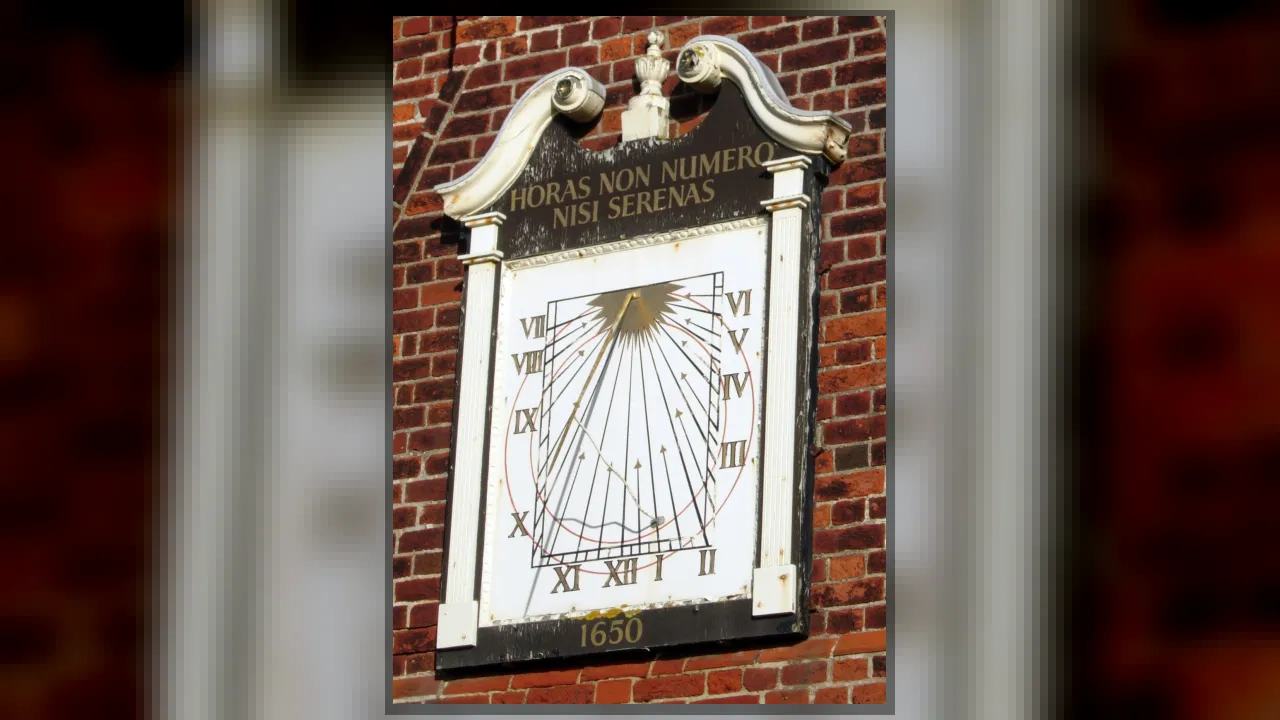
1. When is your shadow outside usually the shortest of the whole day?
2. Why do clock hands move 'clockwise' toward the right?
🤯 Mind-Blowing Fact • Grade 2
NASA bolted a tiny, jewel-bright sundial onto its Mars rovers so scientists on Earth could check Martian sunlight and calibrate rover cameras!
✨ Word Sparks (Grade 2 Glossary)
Tap 🔊 to hear
gnomon
Angled blade that casts a sundial's shadow
obelisk
Tall four-sided stone pillar with pointed top
calibrate
Check and adjust a tool for accuracy
🪝
What happens if you just poke a straight stick in the dirt—why does its shadow tell the wrong hour by winter?
1
Ancient Shadow Watchers
Over three thousand five hundred years ago in sunny Egypt, stone carvers built T-shaped shadow bars and towering stone needles called . Priests watched the crisp dark shadow march across courtyard stones to split the day into neat parts.
2
Why the Pointer Slants
Poke a straight stick upright in the yard, and summer shadows land in different spots than winter shadows! Ancient astronomers fixed that bug by tilting the pointer—called a —toward the North Star.
3
One Drawback: Clouds!
On clear days a stone dial never needs batteries or repairs, though rainy skies and nighttime keep its face completely blank!
1. What is the special name for the angled blade that casts the shadow on a sundial?
2. Toward what spot in the sky must a Northern Hemisphere sundial's pointer tilt to stay accurate all year?
🤯 Mind-Blowing Fact • Grade 3
At Maharaja Jai Singh's giant Jantar Mantar sundial in India, the gnomon staircase towers nine stories high, and its shadow visibly glides at one millimeter per second!
✨ Word Sparks (Grade 3 Glossary)
Tap 🔊 to hear
counterclockwise
Moving opposite to standard clock hand rotation
axis
Invisible line Earth spins around each day
hemisphere
Northern or southern half of Planet Earth
🪝
If you fly a Northern Hemisphere sundial down to Australia, which way does its shadow march?
1
Upside-Down Shadows Down Under!
Stand in New York or London, and the midday Sun shines from the southern sky, sweeping shadows clockwise across a garden dial. Fly south to Sydney, Australia, and the midday Sun shines from the north—making sundial shadows creep !
2
From Pharaohs to Giant Stone Stairways
Around 1500 BCE during Pharaoh Thutmose III's reign, Egyptians carried L-shaped limestone shadow clocks, turning them around at noon as shadows switched direction. Greek geometers carved hollow bowl dials called hemicycles, Islamic mathematicians calculated equal 60-minute hours, and in 1724 Maharaja Jai Singh II built a colossal 27-meter marble sundial in Jaipur, India, accurate to two seconds!
3
Matching Your Latitude
For a sundial to read true all year, the slant angle of its triangular gnomon must match your exact latitude! At 40 degrees north latitude, the gnomon tilts up 40 degrees so its edge lines up parallel to Earth's invisible .
4
Setting Mechanical Clocks
Amazingly, even into the 1800s, village trainmasters still used precision brass sundials on sunny noons to reset drifting mechanical tower clocks!
1. If you live at 35 degrees north latitude, at what angle above flat ground should your sundial's gnomon tilt?
2. Which direction does a horizontal sundial's shadow sweep in Australia in the Southern Hemisphere?
🤯 Mind-Blowing Fact • Grade 4
French railway stations kept precision 'heliochronometer' sundials outside ticket offices until 1900 to keep station clocks synchronized within one minute!
✨ Word Sparks (Grade 4 Glossary)
Tap 🔊 to hear
analemma
Figure-eight path showing yearly solar time shifts
ellipse
Slightly stretched oval path of planet orbits
mean time
Averaged uniform clock time across all seasons
🪝
Why can a perfectly built sundial disagree with your smartphone clock by sixteen minutes in November—even when neither one is broken?
1
Solar Time Versus Clock Time
Check a stone garden sundial on November 3rd at exact solar noon, and look down at your phone: why is there up to a sixteen-minute gap (plus time-zone offsets)? Nothing broke! Your phone tracks steady ',' whereas the real Sun speeds up and slows down slightly across the seasons!
2
Three Millennia of Gnomonics
Archaeologists unearthed the oldest surviving pocket shadow clock in Egypt's Valley of the Kings from around 1500 BCE. Ancient Babylonians and Greeks mapped solar geometry into hollow stone hemicycles, but ancient 'seasonal hours' stretched longer in summer and shrank in winter! Fourteenth-century Arab astronomer Ibn al-Shatir transformed timekeeping in Damascus by tilting his sundial's gnomon parallel to Earth's polar axis, creating equal-length hours across every month of the year.
3
Why Earth's Orbit Draws a Figure-Eight
Two astronomical facts bend solar time: Earth's orbit around the Sun is a slight —so our planet speeds up when closest to the Sun in January—and Earth's axis tilts 23.4 degrees. Photograph the Sun at the same clock minute every week for a year, and it traces a graceful figure-eight loop called an ! Advanced 'heliochronometer' sundials curve their gnomon into that exact figure-eight to read standard clock time within seconds.
4
From Cathedral Walls to Mars
Whether carved into medieval cathedral walls, pocket ivory compass dials, or the 'MarsDial' aboard NASA's Spirit, Opportunity, Curiosity, and Perseverance rovers, shadow geometry links every world that orbits a star.
1. Who pioneered tilting a monumental sundial's gnomon parallel to Earth's axis in the 1300s to create equal year-round hours?
2. What two features of Earth's motion cause sundial solar time to drift up to 16 minutes ahead or behind uniform clock time?
🤯 Mind-Blowing Fact • Grade 5
On an exact equatorial sundial, the Sun shines on the top face for the six months of spring and summer—and switches right onto the bottom face on the autumn equinox for fall and winter!
✨ Word Sparks (Grade 5 Glossary)
Tap 🔊 to hear
declination
Celestial angle north or south of equator
obliquity
Tilt angle of a planet's rotational axis
penumbra
Soft outer edge of a cast shadow
🪝
How can pure geometry carved into motionless marble measure planetary time to within two seconds—and calibrate spacecraft on Mars?
1
Turning Planet Earth Into the Clockwork
Every mechanical or electronic clock hides an internal oscillator inside a case; a sundial turns the entire rotating Earth into its gear train. Without a single moving part to wear down, a properly aligned gnomon translates Earth's 15-degree-per-hour sidereal-to-solar rotation directly into angular shadow motion.
2
From Temporary Hours to the Polar Style
Early Egyptian L-bars (c. 1500 BCE) and Greco-Roman conical hemicycles divided daylight into twelve 'temporary' hours that expanded in June and contracted in December because vertical gnomons track both hour angle and seasonal solar simultaneously. In 1371, Syrian astronomer Abu'l-Hasan Ibn al-Shatir decoupled declination from hour angle on a two-meter marble sundial in Damascus by aligning the shadow-casting edge ('style') parallel to Earth's celestial axis at altitude angle phi equal to local latitude. Regardless of whether the Sun rides +23.4 degrees north at the June solstice or -23.4 degrees south in December, planes of light rotating around a polar style sweep identical hourly angles!
3
Equatorial Dials, Horizontal Trigonometry, and the Equation of Time
On an equatorial sundial—where the dial plate tilts parallel to Earth's equator—hour lines sit spaced at a uniform 15 degrees. Projecting those planes onto a flat horizontal garden dial compresses lines near noon according to the trigonometric formula tan(H) = sin(latitude) times tan(15 degrees times t). To convert 'apparent solar time' to 'mean civil time,' observers apply two corrections: four minutes per degree of longitude from their time zone's standard meridian, plus the Equation of Time—a -14.2 to +16.4 minute seasonal wave caused by Earth's orbital eccentricity (e = 0.0167) and 23.44-degree .
4
Jai Singh's Monumental Samrat Yantra
Scaling up eliminates diffraction blur at the shadow's : completed in 1734 at Jaipur by Maharaja Sawai Jai Singh II, the 27-meter Vrihat Samrat Yantra casts a shadow across twin marble quadrants polished to two-second graduations.
5
Interplanetary Shadow Calibration
Designed with Bill Nye and planetary scientists, anodized aluminum MarsDials ride aboard NASA's Curiosity and Perseverance rovers—combining a central gnomon for Martian local true solar time with colored corner blocks that calibrate panoramic cameras under dusty butterscotch skies.