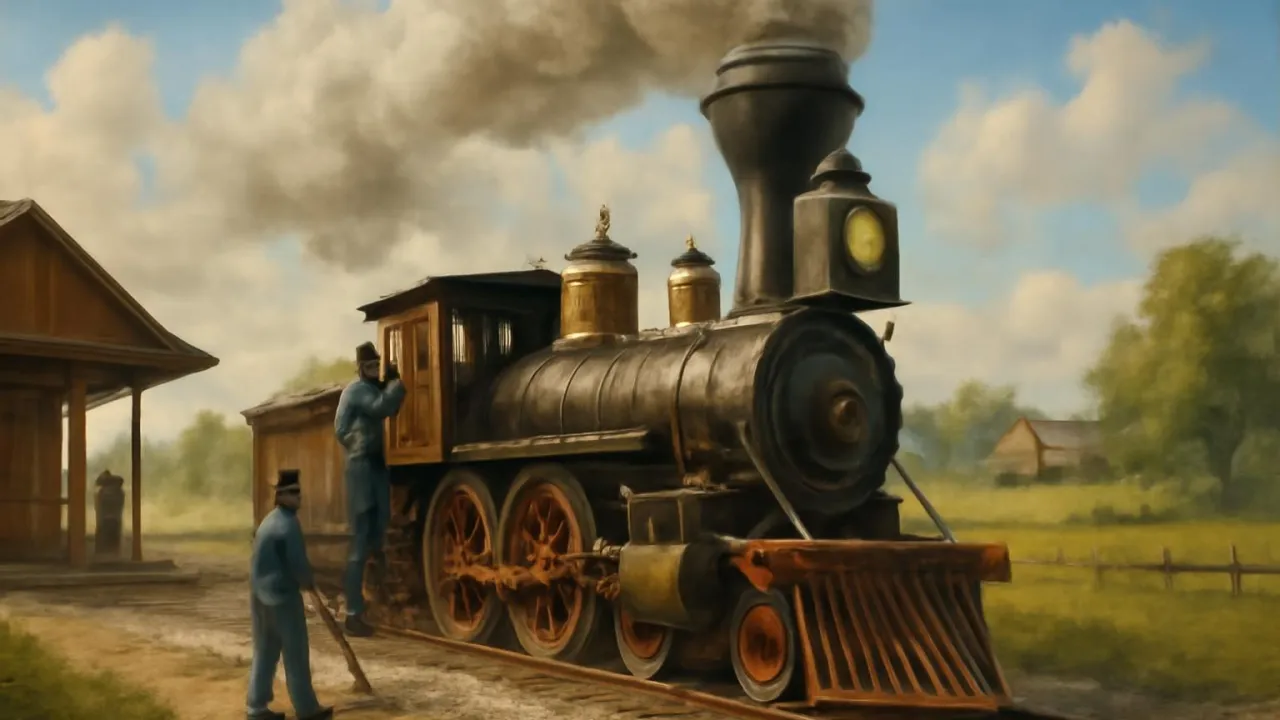
Some steam locomotives could travel over 60 miles per hour!
✨ Word Sparks (Grade 2 Glossary)
Tap 🔊 to hear
locomotive
A train engine that pulls cars
piston
A part that moves up and down
engineer
The person who drives the train
🪝
What if you could ride a train that runs on clouds of steam?
1
Chugging Down the Tracks
Steam make loud chugging sounds as they move. White puffs rise from the engine as it works. People watch the train go by and wave at the windows.
2
How Steam Powers the Train
The train’s engine boils water to make steam. The steam pushes , which turn the big wheels. This helps the train pull many heavy cars across the land.
3
Traveling to New Places
People ride steam trains to visit new towns and cities. Stations are busy with families and workers waiting for their train. The steam made travel much faster and easier for everyone.
The 'Rocket' locomotive won a famous race in 1829 by reaching 30 miles per hour!
✨ Word Sparks (Grade 3 Glossary)
Tap 🔊 to hear
boiler
Big tank where water is heated
prototype
First test version of an invention
mechanical energy
Power made by moving parts
🪝
Imagine standing close as a mighty iron train whistles and clouds of steam fill the air—how does it work?
1
The Iron Horse Arrives
When a steam locomotive rolls into town, its whistle echoes and steam billows high. The engine’s metal wheels grip the rails, making a thunderous chugging sound. People gather at the station to watch the powerful train arrive. The steam locomotive changed how people and goods traveled everywhere.
2
Steam Power in Action
Inside the engine, a fire heats water in a big . The boiling water creates steam, which builds up pressure. This steam pushes pistons back and forth, turning the driving wheels. The process uses to move the heavy train along the tracks.
3
Inventors and Innovation
Early inventors like Richard Trevithick and George Stephenson built the first working steam locomotives. Stephenson’s famous 'Rocket' set the standard for future trains. These inventors experimented with to improve speed and safety. Their work launched the age of railroads around the world.
4
Changing the World
Steam locomotives connected distant cities and towns like never before. They carried people, mail, and supplies across continents quickly and reliably. The invention helped spark the Industrial Revolution by moving coal, iron, and goods. Today, old steam trains are treasured as historic monuments and museum exhibits.
The longest steam locomotive ever built, the Union Pacific 'Big Boy,' was over 132 feet long!
✨ Word Sparks (Grade 4 Glossary)
Tap 🔊 to hear
cylinder
A tube where steam pushes a piston
industrial revolution
A time when machines changed the world
legacy
Something important left behind for others
🪝
What if you could ride across a country in a roaring, steam-powered machine that changed history?
1
The Thunder of Steam and Steel
As a steam locomotive approaches, its whistle shrieks and steam clouds swirl around its iron body. The massive wheels, guided by strong metal rails, grip the tracks with rhythmic chugging and clanking. Crowds gather at bustling stations to witness these powerful machines arrive and depart. Steam locomotives became symbols of progress, adventure, and the promise of new places.
2
The Science Behind the Power
Inside the locomotive’s boiler, a roaring fire heats water until it turns into high-pressure steam. This steam fills , pushing pistons back and forth with great force. The pistons are connected to rods that turn the locomotive’s large driving wheels. This system transforms heat energy from burning coal into mechanical motion, propelling the train forward over long distances.
3
Inventors Who Changed Transportation
Richard Trevithick built the first full-sized working steam locomotive in 1804, but it was George Stephenson’s 'Rocket' in 1829 that set the standard for railway engines. These inventors experimented with different prototypes, improving speed, safety, and reliability. Their breakthroughs led to the rapid spread of railways across Europe, America, and beyond. The steam locomotive’s success inspired new inventions and industries everywhere it traveled.
4
A World Connected by Rails
Steam locomotives revolutionized travel, shrinking continents and making it possible to move people, mail, and freight quickly and efficiently. They powered the , carrying raw materials like coal and iron to factories and finished goods to markets. Railroads changed where people lived and worked, helping cities and towns grow along the tracks. Today, historic steam trains are preserved in museums and sometimes run for tourists, reminding us of their world-changing .
The Union Pacific 'Big Boy' steam locomotive could produce over 6,000 horsepower and pull 4,000-ton trains!
✨ Word Sparks (Grade 5 Glossary)
Tap 🔊 to hear
thermodynamics
The science of heat and energy
friction
A force that slows moving things
urbanization
When more people move to cities
🪝
What if you could step into a 19th-century station and witness the engineering marvel that once powered the world’s fastest journeys?
1
The Arrival of the Steam Age
Picture the thunderous arrival of a steam locomotive: its whistle piercing the air, clouds of vapor rolling from its stack, and the rhythmic clatter of iron wheels on steel rails. These sights and sounds signaled a new era in transportation, as communities across continents became linked by ribbons of track. Steam locomotives were often called 'iron horses' because of their immense strength and ability to pull dozens of cars over long distances. The excitement at stations was electric, as families, workers, and travelers gathered to board these powerful machines.
2
Engineering Principles and Mechanical Power
The steam locomotive operates by converting thermal energy into mechanical energy using the principles of . Inside the firebox, coal or wood burns to heat water in a pressurized boiler, producing high-pressure steam. This steam enters cylinders, where it pushes pistons back and forth, transforming linear motion into rotational force through connecting rods and drive wheels. The efficiency of this process depends on careful engineering—controlling steam pressure, heat loss, and mechanical all play crucial roles in maximizing power output.
3
Inventors, Innovations, and Global Impact
British inventor Richard Trevithick built the first full-scale working steam locomotive in 1804, but it was George Stephenson’s 'Rocket' in 1829 that set the standard for commercial railways. Stephenson’s design introduced innovations like multi-tube boilers and improved safety valves, making trains faster and more reliable. The rapid spread of railways in Europe, North America, and Asia transformed economies, enabling the quick movement of raw materials, manufactured goods, and people. Steam locomotives played a vital role in the Industrial Revolution, driving and the expansion of global trade networks.
4
Quantitative Specs and Lasting Legacy
Steam locomotives varied greatly in size and power, from small industrial engines to giants like the Union Pacific 'Big Boy,' which weighed over 1.2 million pounds and could haul trains more than a mile long. Typical locomotives operated at boiler pressures of 150–300 psi and could reach speeds of 60–100 miles per hour. Their steel frames, precision-machined pistons, and robust wheels allowed them to withstand tremendous forces and operate in harsh conditions. Although diesel and electric trains eventually replaced steam, the legacy of steam locomotives endures in museums, tourist railways, and the very shape of modern transportation.
5
From Steam to the Future
The invention and evolution of the steam locomotive sparked a transportation revolution, connecting distant lands and cultures while fueling industrial and economic growth. Today, restored steam engines delight crowds at heritage railways, offering a living lesson in engineering and history. Their influence can be seen in the design of modern high-speed trains, which still rely on the principles of efficient energy conversion and mechanical power transmission. The story of the steam locomotive is a testament to human ingenuity, teamwork, and the drive to explore new frontiers.