1. What delicious food is Wisconsin famous for making more of than any other U.S. state?
2. Where is Wisconsin's capital city of Madison built?
🤯 Mind-Blowing Fact • Grade 2
Why do cranberries float when farmers flood a Wisconsin marsh? Each little red berry has four tiny air pockets hidden right inside!
✨ Word Sparks (Grade 2 Glossary)
Tap 🔊 to hear
burrow
cozy tunnel dug underground for shelter
ore
natural rock holding useful metals inside
marsh
low wet land covered with water plants
🪝
How did Wisconsin get the nickname 'The Badger State' from people instead of furry animals?
1
Miners Who Dug Like Badgers
Tap, scrape, dig! In the 1820s, lead miners arrived in southwestern Wisconsin right before chilly winter snows. Too busy digging to build wooden cabins, they carved warm bedrooms right into grassy hillsides—just like burrowing badgers! Neighbors playfully called them 'badgers,' and the nickname stuck.
2
Framed by Giant Waters
Giant waters hug Wisconsin on three sides! Cold Lake Superior splashes in the north, Lake Michigan waves roll past Milwaukee in the east, and the Mississippi River flows down the western border.
3
Floating Autumn Cranberries
Every October, Wisconsin farmers harvest more ruby-red cranberries than any other state in America!
1. Who originally inspired Wisconsin's nickname, 'The Badger State'?
2. What hidden feature inside a cranberry lets it float when Wisconsin farmers flood the bogs?
🤯 Mind-Blowing Fact • Grade 3
If you tried to fish in a different Wisconsin lake every single day, it would take you more than forty-one years to visit all fifteen thousand of them!
✨ Word Sparks (Grade 3 Glossary)
Tap 🔊 to hear
isthmus
narrow strip of land between two waters
glacier
huge slow-moving sheet of ancient thick ice
conservation
protecting forests, waters, and wildlife for tomorrow
🪝
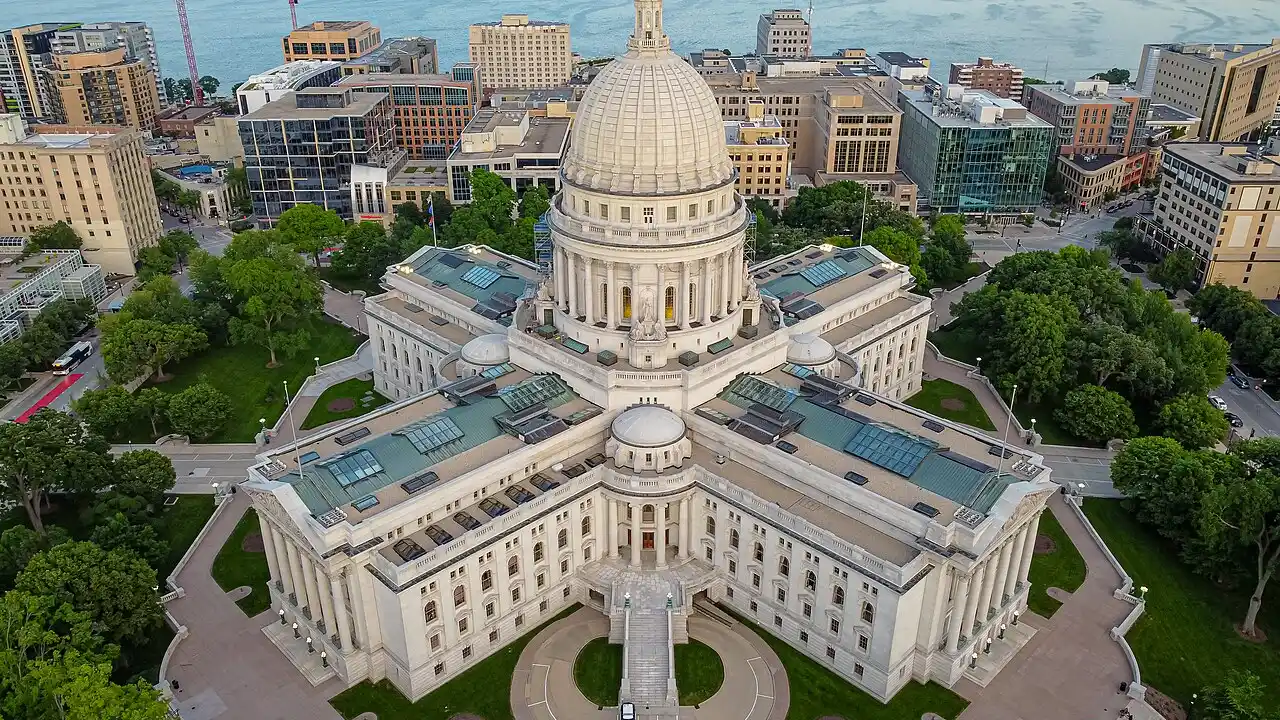
What is an 'isthmus,' and why does Wisconsin's state Capitol dome sit right on one?
1
A Capital on an Isthmus
Picture an airplane flying over Madison, Wisconsin's capital! White granite gleams from the State Capitol dome perched on a narrow strip of land less than a mile wide between Lake Mendota and Lake Monona. Geographers call a thin land bridge between two bodies of water an —making Madison one of only two major U.S. cities built on one!
2
Fifteen Thousand Glacial Lakes
When giant Ice Age melted across northern and eastern Wisconsin, chunks of buried ice left behind over fifteen thousand sparkling lakes. Along Lake Superior, waves carved red sandstone cliffs into the sea caves of the Apostle Islands.
3
Native Homelands and Statehood
Wisconsin's name comes from an Algonquian word for the Wisconsin River, likely meaning 'river running through a red place.' Admitted on May 29, 1848, Wisconsin became the thirtieth state.
4
Forward Into Conservation
Guided by its one-word motto, 'Forward,' Wisconsin nurtured pioneers who helped start America's first Earth Day.
1. What geographic term describes the narrow strip of land between two lakes where downtown Madison sits?
2. Which two Great Lakes form borders along northern and eastern Wisconsin?
🤯 Mind-Blowing Fact • Grade 4
Wisconsin is the only place on Earth where cheesemakers must pass university courses, apprentice under veterans, and pass a strict exam to earn the official title 'Master Cheesemaker'!
✨ Word Sparks (Grade 4 Glossary)
Tap 🔊 to hear
portage
carrying boats overland between two nearby rivers
effigy mound
ancient earthen hill shaped like an animal
ecologist
scientist studying how living things share habitats
🪝
Why did mile-high Ice Age glaciers surround southwestern Wisconsin without ever crushing its steep hills?
1
Glacial Kettles and the Driftless Area
Travel across Wisconsin's 65,496 square miles and you can see exactly where ancient ice sheets stopped! Across the north and east, glaciers flattened hills, dug thousands of kettle lakes, and left behind gravel ridges now traced by the thousand-mile Ice Age National Scenic Trail. Yet in southwestern Wisconsin, ice lobes split and flowed around a rugged corner called the 'Driftless Area,' preserving steep limestone bluffs, cold spring creeks, and winding river valleys untouched by glacial drift.
2
Indigenous Nations and French Voyagers
Ho-Chunk, Menominee, Ojibwe, Potawatomi, Oneida, and Stockbridge-Munsee Mohican communities harvested wild rice (manoomin), built ceremonial shaped like bears and eagles, and paddled birchbark canoes between the Great Lakes and the Mississippi River. In 1673, guided by Indigenous river knowledge, Jacques Marquette and Louis Jolliet carried canoes across a short marshy in central Wisconsin from the Fox River into the Wisconsin River—linking the Atlantic drainage to the Mississippi!
3
Thirtieth State and 'Wisconsin Idea'
Settled by Yankee farmers and German, Norwegian, Polish, and Swiss immigrants after statehood on May 29, 1848, Wisconsin championed the 'Wisconsin Idea'—that public university discoveries should directly improve everyday people's lives, from safer milk testing to worker protections.
4
Birthplace of Conservation Heroes
Wisconsin farms and woods inspired naturalist John Muir, Aldo Leopold, and Senator Gaylord Nelson, who founded Earth Day in 1970.
1. Why does southwestern Wisconsin's 'Driftless Area' have steep bluffs and deep valleys unlike the rest of the state?
2. Which annual global environmental celebration was founded in 1970 by Wisconsin Senator Gaylord Nelson?
🤯 Mind-Blowing Fact • Grade 5
Geologists around the world actually call the entire final Ice Age advance across North America (from about 75,000 to 11,000 years ago) the 'Wisconsin Glaciation' because Wisconsin's kettle moraines and lakes preserve its clearest clues!
✨ Word Sparks (Grade 5 Glossary)
Tap 🔊 to hear
moraine
hilly ridge of rocks piled by glaciers
patent
legal right to profit exclusively from an invention
ethic
guiding moral rule for treating others responsibly
🪝
How did a one-and-a-half-mile canoe portage, glacial moraines, and public-university science shape Wisconsin's national legacy?
1
Laurentide Glaciation, Kettle Moraines, and the Driftless Refuge
Framed by Lake Superior, Lake Michigan, and the upper Mississippi and St. Croix rivers across 65,496 square miles, Wisconsin records the dramatic footprint of the late Wisconsinan glaciation—the final major advance of the Laurentide Ice Sheet, named by geologists directly for its crisp rock exposures in this state! While ice lobes sculpted drumlins, eskers, and more than 15,000 kettle lakes across northern highlands and eastern lowlands, high Precambrian ridges deflected ice around the southwestern Driftless Area, preserving unglaciated Paleozoic sandstone gorges such as the Wisconsin Dells and ancient cliff ecosystems.
2
Effigy Mound Builders, Manoomin Waters, and the Fox-Wisconsin Portage
Between roughly 700 and 1200 CE, Late Woodland Indigenous communities constructed thousands of bird-, panther-, and bear-shaped effigy mounds across southern Wisconsin—the densest concentration in North America, preserved today at Effigy Mounds and Lizard Mound sites. Eleven federally recognized sovereign tribal nations in Wisconsin today sustain traditions of sustainable Menominee forestry and Ojibwe wild-rice harvesting. At present-day Portage, a narrow divide separates the Great Lakes-St. Lawrence watershed from the Mississippi-Gulf watershed, enabling Marquette and Jolliet's historic 1673 crossing.
3
Northwest Ordinance Roots and 1848 Statehood
Carved as the final state from the historic Northwest Territory—where the Northwest Ordinance of 1787 barred slavery and mandated land for public schools—Wisconsin entered the Union on May 29, 1848, as the thirtieth state. Six years later, citizens meeting in a little white schoolhouse in Ripon helped organize a new national anti-slavery coalition, and during the Civil War Wisconsin regiments—accompanied by 'Old Abe,' a famous bald eagle mascot—served across both theaters.
4
The 'Wisconsin Idea' and Dairy Science
When wheat soils tired in the late nineteenth century, agricultural chemist Stephen Moulton Babcock at the University of Wisconsin in Madison invented a simple, accurate butterfat test in 1890 and refused to it so farmers everywhere could prosper fairly. That spirit—codified as the 'Wisconsin Idea' that university research should serve every household in the state—propelled Wisconsin to produce roughly one-quarter of all U.S. cheese and over half of America's cranberries.
5
Environmental Ethic From Muir and Leopold to Earth Day
From John Muir's boyhood meadows in Marquette County and Aldo Leopold's Sand County shack near Baraboo ('A Sand County Almanac') to Gaylord Nelson's creation of Earth Day in 1970, Wisconsin helped write modern America's conservation while Milwaukee, Madison, and Green Bay anchor precision manufacturing, medical imaging software, and civic vitality.